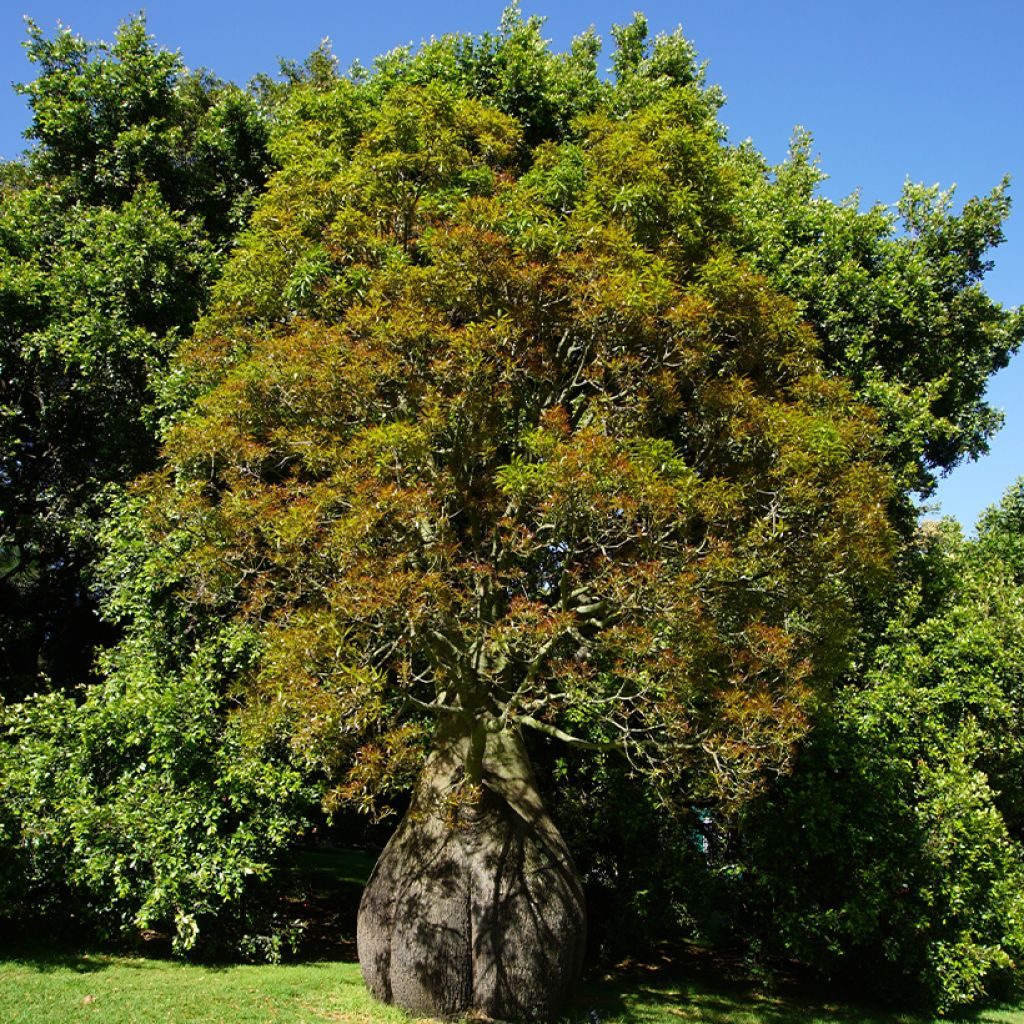
Brachychiton rupestris belongs to the Malvaceae family (formerly Sterculiaceae). This species bears the common names of Australian bottle tree, rupestral bottle tree, Australian baobab or Queensland kurrajong. Its botanical synonyms include Delabechea rupestris, Sterculia rupestris, Clompanus rupestris or Brachychiton delabechei. Native to central Queensland, it grows in dry hills, on clay, schist or volcanic soils, within semi-arid wooded formations called "Brigalow Belt". This tree has a typical swollen bottle-shaped trunk that develops from 5 to 8 years old, reaching 1 to 3.5m in diameter and up to 18 to 20m in height in the wild. In cultivation, specimens remain more compact, around 8 to 12m in open ground, only 3 to 5m in a pot after many years. Growth is slow, mainly focused on the trunk in the early years. Flowering occurs in the northern hemisphere between March and May in the form of axillary panicles grouping ten to thirty small, cream to pale yellow, campanulate flowers, often spotted red inside. Each flower measures about 1.5cm in diameter. This species is monoecious: male and female flowers are distinct but borne on the same individual. Pollination is carried out by insects. The fruits are woody, 3cm long, boat-shaped follicles containing 4 to 8 seeds covered with fine hairs. They are edible after roasting, as are some internal parts of the trunk, traditionally used by Aboriginal peoples.
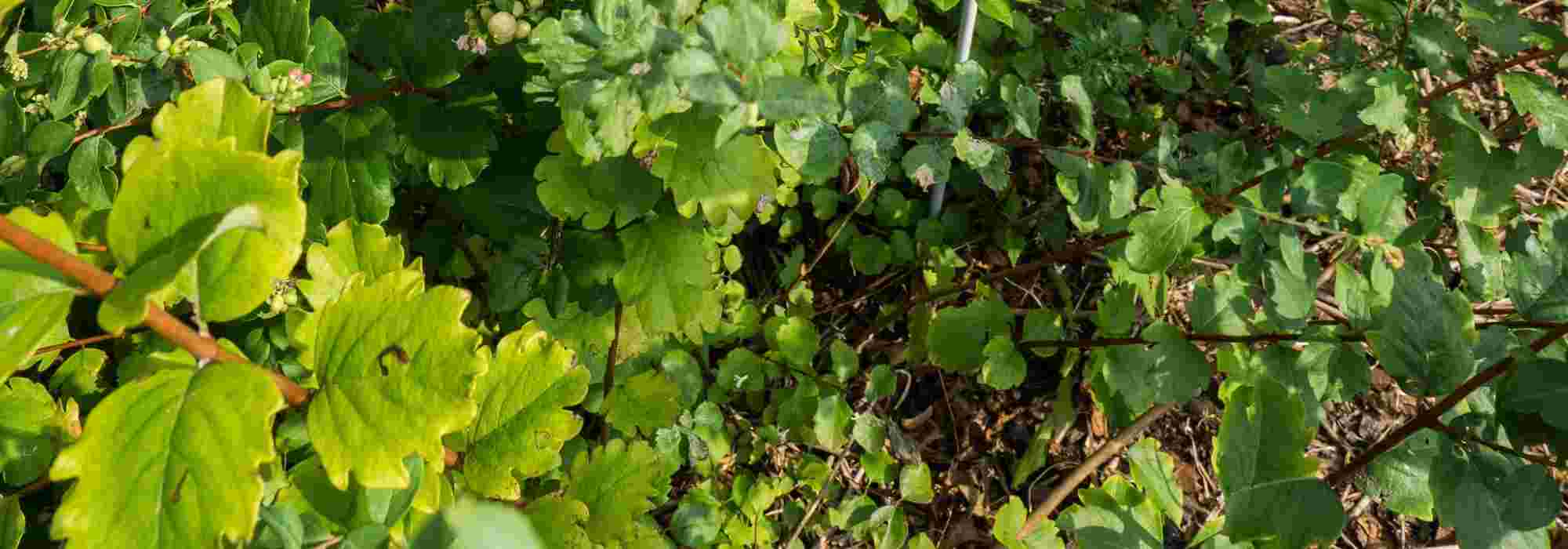
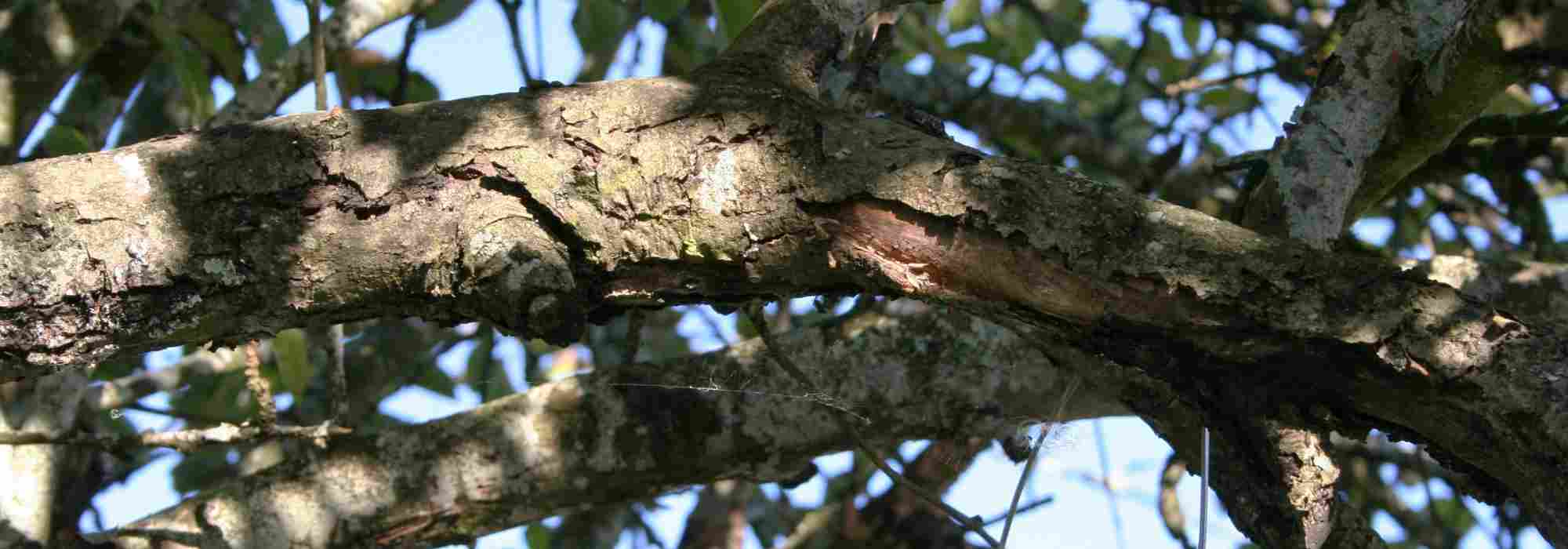
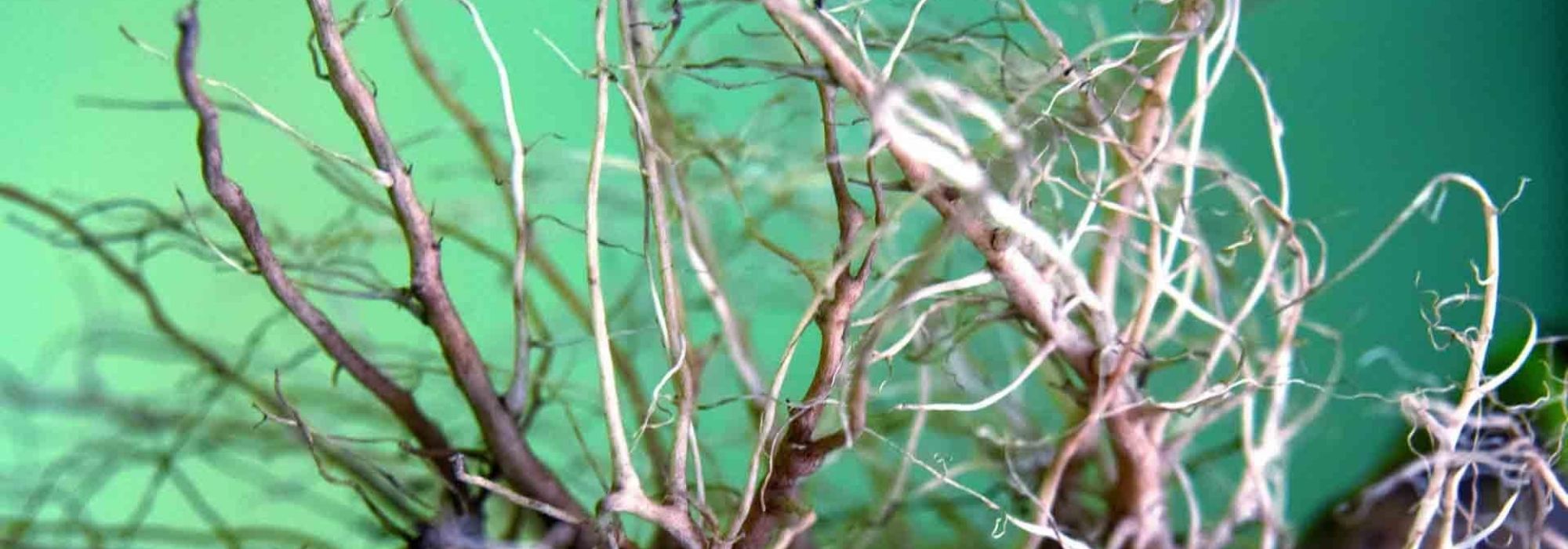
The foliage is more or less deciduous; it falls mainly between September and December, although some leaves may persist in mild climates. Young leaves are deeply palmate, with 3 to 9 narrow lobes. Adult leaves are entire, narrow, lanceolate or elliptical, and they measure between 4 and 14cm long. The foliage is bright green, ribbed, with a duller underside. The bark of the trunk is smooth on young plants, becoming dark grey and cracked into diamonds at maturity, while young twigs retain a lighter colour. The root system is robust, taprooted and adapted to drought, without running or being invasive.
An iconic tree of eastern Australia, Brachychiton rupestris is also steeped in history: in the town of Roma, Queensland, an avenue lined with bottle trees planted between 1918 and 1920 pays tribute to local soldiers who fell during World War I. These trees are now protected and considered a natural memorial.
With its picturesque silhouette and its baobab-like appearance, Brachychiton rupestris can become the focal point of a dry garden or a sunny terrace. It fits into a setting inspired by Australian or Mediterranean landscapes, accompanied by grasses for dry soil, hardy perennials such as Euphorbia characias or even hardy cacti. In a container, it can be placed alongside large pots of agaves or dasylirions, for example. Minimalist and elegant, it also suits contemporary-style gardens.
When grown in a pot,Brachychiton rupestris can be moved indoors and outdoors, provided a few essential steps are followed. Wait until the end of frosts to place it outside, generally from April or May, when nighttime temperatures remain above 8 to 10 °C. To avoid leaf burns, a hardening period is necessary: a few days in partial shade before gradually exposing to full sun. It will then fully enjoy the open air, as long as it stays sheltered from overly strong winds. In autumn, bring it inside as soon as nights drop below 5 °C, into a bright, frost-free space for winter.