Acer platanoides Princeton Gold - Norway Maple
Acer platanoides Princeton Gold - Norway Maple
Acer platanoides Princeton Gold - Norway Maple
Acer platanoides 'Prigo' PRINCETON GOLD
Norway Maple, European Maple, Plane Tree Maple
Back-to-school special offer!
Get €10 off for every €50 you spend! And get up to €40 off on a single order.
How does it work?
1. Shop your favourites
Add your favourite plants to your basket. For every €50 you spend (excluding delivery charges, store credit and the plastic-free option), you’ll receive a €10 voucher.
€50 spent = €10 voucher
€100 spent = €20 voucher
€150 spent = €30 voucher
€200 spent = €40 voucher
2. Place your order
Once your basket reaches one of the spending thresholds, place your order. You can even choose your delivery date!
3. Receive your voucher
As soon as your order has been shipped, you’ll receive an email containing your personal voucher code and its value.
4. Use it on your next order
Your voucher is valid for 90 days from the date you receive it. It can be used once only, on a new order worth at least the value of the voucher, excluding delivery charges.
Please note: Vouchers can be combined with other offers, but cannot be split or refunded.
Home or relay delivery (depending on size and destination)
Important: You may be charged customs duties by your country’s customs authorities upon delivery.
Schedule delivery date,
and select date in basket
This plant carries a 24 months recovery warranty
More information
We guarantee the quality of our plants for a full growing cycle, and will replace at our expense any plant that fails to recover under normal climatic and planting conditions.
Does this plant fit my garden?
Set up your Plantfit profile →
Description
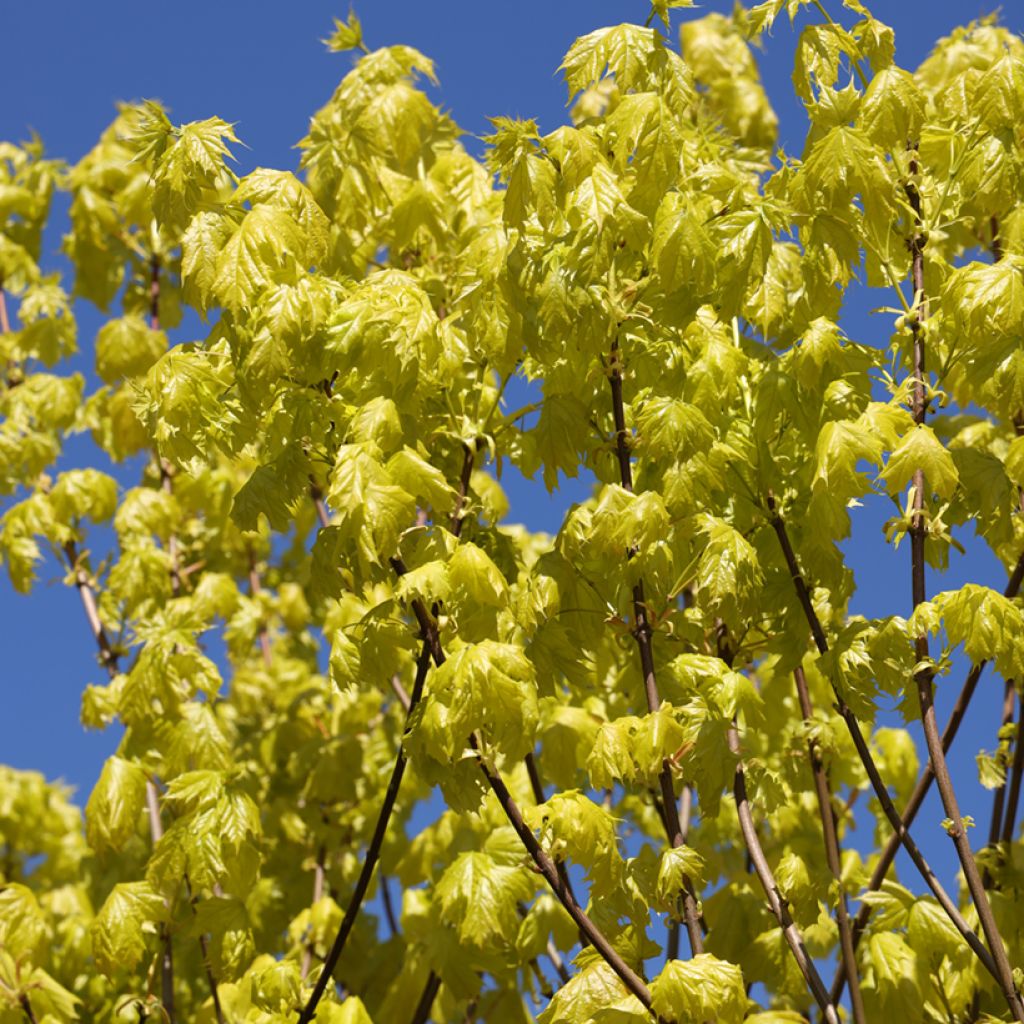
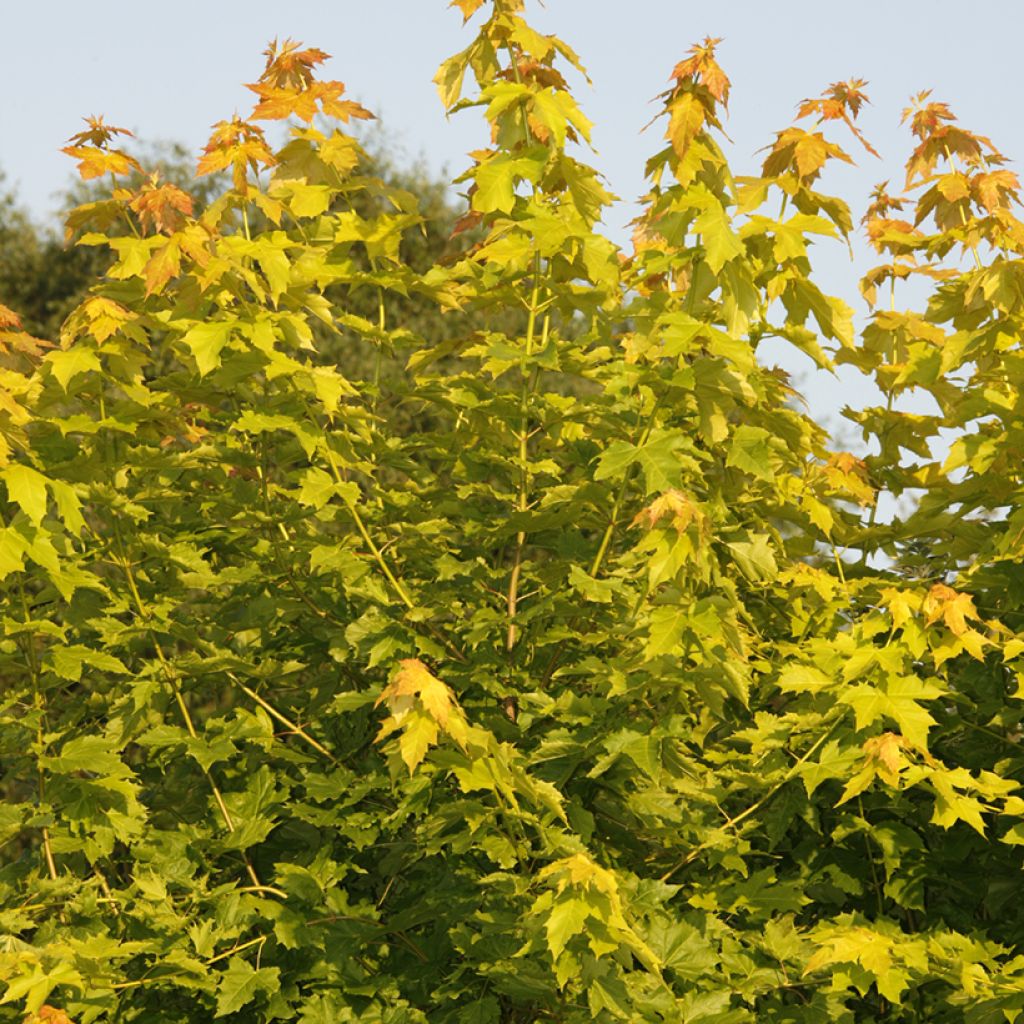
Acer platanoides Princeton Gold 'Prigo' is a variety of the Norway Maple with distinctly yellow and bright foliage. The medium-sized tree with fast growth develops an upright and columnar habit in its early years before rounding out with age, with a densely branched crown. In spring, the leaves are golden yellow, lightening to chartreuse in summer. In autumn, the colouration depends on the soil: from banana yellow to dark yellow, with shades of orange and red. The yellow leaves of this variety, a true visual spectacle, withstand full sun perfectly. The undemanding Norway Maple requires a soil deep enough to accommodate its powerful root system.
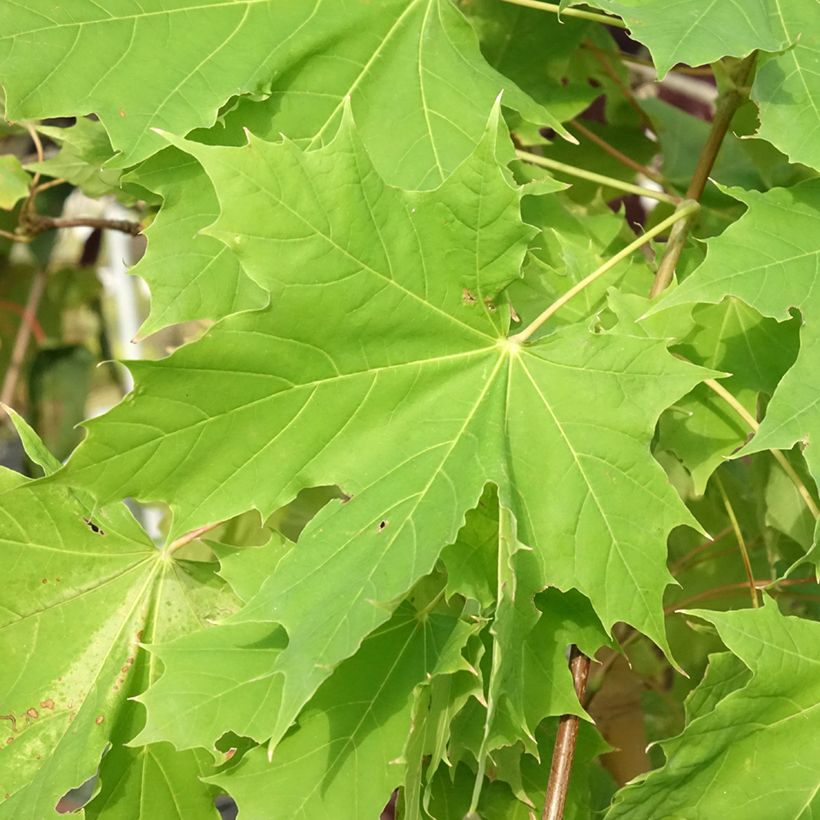
Native to the Caucasus, widespread in Europe, from Scandinavia to Spain and east to Russia, Acer platanoides is a large deciduous tree with fast growth, often associated with oak, lime, and elm in upland forests. It can live up to 200 years. The cultivar 'Prigo' was discovered and selected by American botanist and breeder William Flemmer III, who, in the early 1980s, collected street tree seeds and grew them in his trial plots in anticipation of a mutation. The breakthrough came around 1983 when a seedling showed extremely yellow foliage that did not suffer from sun scorch, and the plant proved vigorous and healthy enough to be considered a new variety. It has an upright habit and its beautiful oval crown rounds out with age. At maturity, this single-stemmed tree reaches 10 to 15 m in height and 7 to 10 m in spread. Its foliage is deciduous. The leaves are opposite, palmate, 10 to 20 cm long, with 5 to 7 very pointed, toothed lobes. The leaves, carried on long petioles, are smooth and glossy. They appear bright yellow in spring and turn chartreuse in summer. In autumn, the tree can offer two different spectacles: if grown in ordinary (neutral to alkaline) soil, as the green pigment disappears, the leaves reveal an even lighter shade of banana yellow that contrasts perfectly with the brown veins and petioles. If grown in very acidic soil, the leaves take on various shades of gold, amber-orange, and scarlet red. The inconspicuous flowering, in the form of erect corymbs of tiny yellow-green flowers, occurs before bud burst, in March, on subjects aged 15 to 20 years. It is followed, in June, by 3 to 5cm long, winged fruits called samaras. The bark of this tree is brown, almost smooth and marked with numerous shallow longitudinal cracks.
Acer platanoides Princeton Gold 'Prigo' is an easy-to-grow tree. Unlike many light-coloured cultivars, it is not very drought-sensitive. It is content with ordinary soil, provided it is deep and well-drained, and it dislikes stagnant moisture. It looks spectacular as a standalone specimen in the middle of a large garden or park, for example. It can also be used as a street tree to border large avenues, or as a windbreak planted along the boundaries of a large garden. For contrast, it can be planted in a grove with a variety with purple foliage, such as the 'Crimson King' Norway Maple, purple beech, or 'Forest Pansy' Eastern Redbud, for example.

Acer platanoides Princeton Gold - Norway Maple in pictures
Plant habit
Flowering
Foliage
Botanical data
Acer
platanoides
'Prigo' PRINCETON GOLD
Sapindaceae
Norway Maple, European Maple, Plane Tree Maple
Cultivar or hybrid
Planting and care
Acer platanoides Princeton Gold 'Prigo' should be planted in spring or autumn in any fertile, deep, and moist soil in a sunny, but not scorching, or semi-shaded location. It tolerates the presence of limestone in the soil but requires a soil deep enough to accommodate its powerful root system. Be cautious of strong winds. Keep the soil moist during the first two summers after planting. Mulching can be beneficial to maintain soil moisture. Training pruning is necessary for young plants, and then every 3 years to balance the branches and maintain a harmonious habit. Do not prune after December as the sap rises very early.
Planting period
Intended location
Care
Planting & care advice
-

-
-

-
-

-

-
-
This item has not been reviewed yet - be the first to leave a review about it.
Recently viewed products
Haven't found what you were looking for?
Hardiness is the lowest winter temperature a plant can endure without suffering serious damage or even dying. However, hardiness is affected by location (a sheltered area, such as a patio), protection (winter cover) and soil type (hardiness is improved by well-drained soil).
In temperate climates, pruning of spring-flowering shrubs (forsythia, spireas, etc.) should be done just after flowering.
Pruning of summer-flowering shrubs (Indian Lilac, Perovskia, etc.) can be done in winter or spring.
In cold regions as well as with frost-sensitive plants, avoid pruning too early when severe frosts may still occur.
The harvesting period indicated on our website applies to countries and regions in USDA zone 8 (France, England, Ireland, the Netherlands).
In colder areas (Scandinavia, Poland, Austria...) fruit and vegetable harvests are likely to be delayed by 3-4 weeks.
In warmer areas (Italy, Spain, Greece, etc.), harvesting will probably take place earlier, depending on weather conditions.
The sowing periods indicated on our website apply to countries and regions within USDA Zone 8 (France, UK, Ireland, Netherlands).
In colder areas (Scandinavia, Poland, Austria...), delay any outdoor sowing by 3-4 weeks, or sow under glass.
In warmer climes (Italy, Spain, Greece, etc.), bring outdoor sowing forward by a few weeks.
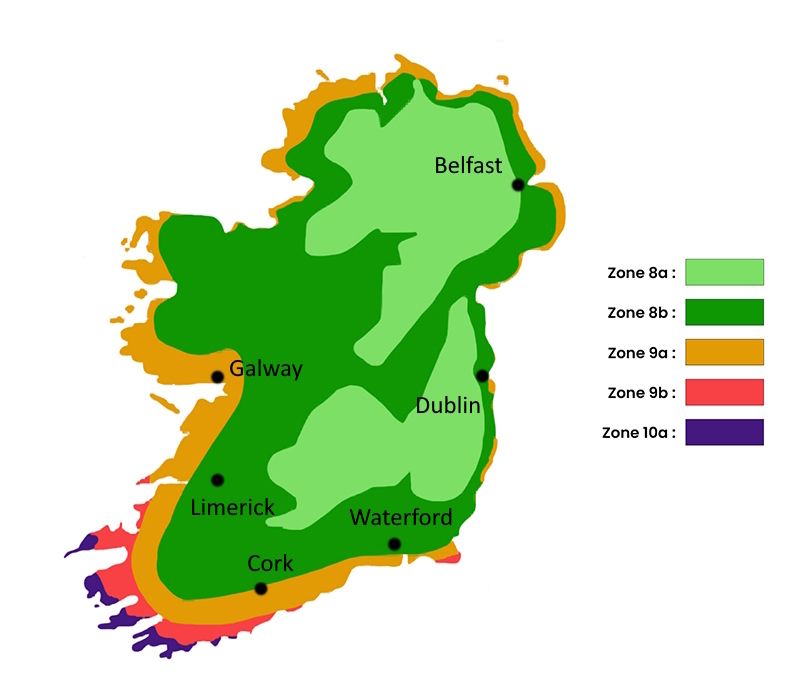
The planting period indicated on our website applies to regions in USDA Zone 9a (East Coast and Midlands: Dublin, Wexford, Waterford, Kilkenny, Portlaoise). It will vary depending on where you live:
- On the west coast and in the north-west (Galway, Limerick, Sligo, Donegal, Westport), delay planting by 1 to 2 weeks in spring and bring it forward by 1 to 2 weeks in autumn compared to the dates given, preferably choosing periods without strong winds.
- In the inland hills and plateaus (Wicklow Mountains, Macgillycuddy’s Reeks, Connemara, Killarney), it is best to plant in spring (April–May) or autumn (September–October), avoiding periods of waterlogged soil in winter and strong winds, which pose the main risk to newly planted trees in these areas.
The flowering period indicated on our website applies to regions in USDA Zone 9a, such as the East Coast and Midlands, including Dublin, Wexford, Waterford, Kilkenny and Portlaoise.
This will vary depending on where you live:
- On the west coast and in the northwest (Galway, Limerick, Sligo, Donegal and Westport), it will be delayed by one to two weeks compared to the given dates, due to stronger Atlantic winds and less spring sunshine.
- In the inland hills and plateaus (the Wicklow Mountains, the Macgillycuddy's Reeks, Connemara and Killarney), flowering will be delayed by two to three weeks. Flowering mainly occurs between May and July, with the limiting factors being less frost and more of the excessive humidity, strong winds and lack of sunshine that are characteristic of these areas.
Shipping country and language
Your country of residence may be:
Your country of residence is:
For a better user experience on our website, you can select:
Your shipping country:
-
 Austria
-
 Belgium
-
 Bosnia & Herzegovina
-
 Bulgaria
-
 Croatia
-
 Cyprus
-
 Czechia
-
 Denmark
-
 Estonia
-
 Finland
-
 France
-
 Germany
-
 Greece
-
 Hungary
-
 Iceland
-
 Ireland
-
 Italy
Italy
-
 Latvia
-
 Liechtenstein
-
 Lithuania
-
 Luxembourg
-
 Malta
Malta
-
 Netherlands
-
 Poland
-
 Portugal
-
 Romania
-
 Serbia
-
 Slovakia
-
 Slovenia
-
 Spain
Spain
-
 Sweden
-
 Switzerland
Language:
-
French
-
 English
-
Spanish
-
Italian
-
German
-
Portuguese
-
Dutch
-
Finnish
My Account
Hello
My wish lists
My cart
Log in / Register
Existing customer?
This form is protected by reCAPTCHA - the Google Privacy Policy and Terms of Service apply.
New customer?
Create an account to track your orders, access our customer service and, if you wish, make the most of our upcoming offers.