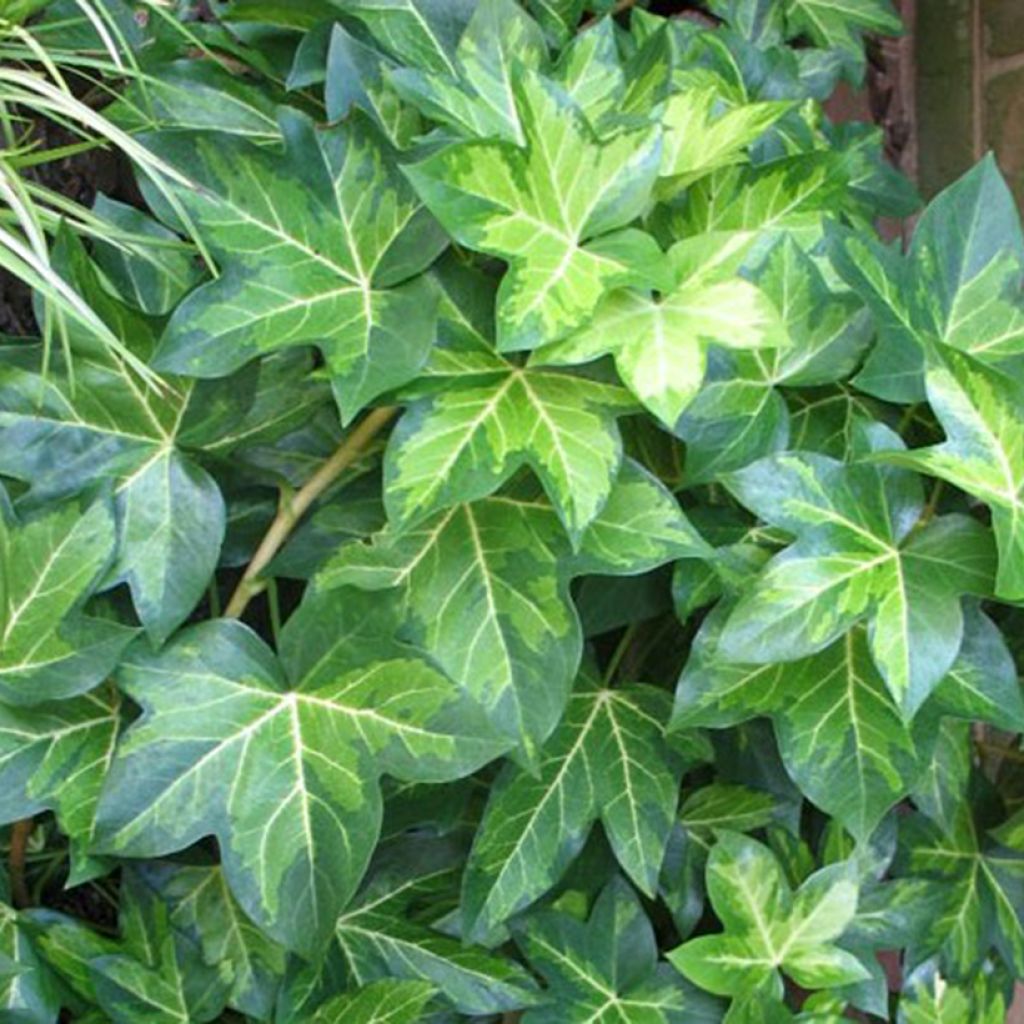
x Fatshedera lizei Annemieke - Tree ivy
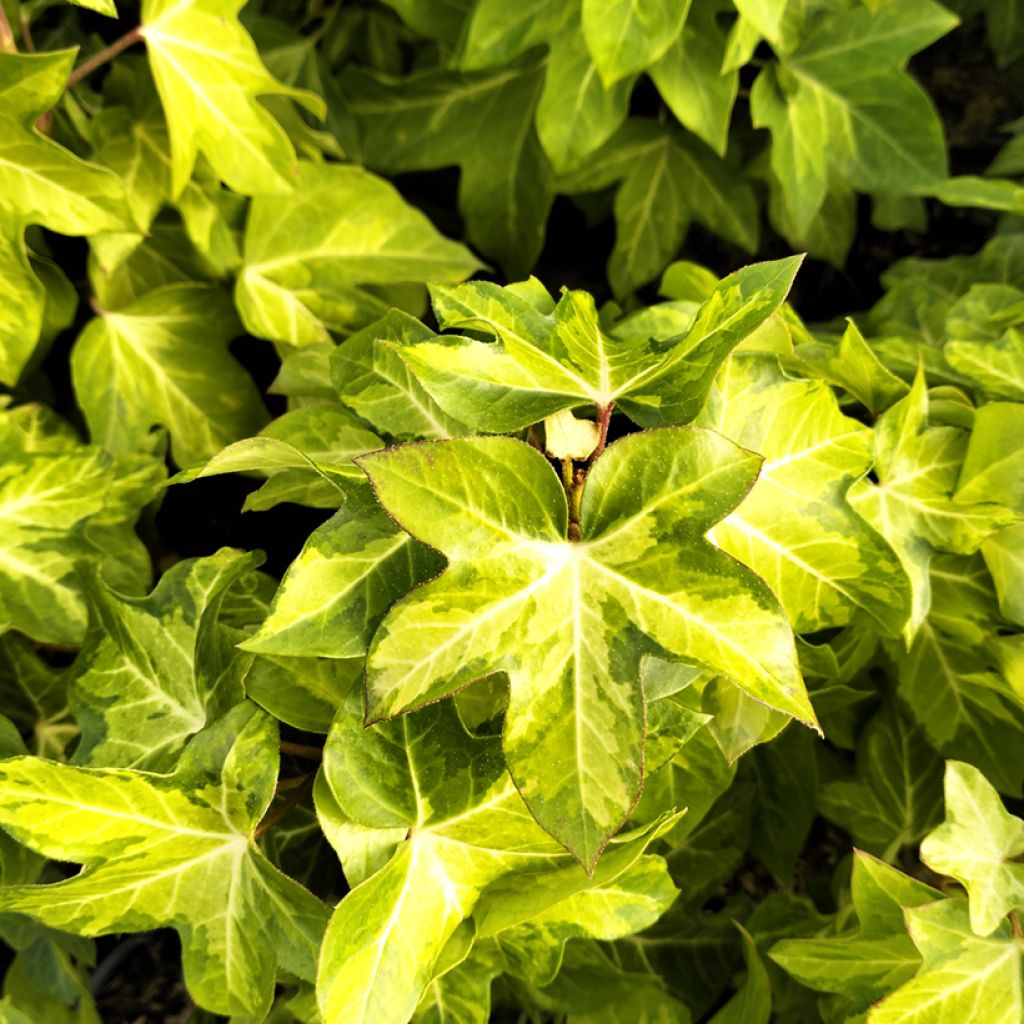
x Fatshedera lizei Annemieke - Tree ivy
x Fatshedera lizei Annemieke - Tree ivy
x Fatshedera lizei Annemieke
Tree ivy
Back-to-school special offer!
Get €10 off for every €50 you spend! And get up to €40 off on a single order.
How does it work?
1. Shop your favourites
Add your favourite plants to your basket. For every €50 you spend (excluding delivery charges, store credit and the plastic-free option), you’ll receive a €10 voucher.
€50 spent = €10 voucher
€100 spent = €20 voucher
€150 spent = €30 voucher
€200 spent = €40 voucher
2. Place your order
Once your basket reaches one of the spending thresholds, place your order. You can even choose your delivery date!
3. Receive your voucher
As soon as your order has been shipped, you’ll receive an email containing your personal voucher code and its value.
4. Use it on your next order
Your voucher is valid for 90 days from the date you receive it. It can be used once only, on a new order worth at least the value of the voucher, excluding delivery charges.
Please note: Vouchers can be combined with other offers, but cannot be split or refunded.
Home or relay delivery (depending on size and destination)
Important: You may be charged customs duties by your country’s customs authorities upon delivery.
Schedule delivery date,
and select date in basket
This plant carries a 24 months recovery warranty
More information
We guarantee the quality of our plants for a full growing cycle, and will replace at our expense any plant that fails to recover under normal climatic and planting conditions.
Does this plant fit my garden?
Set up your Plantfit profile →
Description
x Fatshedera lizei 'Annemieke' is a beautiful variegated variety of a bigeneric hybrid (hence the x before the name) man-made by crossing a Fatsia and a Hedera, or ivy, hence the full name (Fats + Hedera). This small shrub bears extremely decorative evergreen foliage, with different shades of green combined with yellow to create a tasteful effect all year round. Rarely exceeding 1.50m in height and width after slow growth, it can climb or creep along the ground, thus betraying its double parentage. Of medium hardiness, it can be planted in the garden in mild climates, or grown in a conservatory, or even indoors in cold regions. Appreciating fresh, humus-bearing soils, neutral or slightly acidic, it tolerates shade well, but also copes in brighter positions, provided it is protected from scorching sun.
Fatshedera, also known as Ivy Aralia, belongs to the Araliaceae family, like more than 50 genera, including its two parents, ivy (Hedera) and Aralia, and many other ornamental plants, some little-known, such as Tetrapanax with giant leaves that can exceed 1 m in diameter, or the astonishing Cussonia reserved for the mildest coastal areas. We owe Fatshedera to the whimsy of the Lizé brothers, gardeners from Nantes who, around 1910, had the idea of crossing a Fatsia japonica 'Moseri', a compact Japanese Aralia, and Hedera helix subsp 'Hiberbica', with its beautiful shiny dark green foliage. x Fatshedera lizei was born, a horticultural hybrid blending the characteristics of the two original genera, with palmate leaves closer to one, and a flexible habit, erect to climbing or creeping, inherited from the other.
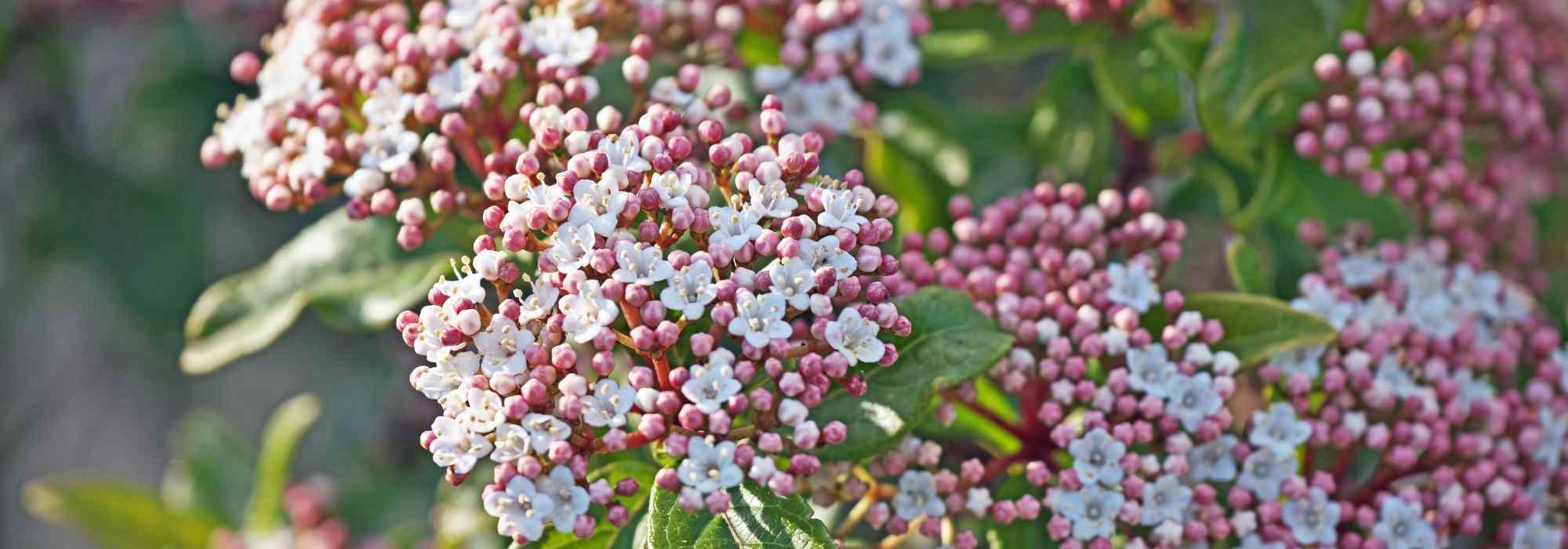
The story does not end there, as mutations appeared and the original green plant gave rise to several variegated varieties, such as 'Annemieke'. This one has a slightly more compact habit than the others, with well-grouped stems that highlight the foliage. The palmate leaves are divided into three to five leaflets, and their surface is highly glossy. The variegation is very harmonious, ranging from dark green on the edge to lighter green towards the inside, chartreuse green and a little yellow near the veins. Being an evergreen shrub, the foliage is decorative all year round. Like ivies, the plant can flower in autumn provided it grows upwards (and not as a creeper). Cream-white flowers then bloom in October or November and have the advantage of being nectar-rich, a rare advantage at this season. Not only very aesthetic, but the plant then proves useful to biodiversity. Sometimes fruits may form, but this is not always the case. Its growth is rather slow; it will reach about 1.20 to 1.50m in height in about ten years, peaking at maturity at a maximum of 1.80m. It is therefore easy to find a spot for it in the garden, or to grow it sustainably in a pot to overwinter it in a frost-free room in overly cold climates.
With its leathery and glossy leaves and their superb variegation, x Fatshedera lizei 'Annemieke' is an original, ornamental plant. Its exotic appearance encourages association with other distinctive plants within a themed bed. Another strange plant with a striking silhouette, Farfugium will be a good companion in partial shade. A clump of Rodgersia, a perennial with large leaves reminiscent of those of the horse chestnut, will reinforce the atmosphere you have created. Add a specimen of Cimicifuga racemosa, also known as fairy candle, with its endless white spiked inflorescences, and a curtain of bamboo in the background to complete your scene.
Report an error about the product description
x Fatshedera lizei Annemieke - Tree ivy in pictures
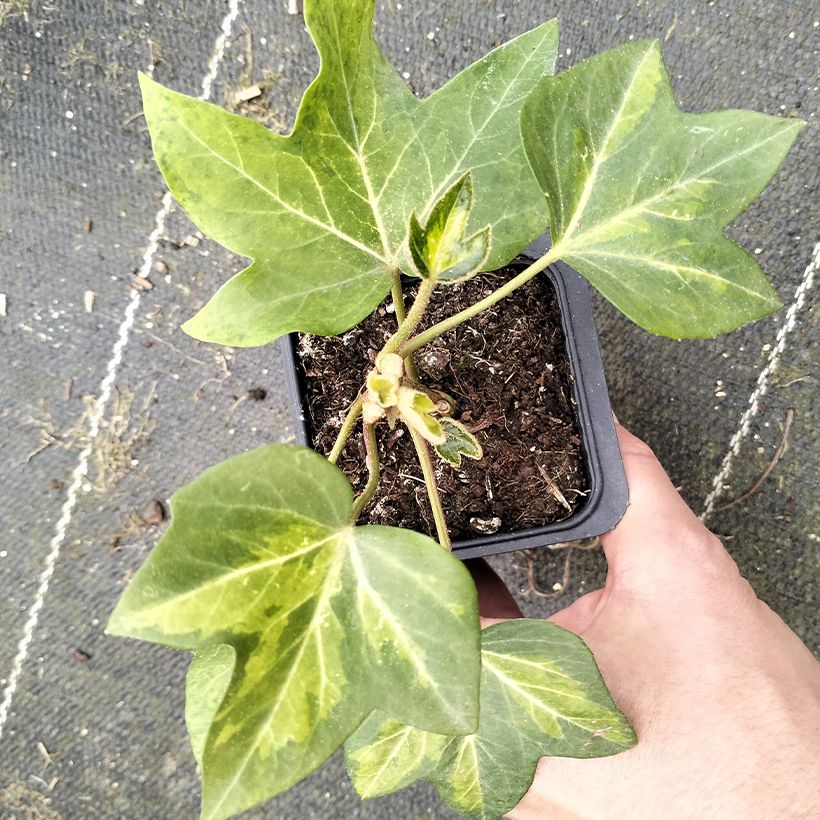
Plant habit
Flowering
Foliage
Botanical data
x Fatshedera
lizei
Annemieke
Araliaceae
Tree ivy
× Fatshedera lizei 'Annemieke', × Fatshedera lizei ‘Aureovariegata’, × Fatshedera lizei ‘Maculata’, × Fatshedera lizei ‘Lemon and Lime’, × Fatshedera lizei ‘Aurea Maculata’
Cultivar or hybrid
Planting and care
x Fatshedera lizei 'Annemieke' can be grown in open ground in mild climates or in pots to be overwintered indoors elsewhere. It prefers slightly acidic soils, so you should enrich your garden soil with leaf mould. Lighten the mixture with some coarse sand to improve drainage (beneficial in winter). Also, take care to plant it in a position sheltered from wind and preferably in partial shade. However, its colours will be better if it receives sufficient light (it is mainly the direct, harsh sun that is harmful). Water it in summer to maintain some moisture at the base of the plant. In winter, do the opposite: ensure it is kept drier (but without excess). It is wise at this time to protect it with a fleece if hard frosts are forecast. When the leaves of your tree ivy turn yellow in winter, it is often due to temperatures being too low; in summer, it is due to drought, so mist the plant with a little water. Prune any unsightly shoots in spring.
If you grow your tree ivy in a pot, protect it from hard frosts in a conservatory or a very bright but little-heated room: its foliage doesn't like dry air, mist it once a week with lime-free water. It can also be used as a houseplant in a cool room. Watch out for the appearance of scale insects or mites, which find favourable conditions for their development in confined spaces.
Planting period
Intended location
Care
Planting & care advice
-
-
-
-
-
-
-

-

This item has not been reviewed yet - be the first to leave a review about it.
Recently viewed products
Haven't found what you were looking for?
Hardiness is the lowest winter temperature a plant can endure without suffering serious damage or even dying. However, hardiness is affected by location (a sheltered area, such as a patio), protection (winter cover) and soil type (hardiness is improved by well-drained soil).
In temperate climates, pruning of spring-flowering shrubs (forsythia, spireas, etc.) should be done just after flowering.
Pruning of summer-flowering shrubs (Indian Lilac, Perovskia, etc.) can be done in winter or spring.
In cold regions as well as with frost-sensitive plants, avoid pruning too early when severe frosts may still occur.
The harvesting period indicated on our website applies to countries and regions in USDA zone 8 (France, England, Ireland, the Netherlands).
In colder areas (Scandinavia, Poland, Austria...) fruit and vegetable harvests are likely to be delayed by 3-4 weeks.
In warmer areas (Italy, Spain, Greece, etc.), harvesting will probably take place earlier, depending on weather conditions.
The sowing periods indicated on our website apply to countries and regions within USDA Zone 8 (France, UK, Ireland, Netherlands).
In colder areas (Scandinavia, Poland, Austria...), delay any outdoor sowing by 3-4 weeks, or sow under glass.
In warmer climes (Italy, Spain, Greece, etc.), bring outdoor sowing forward by a few weeks.
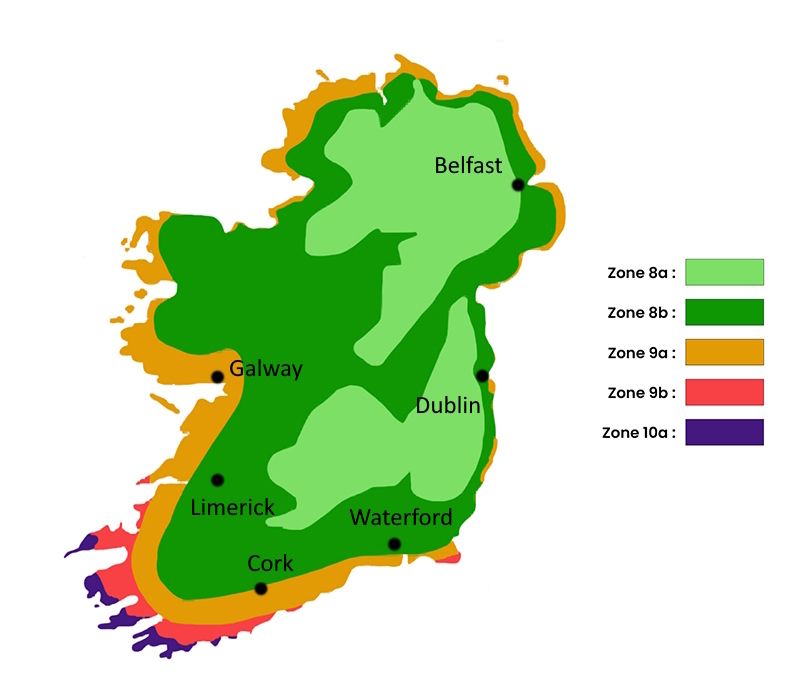
The planting period indicated on our website applies to regions in USDA Zone 9a (East Coast and Midlands: Dublin, Wexford, Waterford, Kilkenny, Portlaoise). It will vary depending on where you live:
- On the west coast and in the north-west (Galway, Limerick, Sligo, Donegal, Westport), delay planting by 1 to 2 weeks in spring and bring it forward by 1 to 2 weeks in autumn compared to the dates given, preferably choosing periods without strong winds.
- In the inland hills and plateaus (Wicklow Mountains, Macgillycuddy’s Reeks, Connemara, Killarney), it is best to plant in spring (April–May) or autumn (September–October), avoiding periods of waterlogged soil in winter and strong winds, which pose the main risk to newly planted trees in these areas.
The flowering period indicated on our website applies to regions in USDA Zone 9a, such as the East Coast and Midlands, including Dublin, Wexford, Waterford, Kilkenny and Portlaoise.
This will vary depending on where you live:
- On the west coast and in the northwest (Galway, Limerick, Sligo, Donegal and Westport), it will be delayed by one to two weeks compared to the given dates, due to stronger Atlantic winds and less spring sunshine.
- In the inland hills and plateaus (the Wicklow Mountains, the Macgillycuddy's Reeks, Connemara and Killarney), flowering will be delayed by two to three weeks. Flowering mainly occurs between May and July, with the limiting factors being less frost and more of the excessive humidity, strong winds and lack of sunshine that are characteristic of these areas.
Shipping country and language
Your country of residence may be:
Your country of residence is:
For a better user experience on our website, you can select:
Your shipping country:
-
 Austria
-
 Belgium
-
 Bosnia & Herzegovina
-
 Bulgaria
-
 Croatia
-
 Cyprus
-
 Czechia
-
 Denmark
-
 Estonia
-
 Finland
-
 France
-
 Germany
-
 Greece
-
 Hungary
-
 Iceland
-
 Ireland
-
 Italy
Italy
-
 Latvia
-
 Liechtenstein
-
 Lithuania
-
 Luxembourg
-
 Malta
Malta
-
 Netherlands
-
 Poland
-
 Portugal
-
 Romania
-
 Serbia
-
 Slovakia
-
 Slovenia
-
 Spain
Spain
-
 Sweden
-
 Switzerland
Language:
-
French
-
 English
-
Spanish
-
Italian
-
German
-
Portuguese
-
Dutch
-
Finnish
My Account
Hello
My wish lists
My cart
Log in / Register
Existing customer?
This form is protected by reCAPTCHA - the Google Privacy Policy and Terms of Service apply.
New customer?
Create an account to track your orders, access our customer service and, if you wish, make the most of our upcoming offers.