Rosa Reine des Violettes
Rosa Reine des Violettes
Rosa Reine des Violettes
Rosa Reine des Violettes
Rosa Reine des Violettes
Rosa Reine des Violettes
Old Rose
Received in perfect condition and in flower. Still small but it makes an impact. The colour is exactly like the photo.
Gab, 26/05/2026
Back-to-school special offer!
Get €10 off for every €50 you spend! And get up to €40 off on a single order.
How does it work?
1. Shop your favourites
Add your favourite plants to your basket. For every €50 you spend (excluding delivery charges, store credit and the plastic-free option), you’ll receive a €10 voucher.
€50 spent = €10 voucher
€100 spent = €20 voucher
€150 spent = €30 voucher
€200 spent = €40 voucher
2. Place your order
Once your basket reaches one of the spending thresholds, place your order. You can even choose your delivery date!
3. Receive your voucher
As soon as your order has been shipped, you’ll receive an email containing your personal voucher code and its value.
4. Use it on your next order
Your voucher is valid for 90 days from the date you receive it. It can be used once only, on a new order worth at least the value of the voucher, excluding delivery charges.
Please note: Vouchers can be combined with other offers, but cannot be split or refunded.
Why not try an alternative variety in stock?
View all →
Available in 0 sizes
Available in 4 sizes

Available in 2 sizes
Available in 2 sizes

Available in 2 sizes
Available in 0 sizes
Available in 2 sizes

Available in 3 sizes

Available in 2 sizes
Available in 0 sizes
This plant carries a 24 months recovery warranty
More information
We guarantee the quality of our plants for a full growing cycle, and will replace at our expense any plant that fails to recover under normal climatic and planting conditions.


Description
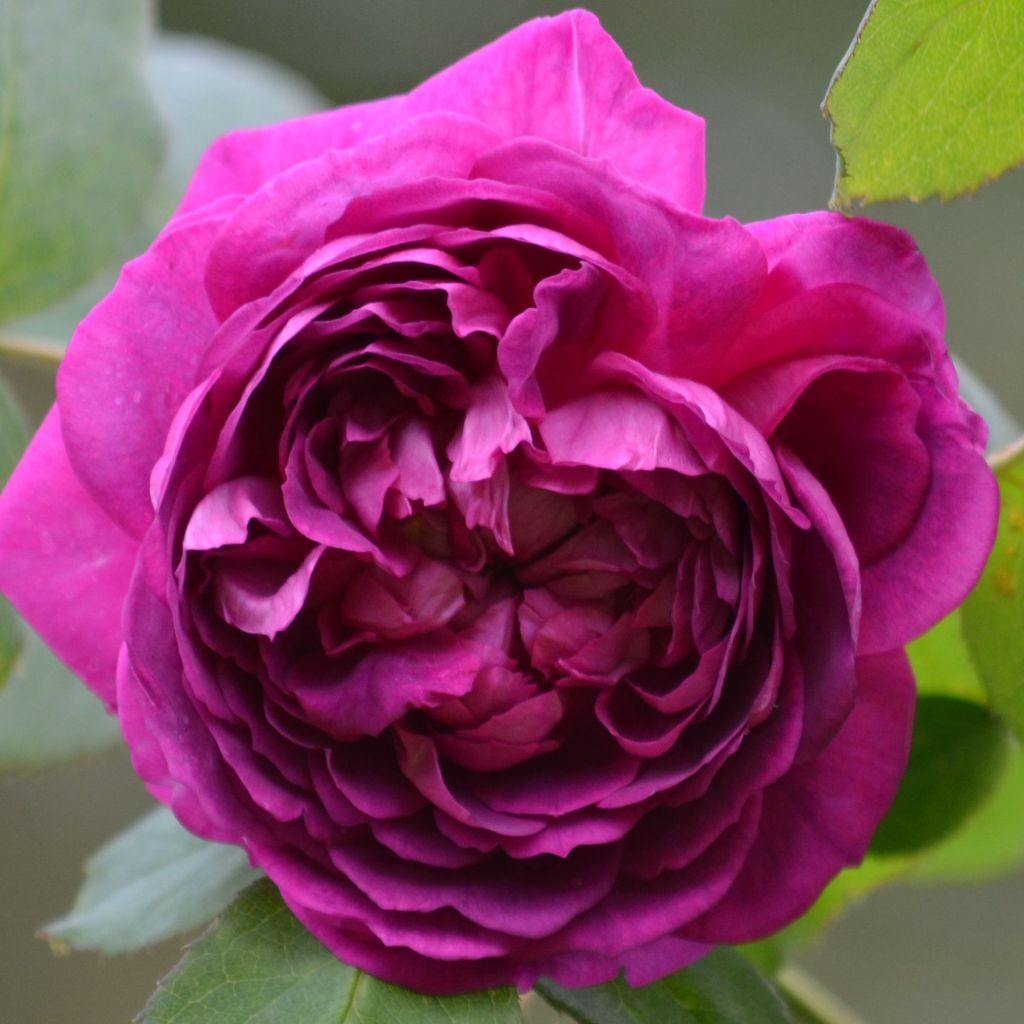
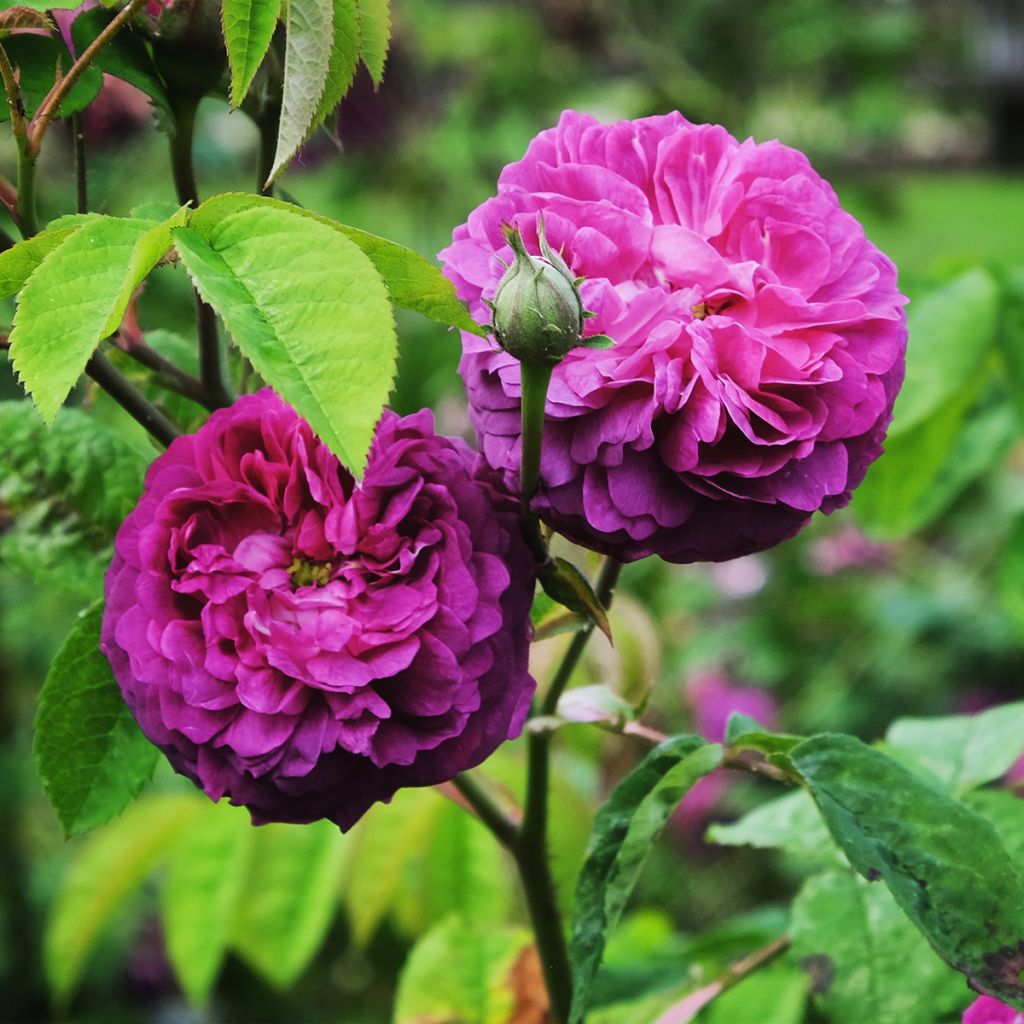
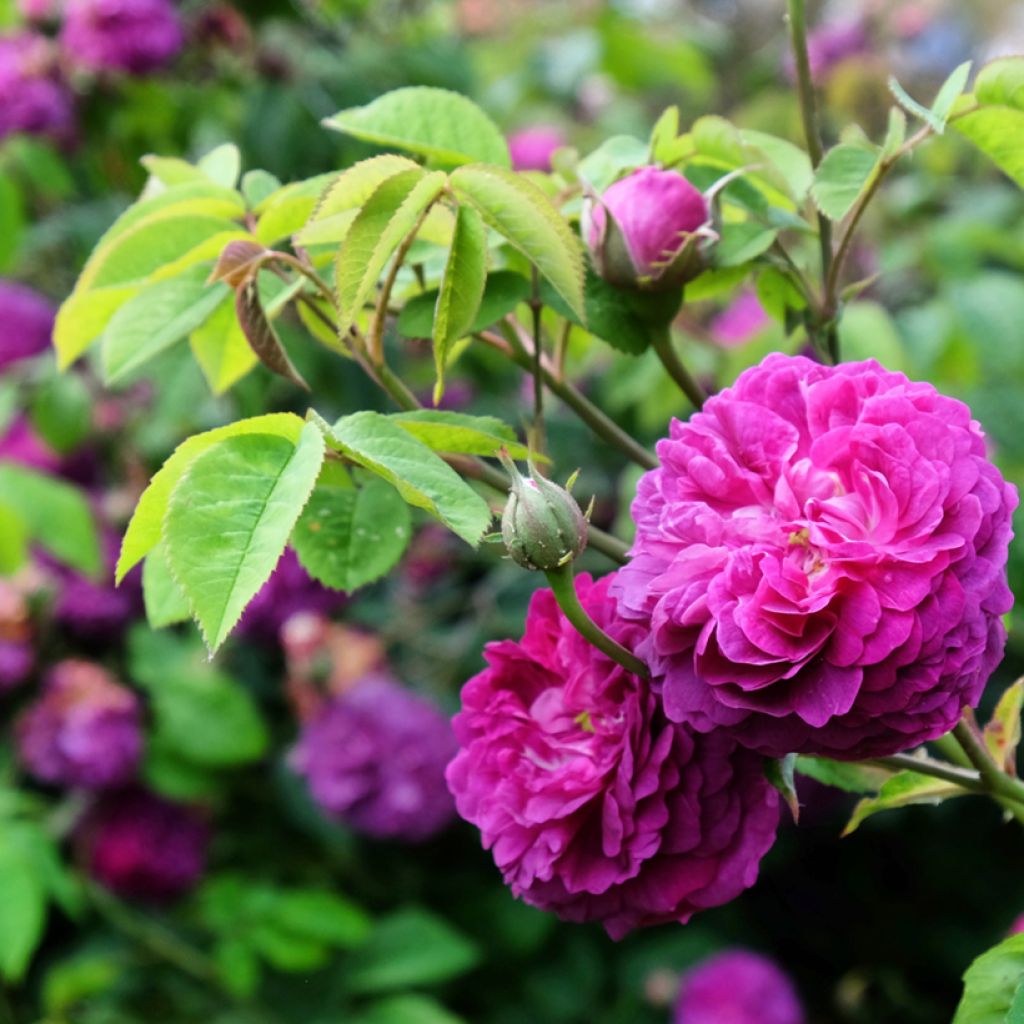
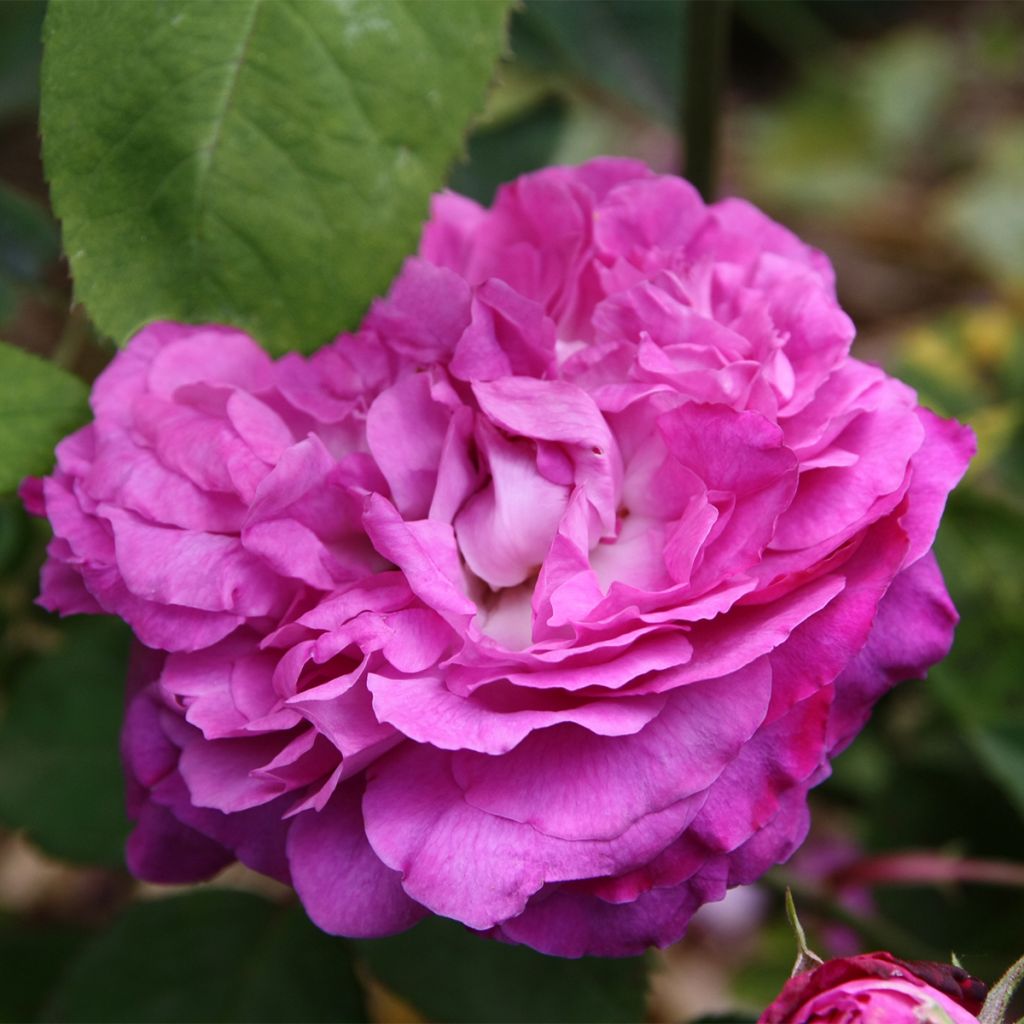
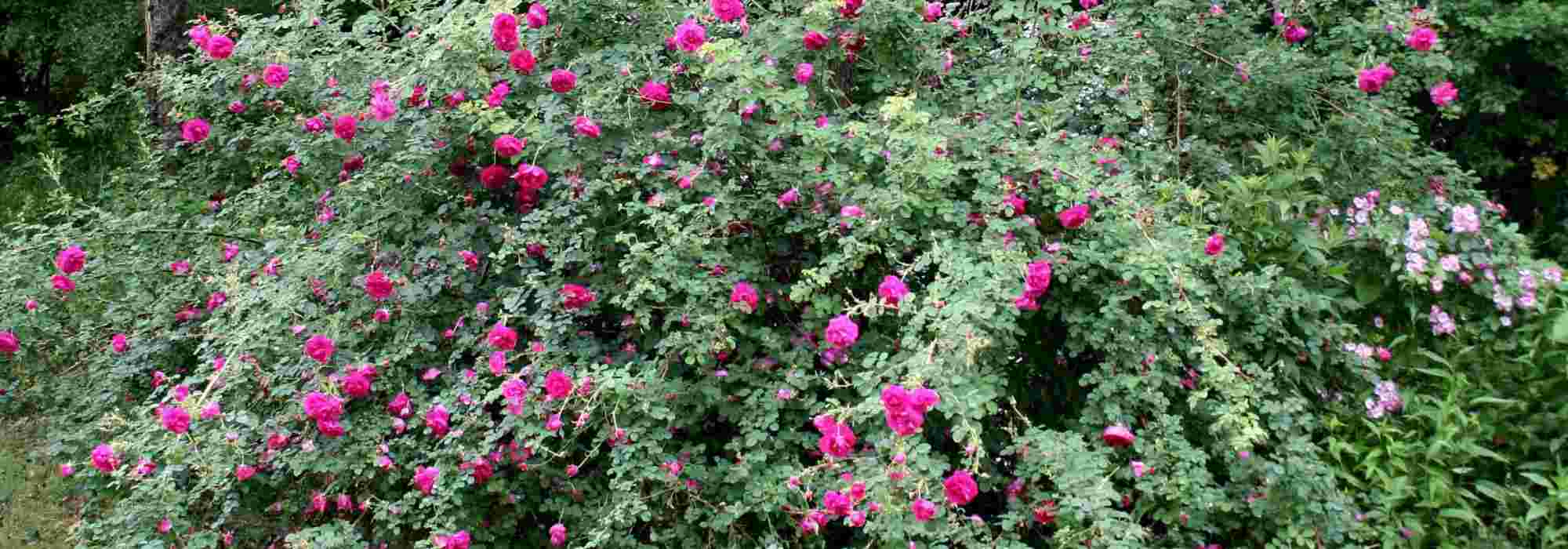
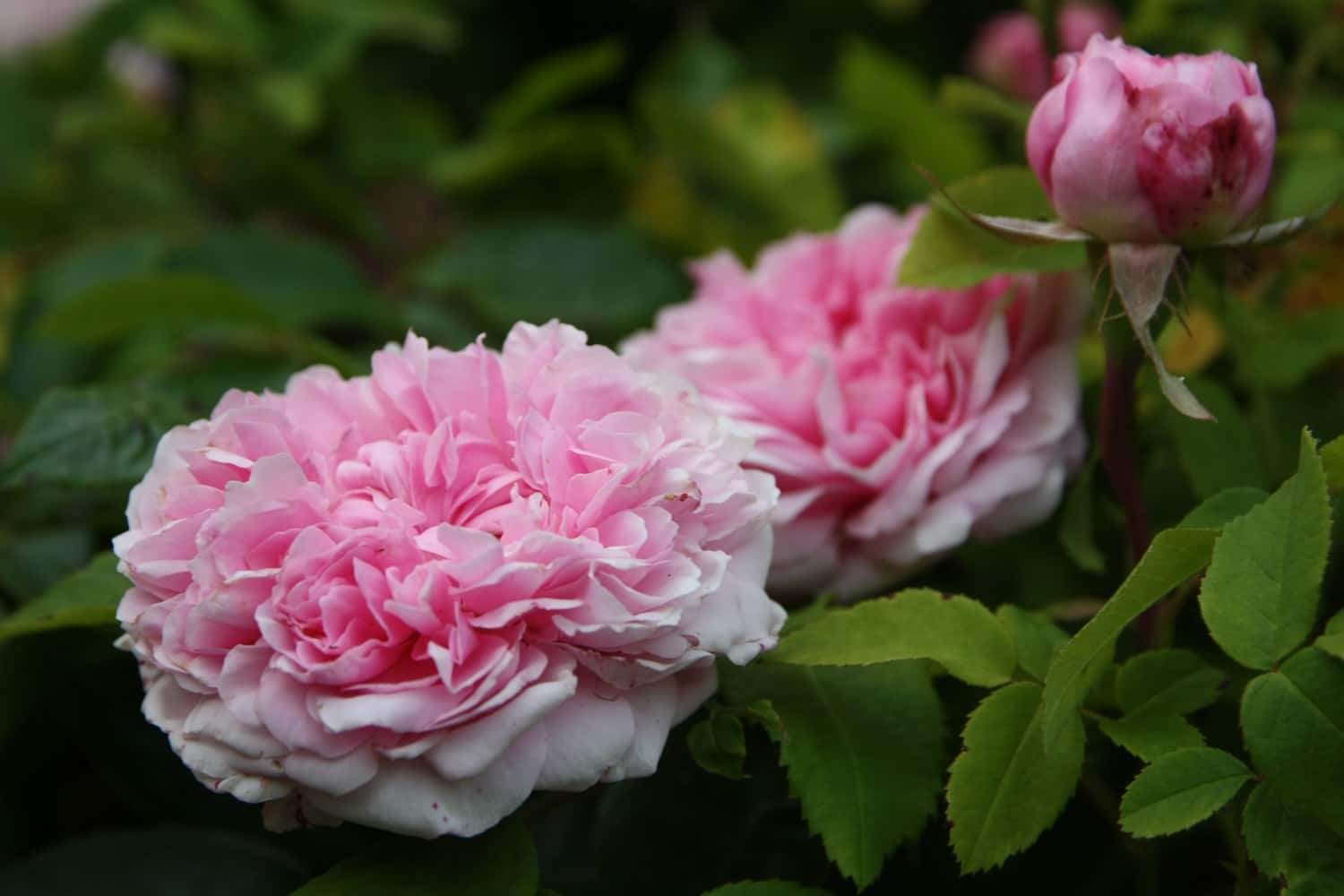
Rosa 'Reine des Violettes' is an ancient variety sumptuous, a cherished perpetual hybrid rose for over a century by all lovers of roses with a quaint charm. It offers bouquets of flat, double and well-formed roses in tight quarters, where an authentic rose fragrance nestles. Their changing colours, with astonishing richness, evolve from violet-purple tinged with carmine at the heart to a range of violet-lilac shades, displaying all possible nuances when the red tones fade at full bloom. This vigorous and very healthy bush offers a generous flowering from May to June, while that of September to October requires water, sunlight, mild temperatures, and fertile soil.
Rosa 'Reine des Violettes' is classified in the category of ancient perpetual hybrids, it was obtained in France, in 1860, by Millet-Mallet. This variety quickly forms a beautiful bush that is both ample and dense, reaching a height of 1.3m (4ft) to 1.5m (5ft) and a width of 1m (3ft 4in). Its stems are almost devoid of thorns, adorned with elegant glaucous, ashy, silky foliage, and are not very susceptible to diseases. The plant produces bouquets of cherry red buds. They open up into wide roses measuring 7 to 8cm (3.1in), composed of 75 petals organized into four quarters in the center of the corolla, with the outer ones being recurved. The dominant colour is a moiré purplish-violet with hints of red, the entire corolla gradually turning into mauve-lilac, enriched with a silvery glow that shimmers in the heart of the flower. The originality of the colour comes from its complexity and surprising variations throughout the hours and exposure; in partial shade, it will fully reveal its beauty.
If you have enough space, English, ancient or shrub roses are magnificent when planted in groups of three. They grow together to form a beautiful and opulent mass that blooms generously. The rose 'Reine des Violettes' can also be planted as a standalone, preferably in partial shade to preserve its unique colour, surrounded by low perennials: Stachys, Montpellier soapwort, carnations, violets, sedums, dwarf asters... It allows you to create very beautiful flower beds in shades of pink and mauve, in the company, for example, of the roses 'Jacques Cartier', 'Robert le Diable', and 'Deuil de Paul Fontaine'. In a contrasting scene, it can be planted with tender yellow or salmon-coloured flowers, such as those of the roses 'Agnes' or 'Aicha' or the yellow foxgloves or 'Spice Island'. Our British gardening friends are accustomed to training the branches of perpetual hybrid roses downwards, which promotes the development of buds but slightly disrupts the natural and exuberant habit of these bushes: this is ultimately a matter of taste.
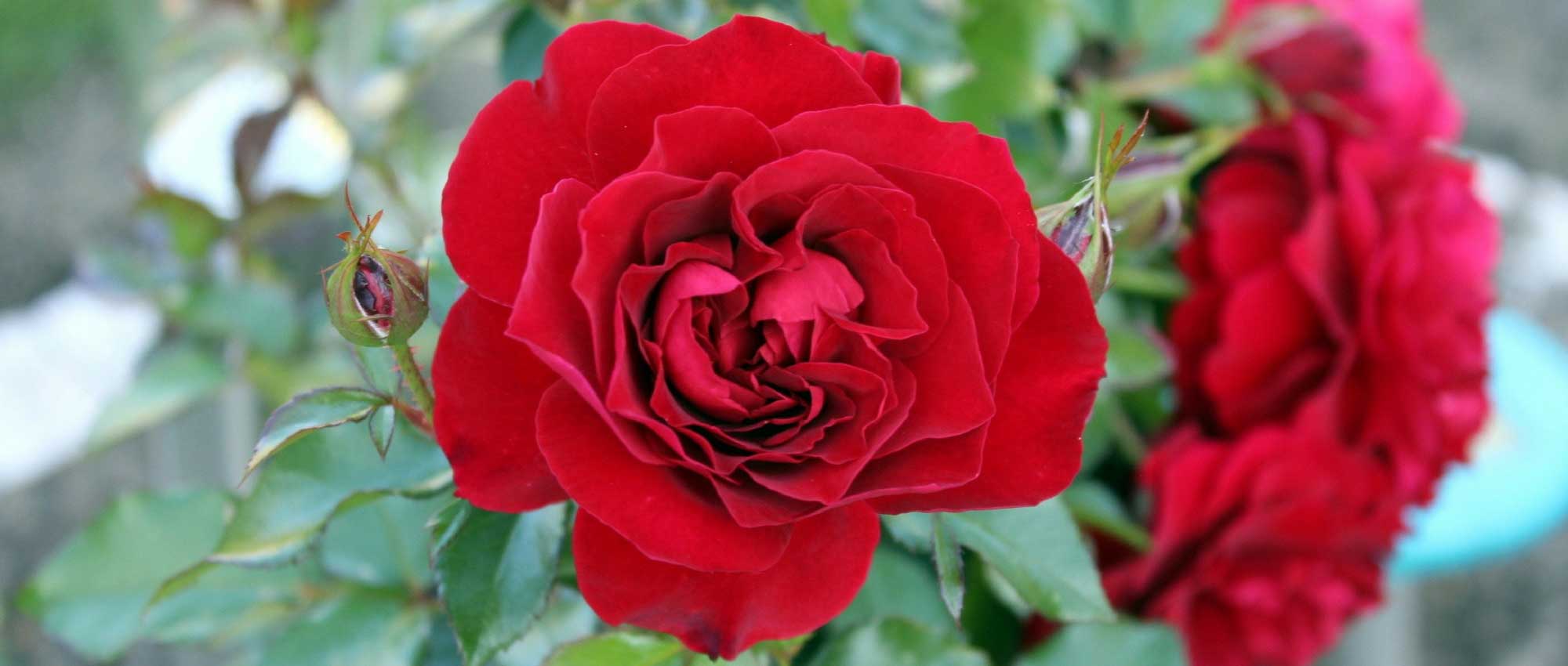
Rosa Reine des Violettes in pictures
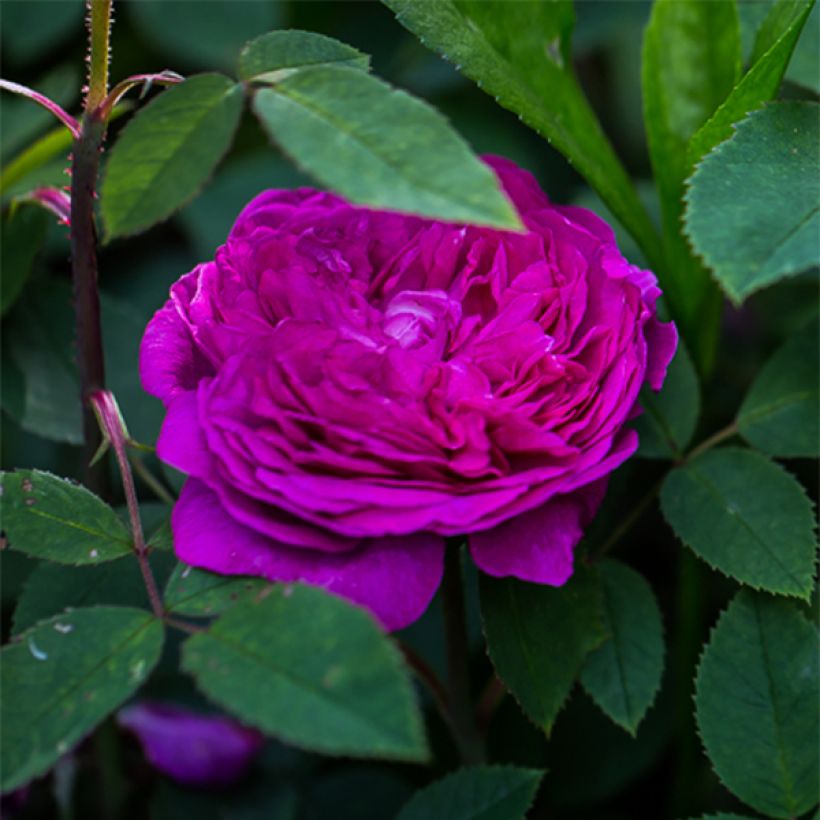

Plant habit
Flowering
Foliage
Botanical data
Rosa
Reine des Violettes
Rosaceae
Old Rose
Cultivar or hybrid
Planting and care
Plant your 'Reine des Violettes' Rose in a sunny location or rather in partial shade to preserve its dark and unique colour, an exposure it tolerates very well in a hot climate. Remontant old roses are tolerant but do not appreciate excess limestone and poor soils where they do not flower well. They will adapt to any garden as long as the soil is well worked, not too heavy, rich, and deep. To install your rose, work the soil by crumbling it well and putting an amendment at the bottom of the planting hole, such as dried blood or dehydrated horn. Water generously after planting to eliminate air pockets, and regularly for a few weeks to facilitate rooting. Also water from time to time in dry weather during the first two years.
Roses are often stained or unsightly at the end of summer, but this is not a problem for their development. These spots are not harmful to the rose, it is a natural phenomenon.
Planting period
Intended location
Care
Planting & care advice
-

-
-

-

-
-

-
-

-
, onOrder confirmed
Reply from on Promesse de fleurs
Recently viewed products
Haven't found what you were looking for?
Hardiness is the lowest winter temperature a plant can endure without suffering serious damage or even dying. However, hardiness is affected by location (a sheltered area, such as a patio), protection (winter cover) and soil type (hardiness is improved by well-drained soil).
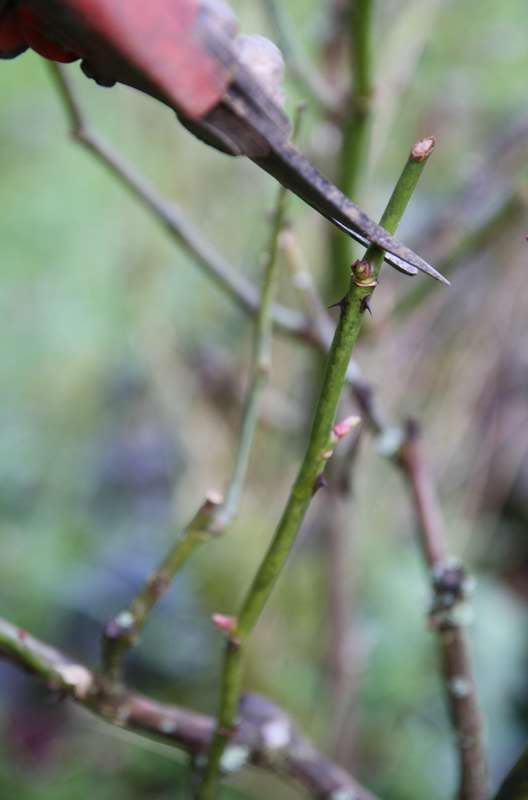
In temperate climates, pruning of spring-flowering shrubs (forsythia, spireas, etc.) should be done just after flowering.
Pruning of summer-flowering shrubs (Indian Lilac, Perovskia, etc.) can be done in winter or spring.
In cold regions as well as with frost-sensitive plants, avoid pruning too early when severe frosts may still occur.
The harvesting period indicated on our website applies to countries and regions in USDA zone 8 (France, England, Ireland, the Netherlands).
In colder areas (Scandinavia, Poland, Austria...) fruit and vegetable harvests are likely to be delayed by 3-4 weeks.
In warmer areas (Italy, Spain, Greece, etc.), harvesting will probably take place earlier, depending on weather conditions.
The sowing periods indicated on our website apply to countries and regions within USDA Zone 8 (France, UK, Ireland, Netherlands).
In colder areas (Scandinavia, Poland, Austria...), delay any outdoor sowing by 3-4 weeks, or sow under glass.
In warmer climes (Italy, Spain, Greece, etc.), bring outdoor sowing forward by a few weeks.
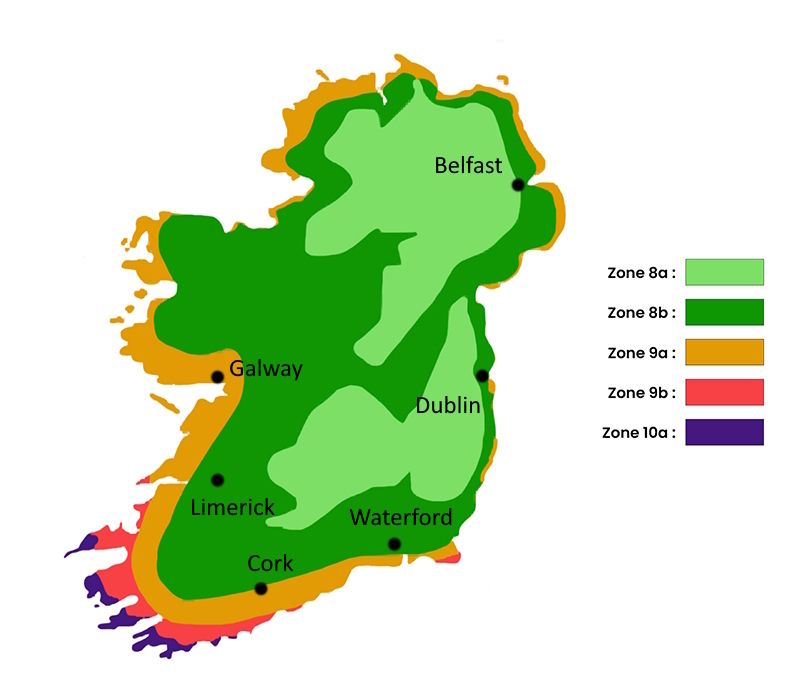
The planting period indicated on our website applies to regions in USDA Zone 9a (East Coast and Midlands: Dublin, Wexford, Waterford, Kilkenny, Portlaoise). It will vary depending on where you live:
- On the west coast and in the north-west (Galway, Limerick, Sligo, Donegal, Westport), delay planting by 1 to 2 weeks in spring and bring it forward by 1 to 2 weeks in autumn compared to the dates given, preferably choosing periods without strong winds.
- In the inland hills and plateaus (Wicklow Mountains, Macgillycuddy’s Reeks, Connemara, Killarney), it is best to plant in spring (April–May) or autumn (September–October), avoiding periods of waterlogged soil in winter and strong winds, which pose the main risk to newly planted trees in these areas.
The flowering period indicated on our website applies to regions in USDA Zone 9a, such as the East Coast and Midlands, including Dublin, Wexford, Waterford, Kilkenny and Portlaoise.
This will vary depending on where you live:
- On the west coast and in the northwest (Galway, Limerick, Sligo, Donegal and Westport), it will be delayed by one to two weeks compared to the given dates, due to stronger Atlantic winds and less spring sunshine.
- In the inland hills and plateaus (the Wicklow Mountains, the Macgillycuddy's Reeks, Connemara and Killarney), flowering will be delayed by two to three weeks. Flowering mainly occurs between May and July, with the limiting factors being less frost and more of the excessive humidity, strong winds and lack of sunshine that are characteristic of these areas.
Shipping country and language
Your country of residence may be:
Your country of residence is:
For a better user experience on our website, you can select:
Your shipping country:
-
 Austria
-
 Belgium
-
 Bosnia & Herzegovina
-
 Bulgaria
-
 Croatia
-
 Cyprus
-
 Czechia
-
 Denmark
-
 Estonia
-
 Finland
-
 France
-
 Germany
-
 Greece
-
 Hungary
-
 Iceland
-
 Ireland
-
 Italy
Italy
-
 Latvia
-
 Liechtenstein
-
 Lithuania
-
 Luxembourg
-
 Malta
Malta
-
 Netherlands
-
 Poland
-
 Portugal
-
 Romania
-
 Serbia
-
 Slovakia
-
 Slovenia
-
 Spain
Spain
-
 Sweden
-
 Switzerland
Language:
-
French
-
 English
-
Spanish
-
Italian
-
German
-
Portuguese
-
Dutch
-
Finnish
My Account
Hello
My wish lists
My cart
Log in / Register
Existing customer?
This form is protected by reCAPTCHA - the Google Privacy Policy and Terms of Service apply.
New customer?
Create an account to track your orders, access our customer service and, if you wish, make the most of our upcoming offers.