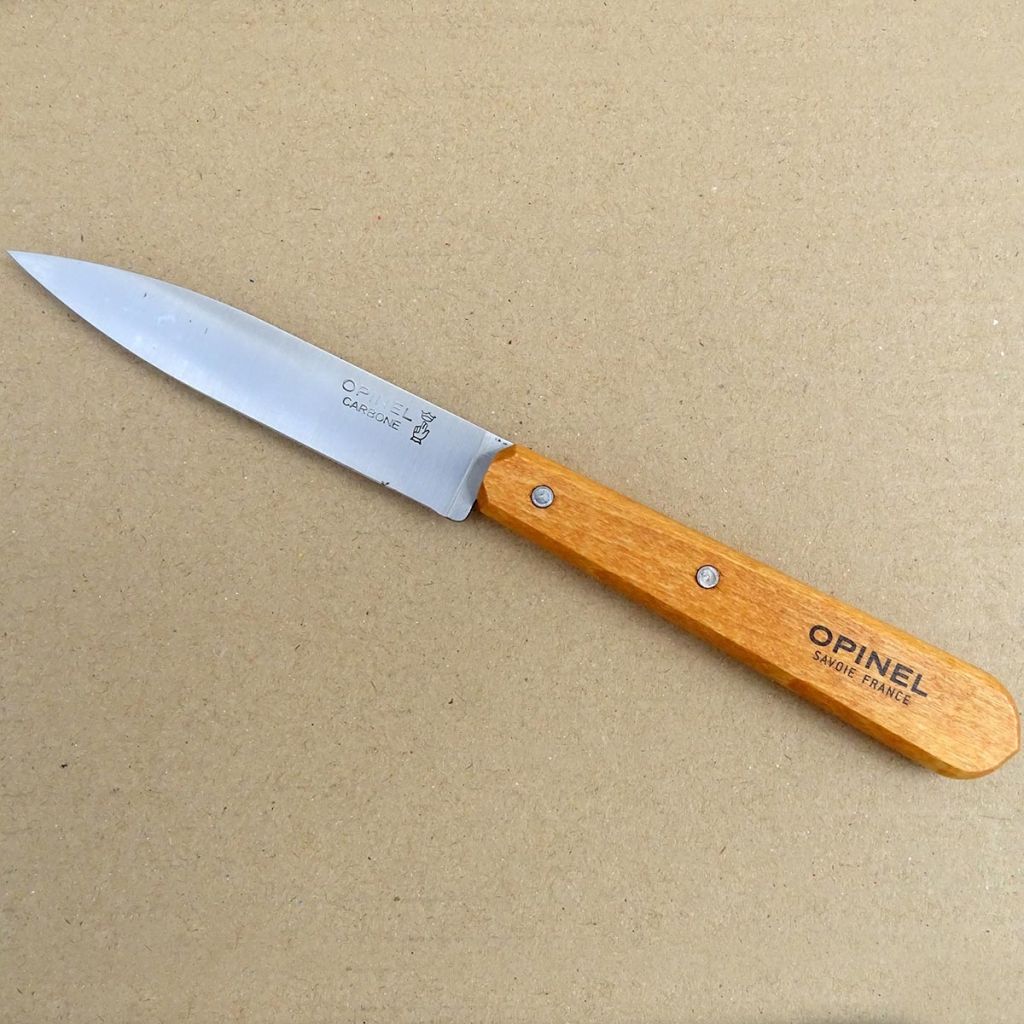
Opinel Vegetable Knife - Carbon Steel Blade
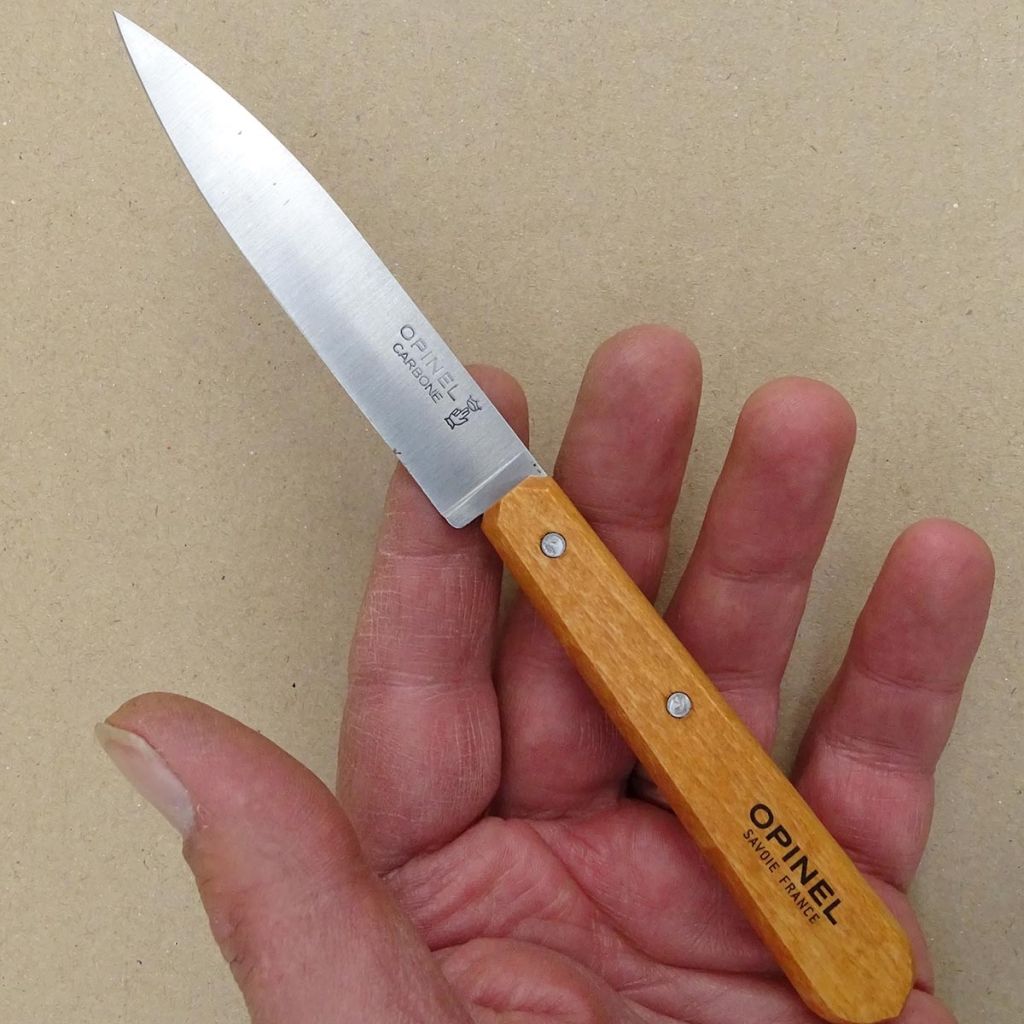
Opinel Vegetable Knife - Carbon Steel Blade
Opinel Vegetable Knife - Carbon Steel Blade
Back-to-school special offer!
Get €10 off for every €50 you spend! And get up to €40 off on a single order.
How does it work?
1. Shop your favourites
Add your favourite plants to your basket. For every €50 you spend (excluding delivery charges, store credit and the plastic-free option), you’ll receive a €10 voucher.
€50 spent = €10 voucher
€100 spent = €20 voucher
€150 spent = €30 voucher
€200 spent = €40 voucher
2. Place your order
Once your basket reaches one of the spending thresholds, place your order. You can even choose your delivery date!
3. Receive your voucher
As soon as your order has been shipped, you’ll receive an email containing your personal voucher code and its value.
4. Use it on your next order
Your voucher is valid for 90 days from the date you receive it. It can be used once only, on a new order worth at least the value of the voucher, excluding delivery charges.
Please note: Vouchers can be combined with other offers, but cannot be split or refunded.
Home or relay delivery (depending on size and destination)
Important: You may be charged customs duties by your country’s customs authorities upon delivery.
Schedule delivery date,
and select date in basket
We guarantee the quality of our plants for a full growing cycle, and will replace at our expense any plant that fails to recover under normal climatic and planting conditions.

A useful knife to have in the kitchen at all times. Handy, efficient, and complementary. Its natural beech wood handle will bring a rustic and traditional touch to your kitchen. It is made of martensitic stainless steel which offers high hardness thanks to the addition of nitrogen (0.15%) and superior corrosion resistance due to a high chromium content (16%).
A 10 cm (4in) blade made of stainless steel that ensures a high-quality cut. Varnished beech wood handle to resist dirt and water. Small, handy, and French, it will be very useful in your garden and kitchen for cutting your vegetables.
Ranked in 1985 by the Victoria and Albert Museum among the top 100 designs, exhibited at the Museum of Modern Art in New York, the Opinel is one of the most famous French knives. It was created in 1890 by Joseph Opinel, who was only 18 years old at the time, and its success has never waned since. By 1897, the range was complete with its 12 sizes. The brand with the “crowned hand” logo was registered in 1909.
The modified 12C27 stainless steel from Sandvik, developed for Opinel, is renowned for its sharpness and ease of maintenance. Stainless steel that can undergo heat treatment to achieve good hardness is called martensitic. It has a carbon content of at least 0.40%, which allows for a very satisfactory sharpness without being prone to corrosion. Blade hardness is 57-58 HRC. The traditional Opinel blade is called a Yatagan blade. Its shape is inspired by a Turkish saber, with a raised point. The blade is ground with an exclusive convex profile that guarantees the robustness of the blade and allows for efficient sharpening.
Beech wood is the most commonly used wood for Opinel handles. Sourced from French forests, it is hard, resistant, and easy to work with. With a homogeneous appearance, its light color varies from yellow to pink. It is recognizable by the presence of many small dark lines. The handle is varnished for better protection against moisture and dirt.
Invented in 1955 by Marcel Opinel, the Virobloc safety ring is fitted on all folding knives from N°06 onwards. Made of stainless steel, the Virobloc consists of two parts: a fixed part and a sliding part. In addition to locking the blade in the open position (for safety during use), it is now possible to lock the blade in the closed position (for safety during transport).
Technical features
Tips
This item has not been reviewed yet - be the first to leave a review about it.
Recently viewed products
Haven't found what you were looking for?
Hardiness is the lowest winter temperature a plant can endure without suffering serious damage or even dying. However, hardiness is affected by location (a sheltered area, such as a patio), protection (winter cover) and soil type (hardiness is improved by well-drained soil).
In temperate climates, pruning of spring-flowering shrubs (forsythia, spireas, etc.) should be done just after flowering.
Pruning of summer-flowering shrubs (Indian Lilac, Perovskia, etc.) can be done in winter or spring.
In cold regions as well as with frost-sensitive plants, avoid pruning too early when severe frosts may still occur.
The harvesting period indicated on our website applies to countries and regions in USDA zone 8 (France, England, Ireland, the Netherlands).
In colder areas (Scandinavia, Poland, Austria...) fruit and vegetable harvests are likely to be delayed by 3-4 weeks.
In warmer areas (Italy, Spain, Greece, etc.), harvesting will probably take place earlier, depending on weather conditions.
The sowing periods indicated on our website apply to countries and regions within USDA Zone 8 (France, UK, Ireland, Netherlands).
In colder areas (Scandinavia, Poland, Austria...), delay any outdoor sowing by 3-4 weeks, or sow under glass.
In warmer climes (Italy, Spain, Greece, etc.), bring outdoor sowing forward by a few weeks.
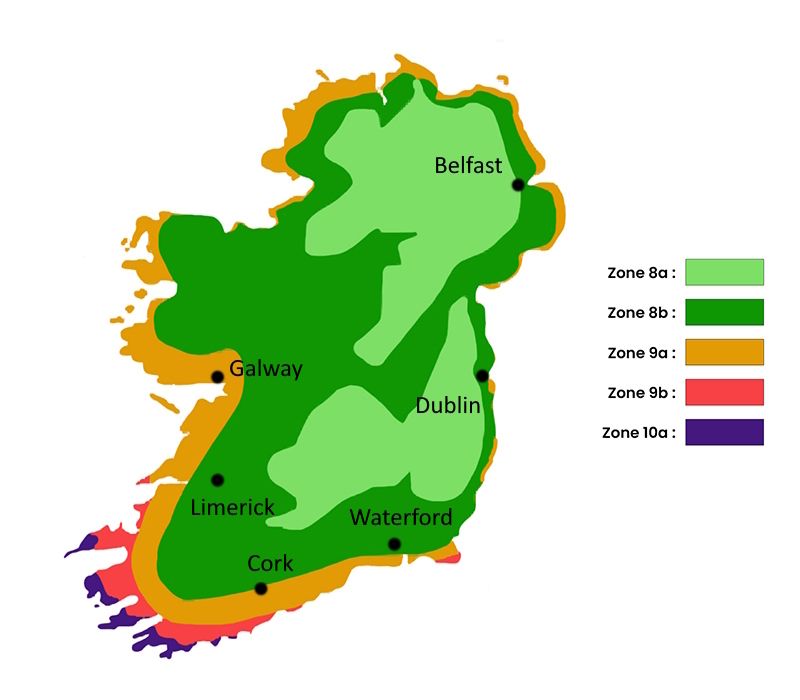
The planting period indicated on our website applies to regions in USDA Zone 9a (East Coast and Midlands: Dublin, Wexford, Waterford, Kilkenny, Portlaoise). It will vary depending on where you live:
- On the west coast and in the north-west (Galway, Limerick, Sligo, Donegal, Westport), delay planting by 1 to 2 weeks in spring and bring it forward by 1 to 2 weeks in autumn compared to the dates given, preferably choosing periods without strong winds.
- In the inland hills and plateaus (Wicklow Mountains, Macgillycuddy’s Reeks, Connemara, Killarney), it is best to plant in spring (April–May) or autumn (September–October), avoiding periods of waterlogged soil in winter and strong winds, which pose the main risk to newly planted trees in these areas.
The flowering period indicated on our website applies to regions in USDA Zone 9a, such as the East Coast and Midlands, including Dublin, Wexford, Waterford, Kilkenny and Portlaoise.
This will vary depending on where you live:
- On the west coast and in the northwest (Galway, Limerick, Sligo, Donegal and Westport), it will be delayed by one to two weeks compared to the given dates, due to stronger Atlantic winds and less spring sunshine.
- In the inland hills and plateaus (the Wicklow Mountains, the Macgillycuddy's Reeks, Connemara and Killarney), flowering will be delayed by two to three weeks. Flowering mainly occurs between May and July, with the limiting factors being less frost and more of the excessive humidity, strong winds and lack of sunshine that are characteristic of these areas.
Shipping country and language
Your country of residence may be:
Your country of residence is:
For a better user experience on our website, you can select:
Your shipping country:
-
 Austria
-
 Belgium
-
 Bosnia & Herzegovina
-
 Bulgaria
-
 Croatia
-
 Cyprus
-
 Czechia
-
 Denmark
-
 Estonia
-
 Finland
-
 France
-
 Germany
-
 Greece
-
 Hungary
-
 Iceland
-
 Ireland
-
 Italy
Italy
-
 Latvia
-
 Liechtenstein
-
 Lithuania
-
 Luxembourg
-
 Malta
Malta
-
 Netherlands
-
 Poland
-
 Portugal
-
 Romania
-
 Serbia
-
 Slovakia
-
 Slovenia
-
 Spain
Spain
-
 Sweden
-
 Switzerland
Language:
-
French
-
 English
-
Spanish
-
Italian
-
German
-
Portuguese
-
Dutch
-
Finnish
My Account
Hello
My wish lists
My cart
Log in / Register
Existing customer?
This form is protected by reCAPTCHA - the Google Privacy Policy and Terms of Service apply.
New customer?
Create an account to track your orders, access our customer service and, if you wish, make the most of our upcoming offers.