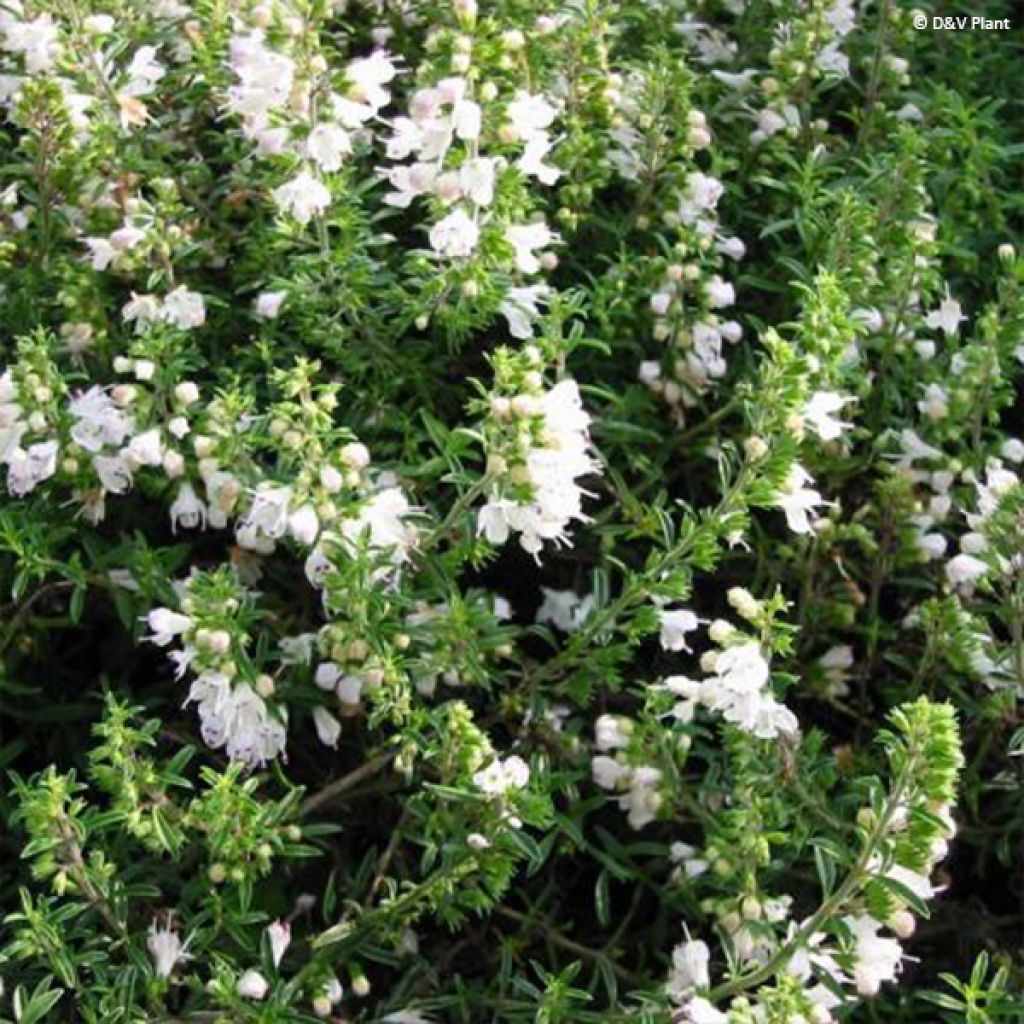
Satureja spicigera
Satureja spicigera
Satureja spicigera
Creeping Savory
This savory was missing from the parcel, and once again there was an opening in the cardboard box that had been made during transit. I was refunded.
Pierth, 27/02/2026
Back-to-school special offer!
Get €10 off for every €50 you spend! And get up to €40 off on a single order.
How does it work?
1. Shop your favourites
Add your favourite plants to your basket. For every €50 you spend (excluding delivery charges, store credit and the plastic-free option), you’ll receive a €10 voucher.
€50 spent = €10 voucher
€100 spent = €20 voucher
€150 spent = €30 voucher
€200 spent = €40 voucher
2. Place your order
Once your basket reaches one of the spending thresholds, place your order. You can even choose your delivery date!
3. Receive your voucher
As soon as your order has been shipped, you’ll receive an email containing your personal voucher code and its value.
4. Use it on your next order
Your voucher is valid for 90 days from the date you receive it. It can be used once only, on a new order worth at least the value of the voucher, excluding delivery charges.
Please note: Vouchers can be combined with other offers, but cannot be split or refunded.
Why not try an alternative variety in stock?
View all →
Available in 2 sizes
Available in 2 sizes

Available in 2 sizes

Available in 2 sizes

Available in 1 sizes

Available in 2 sizes

Available in 3 sizes
Available in 2 sizes

Available in 1 sizes

Available in 2 sizes
This plant carries a 12 months recovery warranty
More information
We guarantee the quality of our plants for a full growing cycle, and will replace at our expense any plant that fails to recover under normal climatic and planting conditions.

Does this plant fit my garden?
Set up your Plantfit profile →
Description
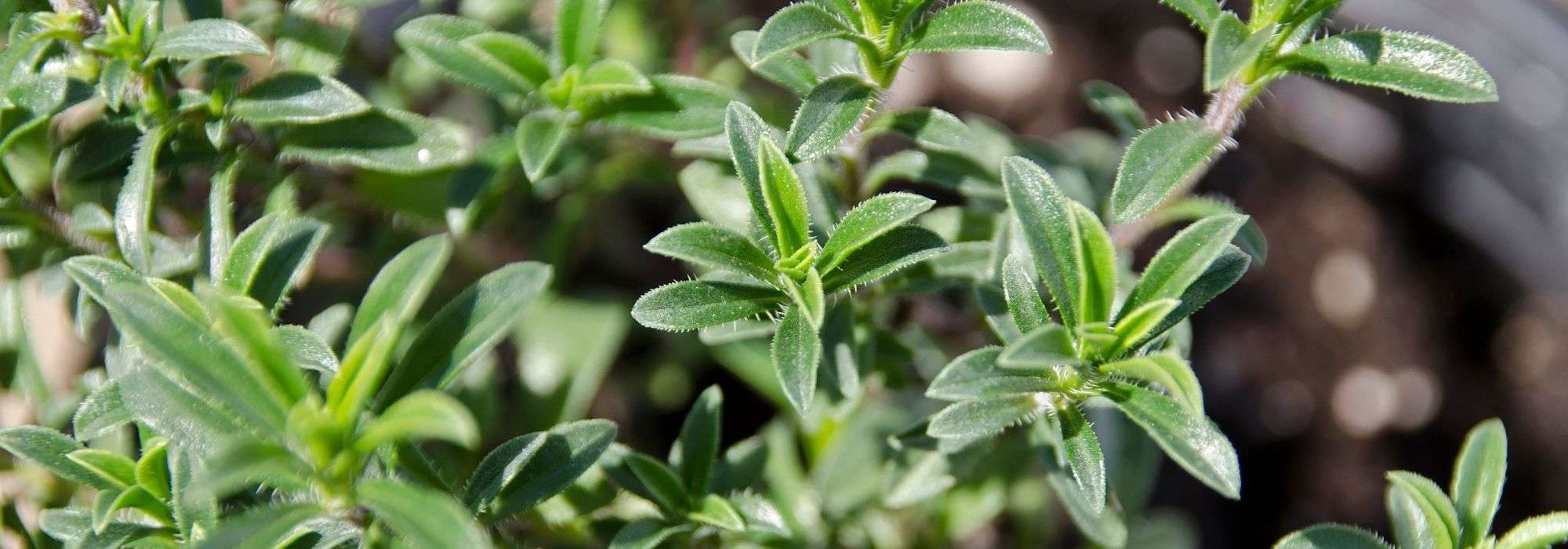
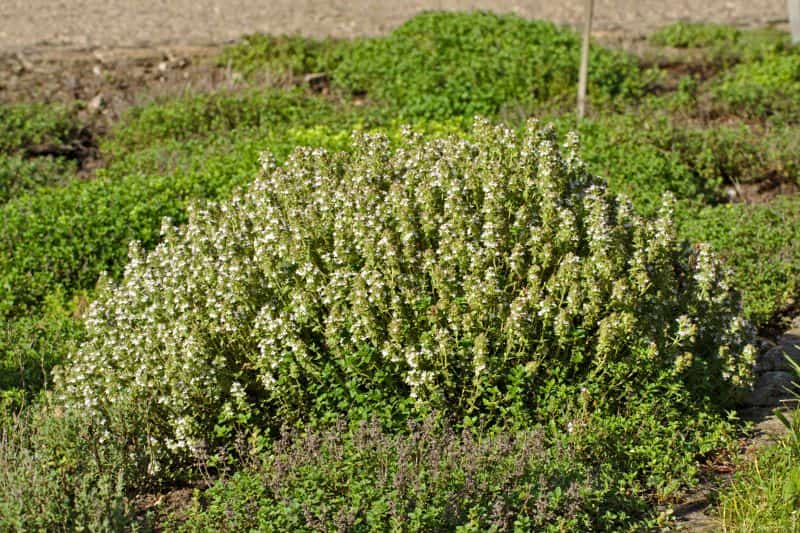
The creeping or prostrate savory, in Latin Satureja spicigera, is a plant that is both very honey-bearing, aromatic, medicinal, and culinary. Covering the ground with its long stems adorned with small, very aromatic dark green foliage, it also offers a beautiful white and honey-bearing flowering at the beginning of summer. In cuisine, its foliage is used to pleasantly flavour stews and grilled dishes. It is also a medicinal plant with recognized properties. Very comfortable in slightly arid and sun-drenched places, Caucasian savory finds its place in ornamental gardens, bordering flower beds, or in rockeries.
The creeping savory belongs to the family Lamiaceae or Labiatae, just like the thyme with which it is closely related. This botanical species originates from Western Asia, Turkey, Iran, and the Caucasus, where it spreads in full sun on dry and eroded slopes as well as in rocky scree. Its cold resistance is excellent (down to -15°C (5°F)), but in well-drained soils. It also tolerates dry to very dry summers once well rooted. Its foliage persists in winter.
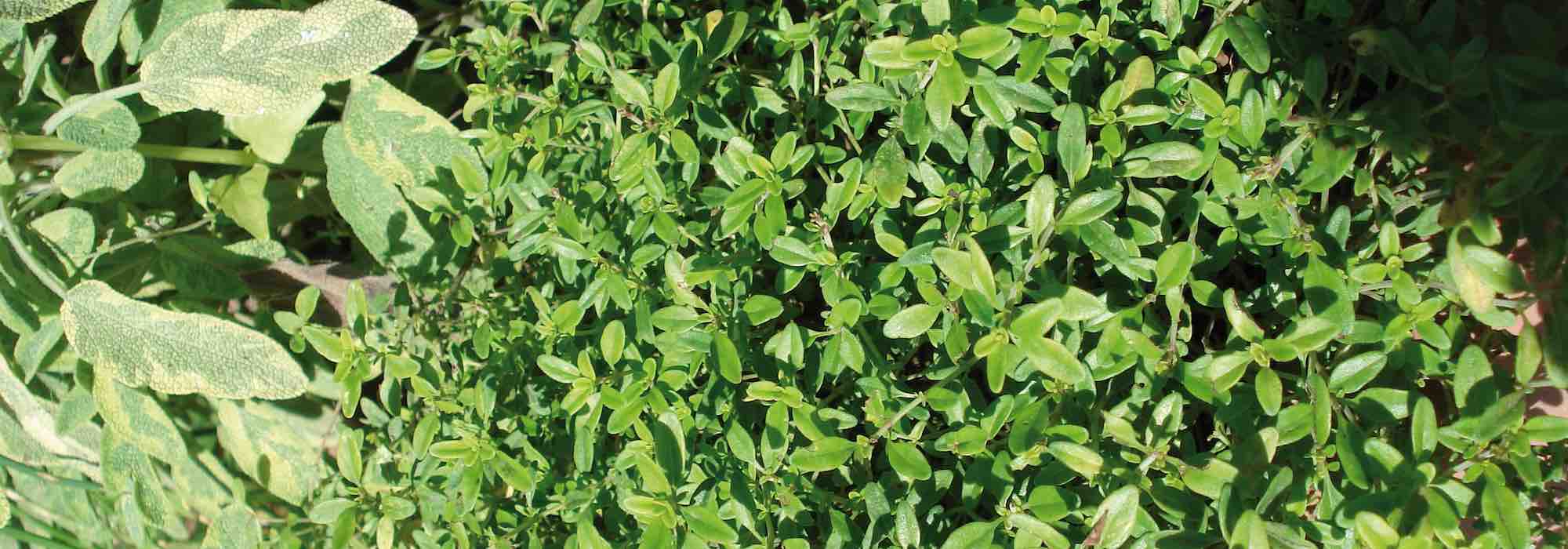
This is a perennial plant with woody base whose branches, arched towards the ground, form a spread-out tuft about 15-20cm (6-8in) high and 40-50cm (16-20in) wide. Its hairy, square-sectioned stems bear small, opposite, leathery and shiny, linear, dark green leaves that are very fragrant when crushed, with a spicy aroma. Flowering generally occurs in June in the south of France, but from July to August further north. At the ends of the stems, inflorescences in whorls or clusters of white flowers with 2 lips are born, which are heavily visited by bees. Outside its preferred regions, savory does not age well: we recommend renewing your plantings every 5 years.
Satureja spicigera is cultivated like thyme, lavender, rosemary, and marjoram, with which it can be perfectly associated on a dry slope or in a very sunny rockery. Pot cultivation is possible in a loose and well-drained soil mix. You can arrange the border of a gravelled alley by alternating, for example, savory plants with different varieties of thyme (Thymus capitata, ciliatus, herba-barona), white germander (Teucrium chamaedrys), small sedums, cotton lavenders, etc. Pruning once a year, in September, will be enough to keep it looking neat. One of the charms of this type of arrangement lies in the scents that all these plants diffuse after a hot day: they blend in a complex fragrance to be savored with closed eyes: intense, captivating, unforgettable, it constitutes the quintessence of the Mediterranean countryside.
In cuisine: savory leaves are harvested in the morning. Wait until the plant is at least one year old. For preservation, harvest the leaves at the beginning of flowering and dry them to retain their flavour. They are used to flavor salads, sauces, stews, legumes, and grilled dishes. The essential oil of Satureja contained in the leaves has antiseptic, stimulating, and digestive properties.
In the vegetable garden or garden, savory repels aphids. It pairs well with peas, beans, and broad beans, protecting them from insects. But keep it away from sage, turnips, and radishes.
Flowering
Foliage
Plant habit
Botanical data
Satureja
spicigera
Lamiaceae
Creeping Savory
Caucasus
Planting and care
Satureja spicigera is planted in spring or autumn in a very well-drained soil (stony, rocky or sandy). It does not tolerate heavy and compact soils, especially in winter. It strongly prefers limestone soils, but it also grows in neutral or slightly acidic soils. Add coarse sand or gravel to the original soil and plant in a slight mound in a very sunny spot. Prune after flowering. Pot cultivation is preferable in regions with a too humid and cold climate in winter. Plant in a soft and well-drained potting soil in a 40 to 50cm (16 to 20in) diameter pot. The more savory grows in poor and dry soil, the more fragrant its foliage is: the production of essential oils is a defense mechanism for plants in the garrigue field.
Planting period
Intended location
Care
Planting & care advice
-

-
-

-

-
-
-
-

-
, onOrder confirmed
Reply from on Promesse de fleurs
Recently viewed products
Haven't found what you were looking for?
Hardiness is the lowest winter temperature a plant can endure without suffering serious damage or even dying. However, hardiness is affected by location (a sheltered area, such as a patio), protection (winter cover) and soil type (hardiness is improved by well-drained soil).
In temperate climates, pruning of spring-flowering shrubs (forsythia, spireas, etc.) should be done just after flowering.
Pruning of summer-flowering shrubs (Indian Lilac, Perovskia, etc.) can be done in winter or spring.
In cold regions as well as with frost-sensitive plants, avoid pruning too early when severe frosts may still occur.
The harvesting period indicated on our website applies to countries and regions in USDA zone 8 (France, England, Ireland, the Netherlands).
In colder areas (Scandinavia, Poland, Austria...) fruit and vegetable harvests are likely to be delayed by 3-4 weeks.
In warmer areas (Italy, Spain, Greece, etc.), harvesting will probably take place earlier, depending on weather conditions.
The sowing periods indicated on our website apply to countries and regions within USDA Zone 8 (France, UK, Ireland, Netherlands).
In colder areas (Scandinavia, Poland, Austria...), delay any outdoor sowing by 3-4 weeks, or sow under glass.
In warmer climes (Italy, Spain, Greece, etc.), bring outdoor sowing forward by a few weeks.
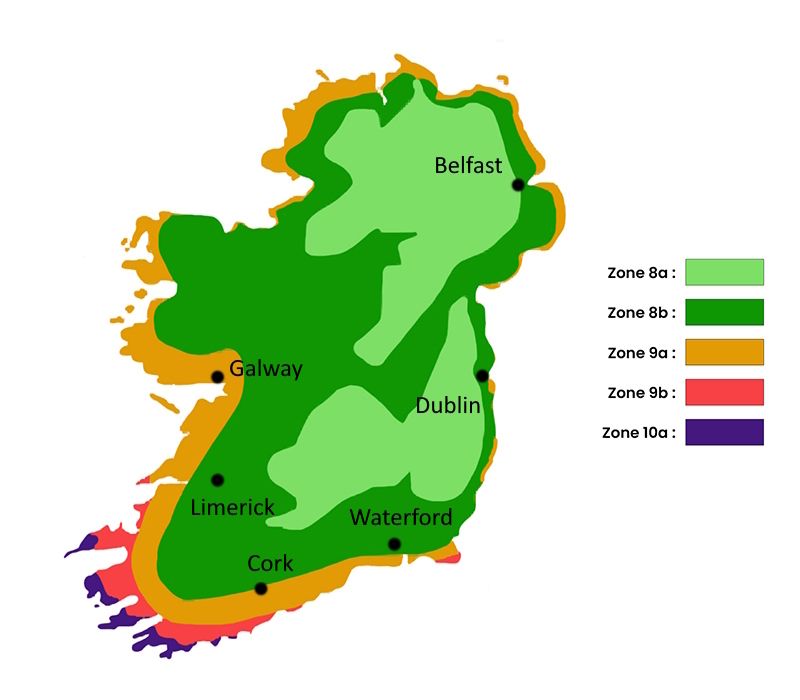
The planting period indicated on our website applies to regions in USDA Zone 9a (East Coast and Midlands: Dublin, Wexford, Waterford, Kilkenny, Portlaoise). It will vary depending on where you live:
- On the west coast and in the north-west (Galway, Limerick, Sligo, Donegal, Westport), delay planting by 1 to 2 weeks in spring and bring it forward by 1 to 2 weeks in autumn compared to the dates given, preferably choosing periods without strong winds.
- In the inland hills and plateaus (Wicklow Mountains, Macgillycuddy’s Reeks, Connemara, Killarney), it is best to plant in spring (April–May) or autumn (September–October), avoiding periods of waterlogged soil in winter and strong winds, which pose the main risk to newly planted trees in these areas.
The flowering period indicated on our website applies to regions in USDA Zone 9a, such as the East Coast and Midlands, including Dublin, Wexford, Waterford, Kilkenny and Portlaoise.
This will vary depending on where you live:
- On the west coast and in the northwest (Galway, Limerick, Sligo, Donegal and Westport), it will be delayed by one to two weeks compared to the given dates, due to stronger Atlantic winds and less spring sunshine.
- In the inland hills and plateaus (the Wicklow Mountains, the Macgillycuddy's Reeks, Connemara and Killarney), flowering will be delayed by two to three weeks. Flowering mainly occurs between May and July, with the limiting factors being less frost and more of the excessive humidity, strong winds and lack of sunshine that are characteristic of these areas.
Shipping country and language
Your country of residence may be:
Your country of residence is:
For a better user experience on our website, you can select:
Your shipping country:
-
 Austria
-
 Belgium
-
 Bosnia & Herzegovina
-
 Bulgaria
-
 Croatia
-
 Cyprus
-
 Czechia
-
 Denmark
-
 Estonia
-
 Finland
-
 France
-
 Germany
-
 Greece
-
 Hungary
-
 Iceland
-
 Ireland
-
 Italy
Italy
-
 Latvia
-
 Liechtenstein
-
 Lithuania
-
 Luxembourg
-
 Malta
Malta
-
 Netherlands
-
 Poland
-
 Portugal
-
 Romania
-
 Serbia
-
 Slovakia
-
 Slovenia
-
 Spain
Spain
-
 Sweden
-
 Switzerland
Language:
-
French
-
 English
-
Spanish
-
Italian
-
German
-
Portuguese
-
Dutch
-
Finnish
My Account
Hello
My wish lists
My cart
Log in / Register
Existing customer?
This form is protected by reCAPTCHA - the Google Privacy Policy and Terms of Service apply.
New customer?
Create an account to track your orders, access our customer service and, if you wish, make the most of our upcoming offers.