When planting a tree or a shrub, watering is essential to encourage good establishment. To ensure water really benefits the roots, you can create a watering basin around the plant. Easy to make, this small rim of earth concentrates water at the plant’s base and limits run-off.
But how do you make a watering basin? What depth and diameter should you allow for? What are the steps? Discover all our tips to make it correctly and so make watering your plants easier.
Why make a watering basin?
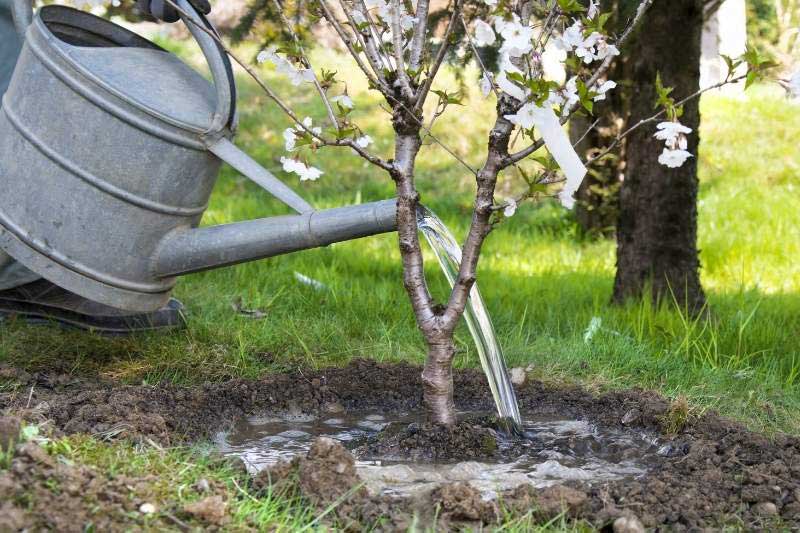
A watering basin is a small depression formed in the soil, generally around the base of a tree or a shrub. Its main advantage is to allow water to infiltrate gradually into the soil, rather than run off the surface. It is particularly useful when plants are newly planted and their root system is still poorly developed. The basin notably helps water infiltration at the root zone and prevents run-off.
It is therefore particularly useful during the first months after planting, when roots need a regular supply of water to establish.
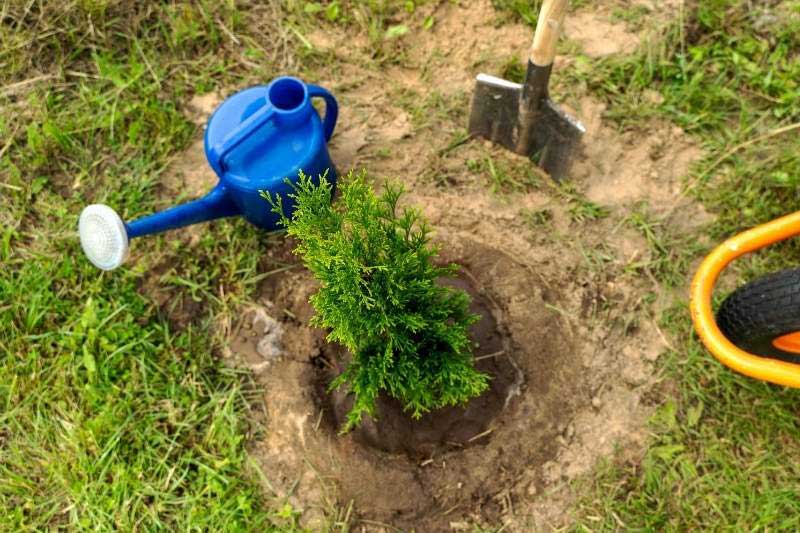
When to create a watering basin?
The watering basin can be created at planting, just after placing the plant in the ground. It is actually the ideal moment: soil is already worked and it is easy to shape earth around the rootball.
It is particularly useful for recently planted trees and shrubs, especially in spring or autumn when rainfall does not suffice to keep soil moist enough.
A basin can also be arranged around an established plant if water tends to run off quickly, notably on a slightly sloping site or in soil that is very prone to run-off.
However, it is not always necessary. In very heavy, clayey and poorly drained soil, retaining water at the base of a plant can encourage excess moisture and be harmful, causing root asphyxiation or rot.
How to make a watering basin step by step?
Materials needed
In most cases, to make a watering basin you only need to have:
- a spade or a shovel;
- a rake to level the soil;
- optionally a hand fork or a hoe to lightly loosen the soil surface;
- mulch, if you wish to complete the basin.
The main point is to have soil that is sufficiently friable so it can be moved easily around the plant.
What dimensions for a watering basin?
There is no single size suitable for all plantings. The basin’s diameter should be proportionate to the size of the plant and, above all, to that of its rootball or root zone.
For a young tree or a recently planted shrub, you can generally plan a basin of around 60 cm to 1 m in diameter. For a larger tree, you can gradually increase this area to accompany the expansion of the roots.
Depth should remain moderate. A basin of about 5 to 10 cm deep is generally enough to hold water without creating too large an excavation. The aim is not to dig deeply around the trunk, but simply to form a slightly hollowed surface.
It is also important not to alter the soil level excessively around the collar, that is the transition area between the roots and the above-ground part of the plant. The collar must remain exposed and not be buried under a layer of soil or mulch.
How to make a watering basin?
Making a watering basin is simple and only takes a few minutes:
- Clean the area around the plant by removing weeds, stones and plant debris.
- Loosen the soil surface slightly using a spade, fork or hoe. Avoid working too deeply so as not to damage roots.
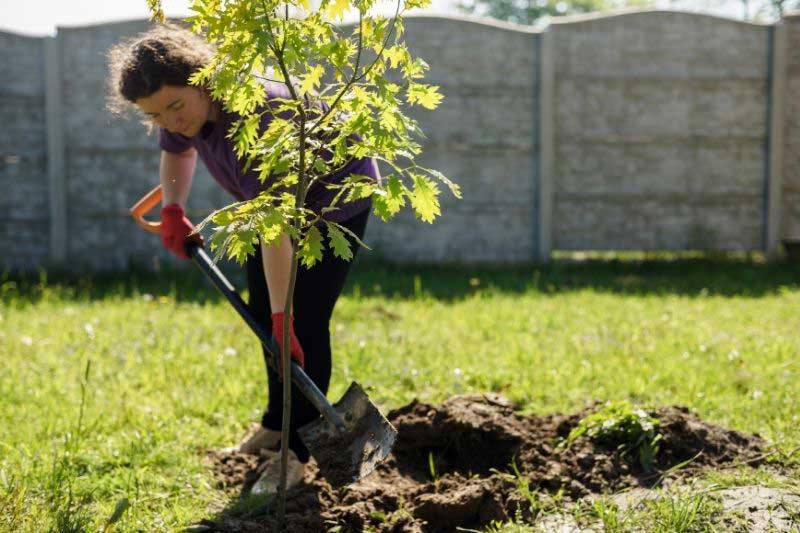
- Form a small circular ridge around the plant, a few tens of centimetres from the trunk or stem. Bring the earth outward to create a border capable of holding water.
- Leave the centre slightly hollow and level the basin’s base so that water can spread in a homogeneous way around the rootball.
- Gently firm the ridge so it resists water, without compacting the soil excessively.
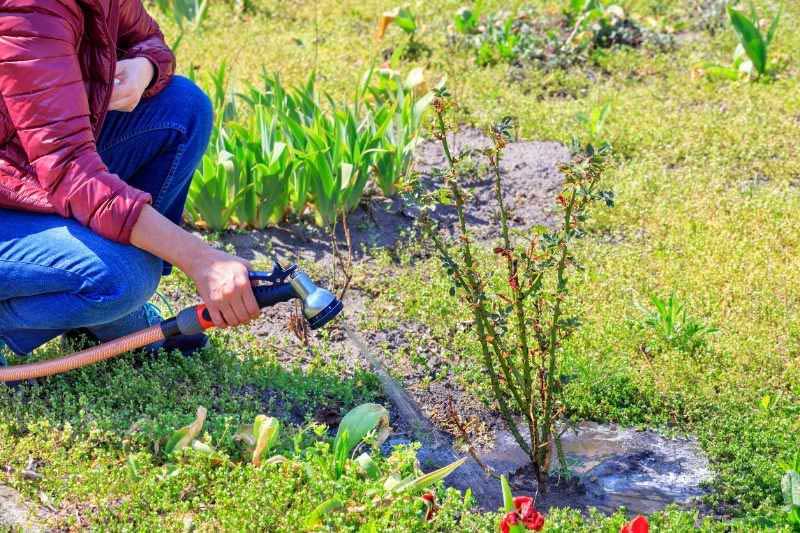
- Water slowly to check that water stays in the basin and infiltrates correctly. If it runs off, reinforce the ridge slightly.
To limit evaporation, the basin can be paired with an organic mulch. This retains more moisture in the soil and also reduces competition from unwanted weeds.
Over time, roots develop and the plant becomes more self-sufficient. The basin can then be widened, reshaped or gradually removed, depending on the plant’s needs and site conditions.
Mistakes to avoid
A watering basin is easy to make, but some mistakes can limit its effectiveness or harm the plant. Here are the main pitfalls to avoid:
- Making a basin too deep: a slight depression of a few centimetres is usually enough to hold water. There is no need to dig deeply around the tree or shrub.
- Piling soil against the trunk: always leave the plant’s base clear to avoid maintaining excessive moisture at the collar.
- Burying the collar: respect planting level and do not cover the transition zone between roots and aerial part with soil or mulch.
- Making a basin too close to the trunk: the basin should cover a wide enough area to favour water infiltration at the rootball and root zone.
- Watering too quickly: pour water slowly, with a watering can, to encourage infiltration and avoid run-off over the ridge.
- Keeping the same basin over the years: as the tree or shrub grows, its root zone extends. It may therefore be necessary to widen the basin or remove it gradually.
- Making a basin in very poorly drained soil: if water already stands naturally on the site, a basin may worsen excess moisture. In that case adapt watering to soil characteristics and the plant’s needs.


































Comments