
Invasive morning glory: how to control it?
Our tips to prevent morning glories from colonising your garden and your neighbour's
Contents
The bay laurel in a few words
Valued for its spectacular flowering and rapid growth, morning glory (Ipomoea) appeals to many amateur gardeners fond of exuberant climbing plants. It must be said that this voluble perennial or annual, depending on species, is unmatched at covering pergolas, fences and railings in no time. With its colourful trumpets, often in shades of blue, violet, pink or white, it covers its support in record time. But behind this attractive appearance sometimes hides a plant capable of proliferating rapidly, to the point of becoming invasive. So, is morning glory a friend to the garden or should gardeners be wary?
Discover under what conditions morning glory can become invasive and, above all, how to contain it effectively.

Ipomoea, a prized climbing or creeping plant
Sown mid-May in open ground, morning glory is a spectacular ornamental plant, ideal for quickly covering a wall or pergola, providing shade or hiding an unsightly area. It finds its place in wild gardens, flowering fences, or even in a pot on a terrace.
Its rapid growth also makes it an excellent temporary groundcover or a seasonal vegetative screen, in areas where it does not survive winter. It is a natural, low-cost and decorative solution to beautify a fallow area or structure a corner of the garden while waiting for more permanent plantings.
However, it can sometimes become invasive…
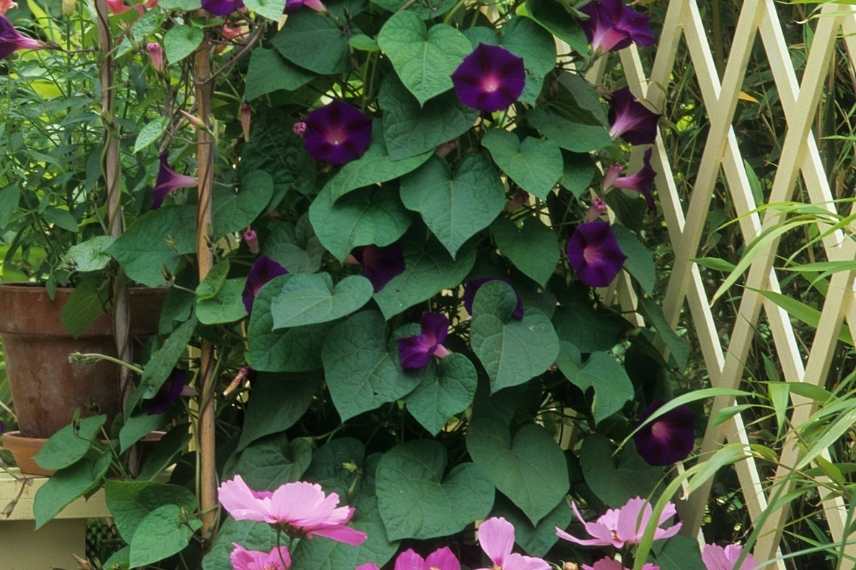
Morning glory is grown as a climbing plant or a creeping plant
Ipomoea, a plant of a family renowned for its vigour
Term “ipomoea” actually covers several hundred plant species belonging to genus Ipomoea, family Convolvulaceae. Widespread in tropical and subtropical regions, these herbaceous plants can be annual or perennial in areas with mild winters, and climbing or creeping. Among best-known garden species are Ipomoea purpurea, Ipomoea tricolor, Ipomoea lobata or Ipomoea indica or learii, the latter being particularly feared for invasive habit.
Convolvulaceae also include other plants known for vigour and ability to colonise space rapidly, to point of becoming undesirable in some contexts. This is notably case of field bindweed (Convolvulus arvensis), an adventive well known to gardeners, very difficult to eradicate once established because of long running roots. This perennial plant twines around crops and ornamental perennial plants, slowing growth and making weeding laborious. Its cousin, hedge bindweed (Calystegia sepium), behaves similarly.
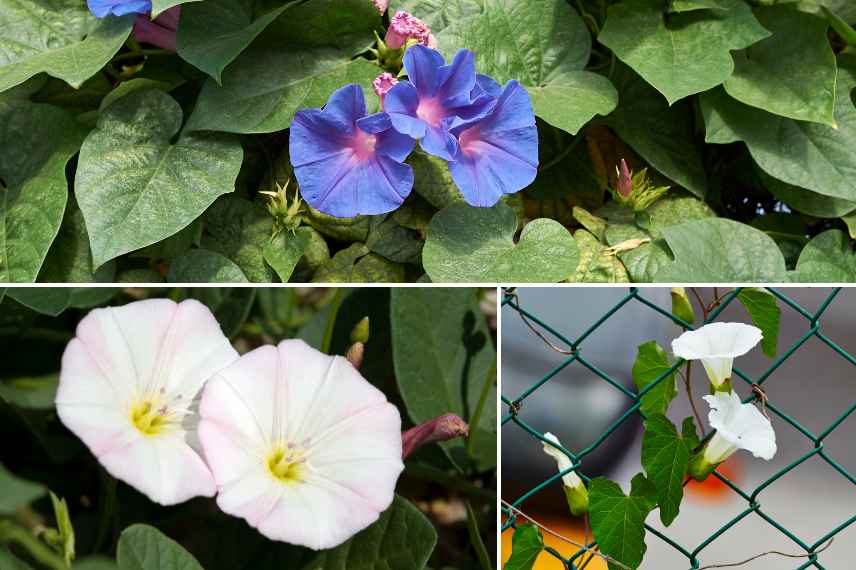
Three highly invasive Convolvulaceae species: clockwise from top, Indian morning glory (Ipomoea indica or learii), hedge bindweed and field bindweed.
As for Ipomoea batatas, better known as sweet potato, it is indeed part of genus Ipomoea, but displays very different behaviour from ornamental ipomoeas. This tuberous perennial plant, generally grown as annual in our latitudes due to frost sensitivity and rapid growth, is not considered invasive. Indeed, it is frost-tender, does not self-seed and multiplies by tubers.
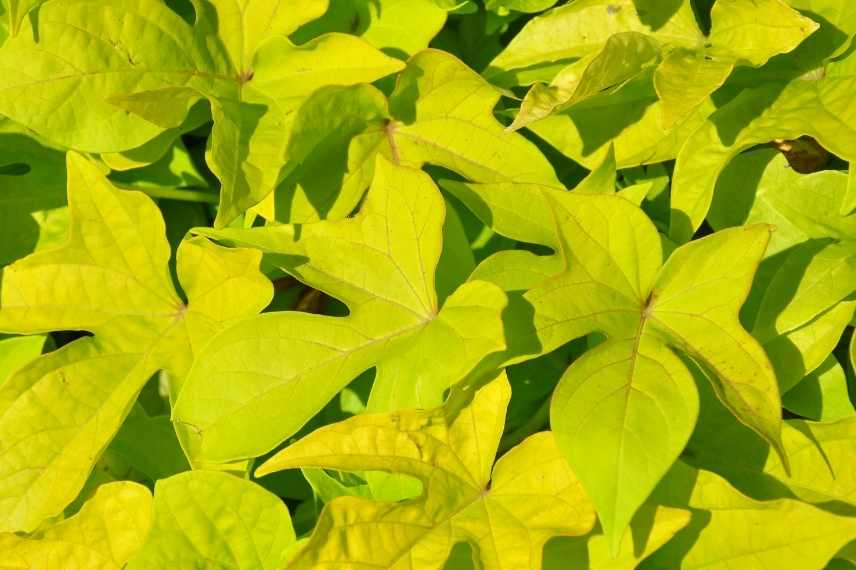
Ipomoea batatas does not display same invasive behaviour
Why can Ipomoea become invasive?
The vigour that gives Ipomoea its charm can also become a nuisance in the garden. Its twining stems coil around any available support: wire mesh, stakes, shrubs, even neighbouring plants. When it thrives, it can smother less vigorous plants or hinder their development by shading them.
Some species are particularly persistent. This is the case of Ipomoea indica, native to South America and capable of multiplying by natural layering, by rooting its stems where they touch the soil. In mild climates, although considered an annual, it remains in growth all year round and can quickly form a dense carpet that is hard to remove. It can also escape gardens to colonise natural habitats, notably fallow land, embankments and hedgerows, impacting local biodiversity. Its vigorous rooting makes it difficult to dislodge once established.
Other species, such as Ipomoea purpurea and Ipomoea tricolor, are less problematic in temperate climates because they do not survive frost. However, they self-seed abundantly if their capsules are allowed to ripen, and can reappear in large numbers the following year, sometimes well beyond the areas originally sown.
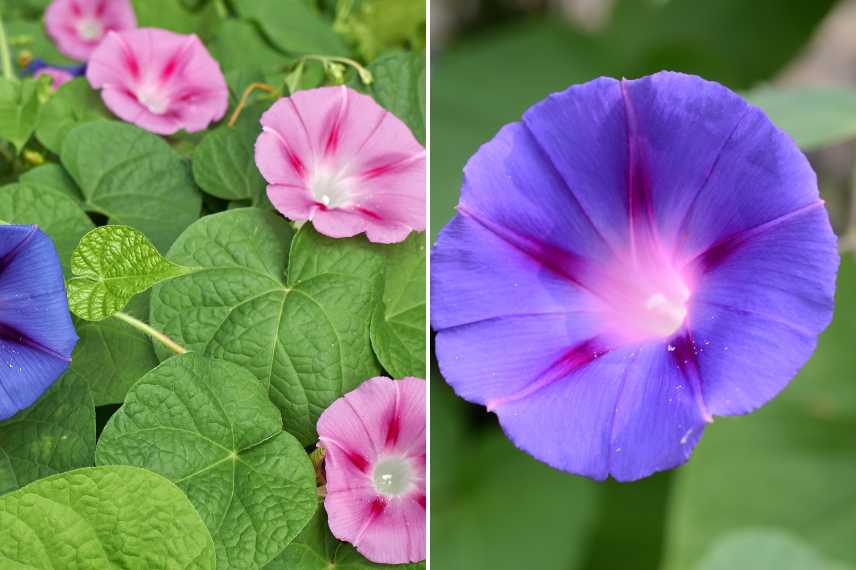
Ipomoea purpurea and tricolor are significantly less invasive
What precautions should be taken to prevent proliferation?
It is perfectly possible to enjoy the beauty of morning glories without letting them take over, provided a few simple cultivation rules are followed.
First, it’s better to choose less invasive species, such as Ipomoea purpurea, which has a limited lifespan, or sterile horticultural varieties that produce few or no seeds.
Growing them in pots is also a good solution to limit their root expansion. Planting them in large containers or tubs prevents them taking over borders or garden soil. It also makes their development easier to control and allows simple removal if necessary.
It is also advisable to cut off faded flowers before seeds form, especially at season end. This tidy-up prevents self-seeding and limits unwanted spread.
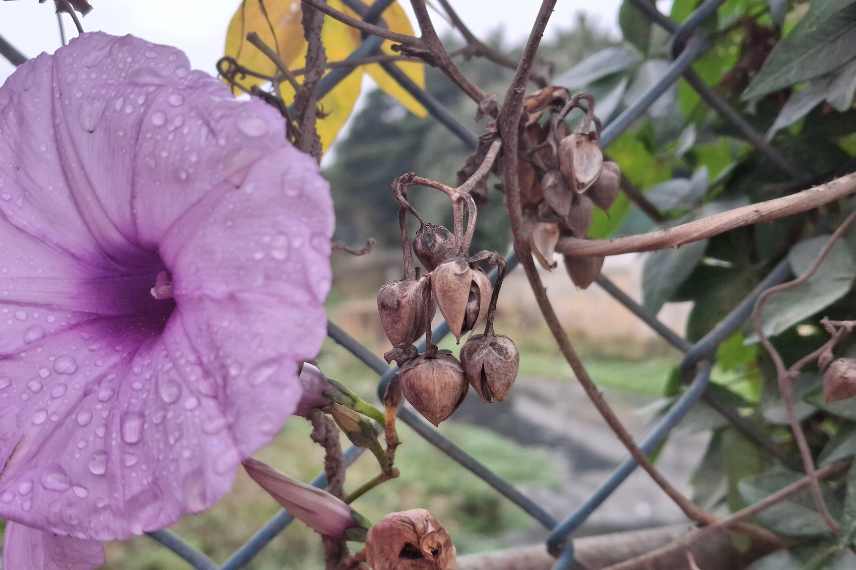
Spent flowers of morning glories should be cut off before seeds form.
Finally, it is recommended to check surrounding areas regularly: any layered stem or unwanted seedling should be removed quickly while the plant is still young and easy to eliminate.
What to do if morning glory has already colonised the garden?
If an ipomoea has become too vigorous, escaped your control and started to colonise an area of the garden, the best strategy remains systematic hand-pulling, to be repeated several times during the season. Make sure to remove roots or rooted stems thoroughly, as these can give rise to new shoots.
In some cases, covering the soil with heavy-duty sheeting for several weeks can help weaken underground parts. Chemical treatments should be avoided, not only because they do not always guarantee complete eradication but also because they damage soil balance.
Be persistent: a well-established ipomoea can take two to three seasons to disappear completely, especially if it spreads by layering. Regular monitoring remains essential, even after large-scale removal.
The word from our expert
To reap laurels"... Naturally, this expression refers to achieving victories. But it is indeed the bay laurel (Laurus nobilis) that we are talking about. Indeed, this evergreen bush, with its glossy dark green leaves, is the symbol of victory among the Greeks and Romans. Were not the heads of the winners of the Pythian Games at Delphi crowned with a wreath of bay laurel leaves? Beyond its symbolism, often associated with glory, success, and even immortality, the bay laurel is a bush from the Lauraceae family, highly prized by gardeners. It is, in fact, a bush of rare elegance, thanks to its glossy, undulate-edged foliage and its conical silhouette, which makes a striking impression along sunny façades or even as a hedge. When crushed, these leaves also release a very distinctive fragrance. This is why they flavour many dishes, especially since, when dried, they retain their aromatic properties. They can be harvested throughout the year, as needed. But this foliage also has medicinal and repellent properties. [caption id="attachment_227802" align="aligncenter" width="1172"]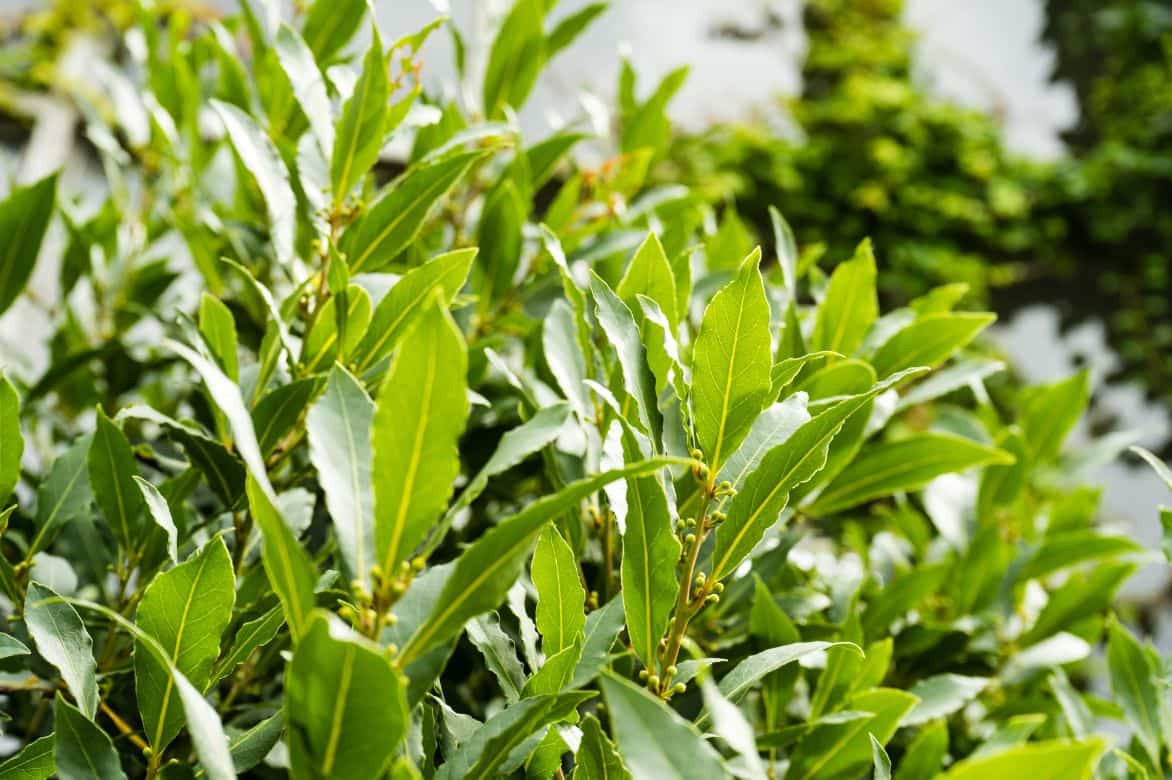 The bay laurel (Laurus nobilis)[/caption]
In spring, the bay laurel displays creamy white to yellow flowers, clustered in axillary bouquets. On female plants (the bay laurel is a dioecious variety of bush), ovoid black drupes follow. These are a delight for garden birds in autumn and winter.
This very graceful bush is highly resistant to drought and sea spray. However, its hardiness officially does not exceed -12°C. That said, when well-established in a sheltered spot, it can withstand lower temperatures. Even if touched by frost, the bay laurel quickly regrows from the base. Very resistant to pruning, it is well-suited for creating windbreak hedges in Mediterranean or Atlantic coastal regions, or even for topiary art. It can even serve as an interesting alternative to boxwood.
The bay laurel (Laurus nobilis)[/caption]
In spring, the bay laurel displays creamy white to yellow flowers, clustered in axillary bouquets. On female plants (the bay laurel is a dioecious variety of bush), ovoid black drupes follow. These are a delight for garden birds in autumn and winter.
This very graceful bush is highly resistant to drought and sea spray. However, its hardiness officially does not exceed -12°C. That said, when well-established in a sheltered spot, it can withstand lower temperatures. Even if touched by frost, the bay laurel quickly regrows from the base. Very resistant to pruning, it is well-suited for creating windbreak hedges in Mediterranean or Atlantic coastal regions, or even for topiary art. It can even serve as an interesting alternative to boxwood.
- Subscribe!
- Contents
This form is protected by reCAPTCHA - the Google Privacy Policy and Terms of Service apply.

































Comments