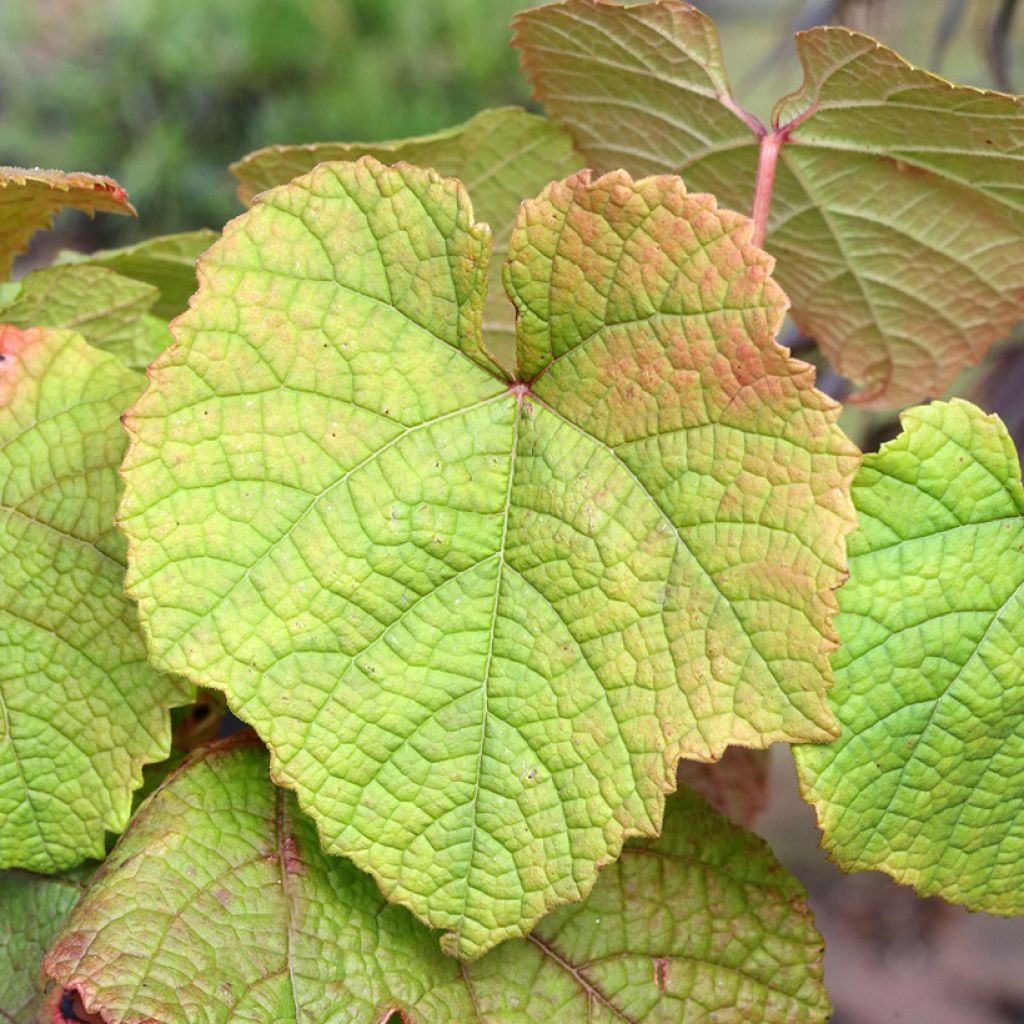
Vitis riparia
Vitis riparia
Vitis riparia
Riverbank Grape, Frost Grape
Back-to-school special offer!
Get €10 off for every €50 you spend! And get up to €40 off on a single order.
How does it work?
1. Shop your favourites
Add your favourite plants to your basket. For every €50 you spend (excluding delivery charges, store credit and the plastic-free option), you’ll receive a €10 voucher.
€50 spent = €10 voucher
€100 spent = €20 voucher
€150 spent = €30 voucher
€200 spent = €40 voucher
2. Place your order
Once your basket reaches one of the spending thresholds, place your order. You can even choose your delivery date!
3. Receive your voucher
As soon as your order has been shipped, you’ll receive an email containing your personal voucher code and its value.
4. Use it on your next order
Your voucher is valid for 90 days from the date you receive it. It can be used once only, on a new order worth at least the value of the voucher, excluding delivery charges.
Please note: Vouchers can be combined with other offers, but cannot be split or refunded.
Home or relay delivery (depending on size and destination)
Important: You may be charged customs duties by your country’s customs authorities upon delivery.
Schedule delivery date,
and select date in basket
This plant carries a 12 months recovery warranty
More information
We guarantee the quality of our plants for a full growing cycle, and will replace at our expense any plant that fails to recover under normal climatic and planting conditions.
Does this plant fit my garden?
Set up your Plantfit profile →
Description
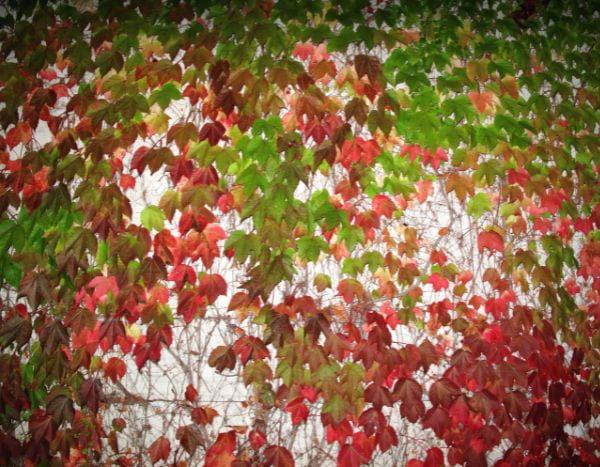
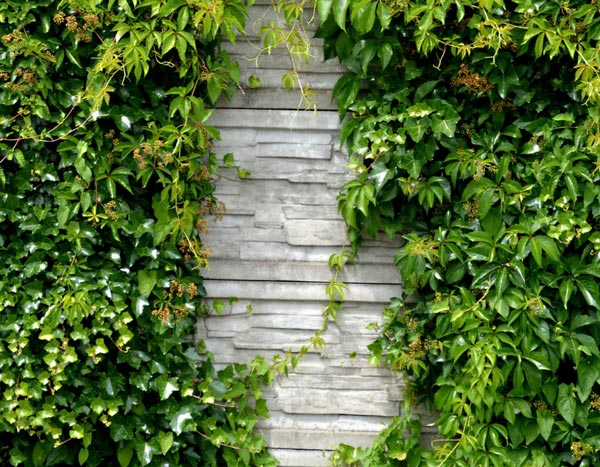
Vitis riparia (synonyms V. odoratissima, V. vulpina or V. cordifolia), commonly known as frost grape or riverbank grape, is a beautiful wild vine native to North America, introduced to France as a rootstock for its resistance to phylloxera, a formidable parasite that decimated the French vineyard in the 19th century. It is also used as an ornamental climbing plant because it produces a sour black grape of poor taste. In early summer, its cream-white flowering, in vaporous clusters, is both melliferous and pleasantly fragrant. Its grapes ripen in September, somewhat softened by the autumn frost, and are used to make jellies in North America. It is appreciated for its hardiness, its charm as a wild plant, and its beautiful autumn colours. Very hardy and not demanding in terms of soil, it thrives in the sun and prefers loamy, fertile soils.
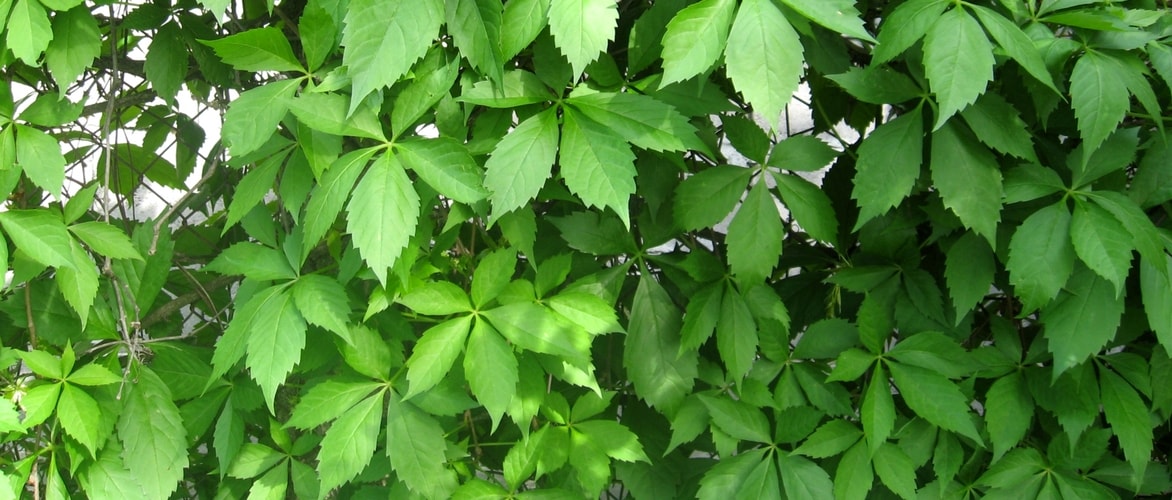
Riverbank grape belongs to the vitaceae family. Native to eastern North America, it grows spontaneously from southern Canada to Oklahoma and Arkansas. It has naturalised in the Mediterranean region where it hybridizes with wild grape (Vitis vinifera subsp. sylvestris). Many hybrids have been created to vary u, flavours, and uses. Frost grape is a vigorous, fast-growing sarmentous shrub, capable of living for many years in the garden. This fast-growing plant can send its stems up to 18-20 metres (59-66 feet) depending on growing conditions. It spreads both by its seeds, dispersed by birds, and by producing shoots. Its final shape will depend on the pruning practiced. The vine attaches itself to its support (trellis, espalier, etc.) thanks to its tendrils and prefers sunny locations. The foliage of Vitis riparia is deciduous, appearing in spring and falling in autumn. The heart-shaped leaves, 7 to 15 cm (3 to 6in) long, have toothed edges. They sometimes have 3 slightly marked lobes. The lamina is medium green, turning orange to red tones in autumn. This species is dioecious: there are male and female plants. Only the females produce fruits. Flowering occurs in June, often as early as May in mild climates. Panicles of 5 to 15 cm (2 to 6in) long, composed of numerous tiny cream-coloured flowers with a sweet fragrance, form at the leaf axils. After pollination, grapes form in small clusters, more or less tightly packed together. These round grapes, 9 mm (<1in) in diameter, start off green and ripen in September-October, earlier in the south than in tnorthern or central regions. They are blackish-blue when ripe, with thick and powdery skin. The pulp is very acidic and contains seeds. Any other vine that flowers at the same time can pollinate it.
Resistant to mildew and phylloxera, this vine avoids repeated treatments and promotes biodiversity in the garden. It is indifferent to soil types but thrives in deep, loamy, and fertile soils. Riverbank grape climbs willingly on any available support: it covers fences, climbs over walls, reaches into trees, and quickly adorns facades, arbors, and pergolas. It pairs well with Virginia creeper, large mountain clematis, or wisterias.
The grapes of this vine can be eaten as table fruit after being exposed to frost, but they can also be used for jam, jelly, pastries, and wine. The frost grape provides food for bees and birds that nest in its vegetation, as well as for the red fox, which does not disdain the fallen grapes on the ground.

Vitis riparia in pictures
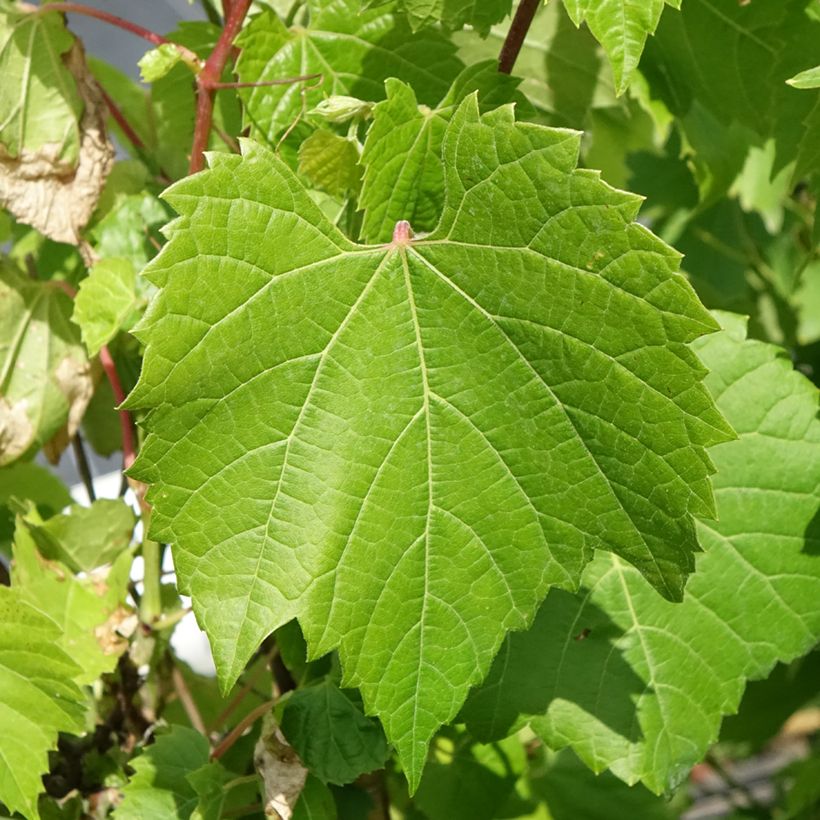
Plant habit
Flowering
Foliage
Botanical data
Vitis
riparia
Vitaceae
Riverbank Grape, Frost Grape
North America
Planting and care
The Vitis riparia should be planted in early spring or autumn. This plant is not very demanding in terms of soil, although it prefers loamy, rich, and slightly moist soils. Plant it in a slightly acidic, neutral, or even limestone soil, deep, loose, rather moist, which you will have enriched with an organic fertiliser. Choose a semi-shaded or sunny exposure, the autumn colour will be more intense in full sun and the fruits less acidic. It can withstand temperatures as low as -25°C (-13°F) and moderate periods of summer drought once it is well rooted. Prune it in February by cutting it back quite severely. You can train it to support and guide the branches. This vine can spread by layering or by producing suckers in favorable conditions. And birds, which are fond of its grapes, can scatter it in the garden, at the foot of hedges or perching trees.
Planting period
Intended location
Care
Planting & care advice
-
-

-

-
-
-
-
-
This item has not been reviewed yet - be the first to leave a review about it.
Recently viewed products
Haven't found what you were looking for?
Hardiness is the lowest winter temperature a plant can endure without suffering serious damage or even dying. However, hardiness is affected by location (a sheltered area, such as a patio), protection (winter cover) and soil type (hardiness is improved by well-drained soil).
In temperate climates, pruning of spring-flowering shrubs (forsythia, spireas, etc.) should be done just after flowering.
Pruning of summer-flowering shrubs (Indian Lilac, Perovskia, etc.) can be done in winter or spring.
In cold regions as well as with frost-sensitive plants, avoid pruning too early when severe frosts may still occur.
The harvesting period indicated on our website applies to countries and regions in USDA zone 8 (France, England, Ireland, the Netherlands).
In colder areas (Scandinavia, Poland, Austria...) fruit and vegetable harvests are likely to be delayed by 3-4 weeks.
In warmer areas (Italy, Spain, Greece, etc.), harvesting will probably take place earlier, depending on weather conditions.
The sowing periods indicated on our website apply to countries and regions within USDA Zone 8 (France, UK, Ireland, Netherlands).
In colder areas (Scandinavia, Poland, Austria...), delay any outdoor sowing by 3-4 weeks, or sow under glass.
In warmer climes (Italy, Spain, Greece, etc.), bring outdoor sowing forward by a few weeks.
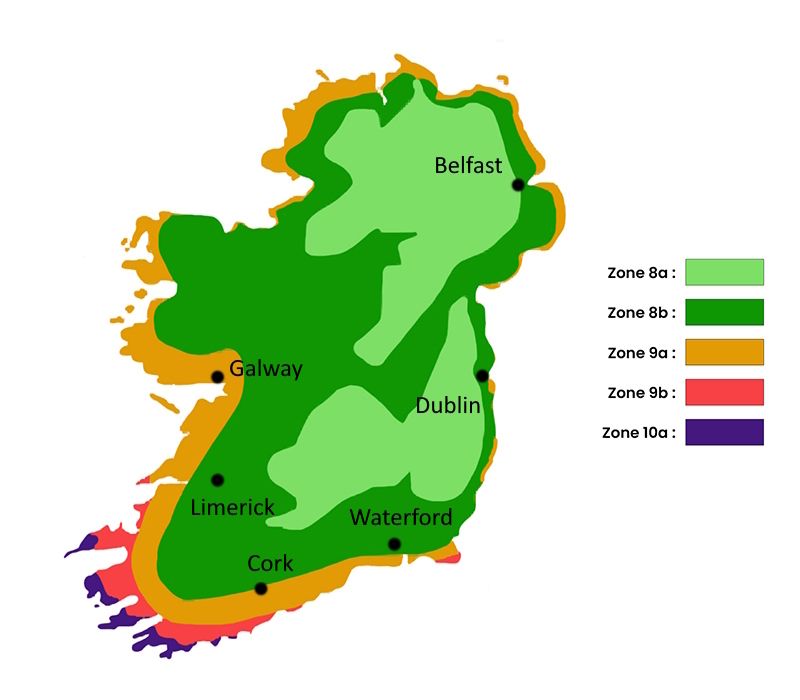
The planting period indicated on our website applies to regions in USDA Zone 9a (East Coast and Midlands: Dublin, Wexford, Waterford, Kilkenny, Portlaoise). It will vary depending on where you live:
- On the west coast and in the north-west (Galway, Limerick, Sligo, Donegal, Westport), delay planting by 1 to 2 weeks in spring and bring it forward by 1 to 2 weeks in autumn compared to the dates given, preferably choosing periods without strong winds.
- In the inland hills and plateaus (Wicklow Mountains, Macgillycuddy’s Reeks, Connemara, Killarney), it is best to plant in spring (April–May) or autumn (September–October), avoiding periods of waterlogged soil in winter and strong winds, which pose the main risk to newly planted trees in these areas.
The flowering period indicated on our website applies to regions in USDA Zone 9a, such as the East Coast and Midlands, including Dublin, Wexford, Waterford, Kilkenny and Portlaoise.
This will vary depending on where you live:
- On the west coast and in the northwest (Galway, Limerick, Sligo, Donegal and Westport), it will be delayed by one to two weeks compared to the given dates, due to stronger Atlantic winds and less spring sunshine.
- In the inland hills and plateaus (the Wicklow Mountains, the Macgillycuddy's Reeks, Connemara and Killarney), flowering will be delayed by two to three weeks. Flowering mainly occurs between May and July, with the limiting factors being less frost and more of the excessive humidity, strong winds and lack of sunshine that are characteristic of these areas.
Shipping country and language
Your country of residence may be:
Your country of residence is:
For a better user experience on our website, you can select:
Your shipping country:
-
 Austria
-
 Belgium
-
 Bosnia & Herzegovina
-
 Bulgaria
-
 Croatia
-
 Cyprus
-
 Czechia
-
 Denmark
-
 Estonia
-
 Finland
-
 France
-
 Germany
-
 Greece
-
 Hungary
-
 Iceland
-
 Ireland
-
 Italy
Italy
-
 Latvia
-
 Liechtenstein
-
 Lithuania
-
 Luxembourg
-
 Malta
Malta
-
 Netherlands
-
 Poland
-
 Portugal
-
 Romania
-
 Serbia
-
 Slovakia
-
 Slovenia
-
 Spain
Spain
-
 Sweden
-
 Switzerland
Language:
-
French
-
 English
-
Spanish
-
Italian
-
German
-
Portuguese
-
Dutch
-
Finnish
My Account
Hello
My wish lists
My cart
Log in / Register
Existing customer?
This form is protected by reCAPTCHA - the Google Privacy Policy and Terms of Service apply.
New customer?
Create an account to track your orders, access our customer service and, if you wish, make the most of our upcoming offers.