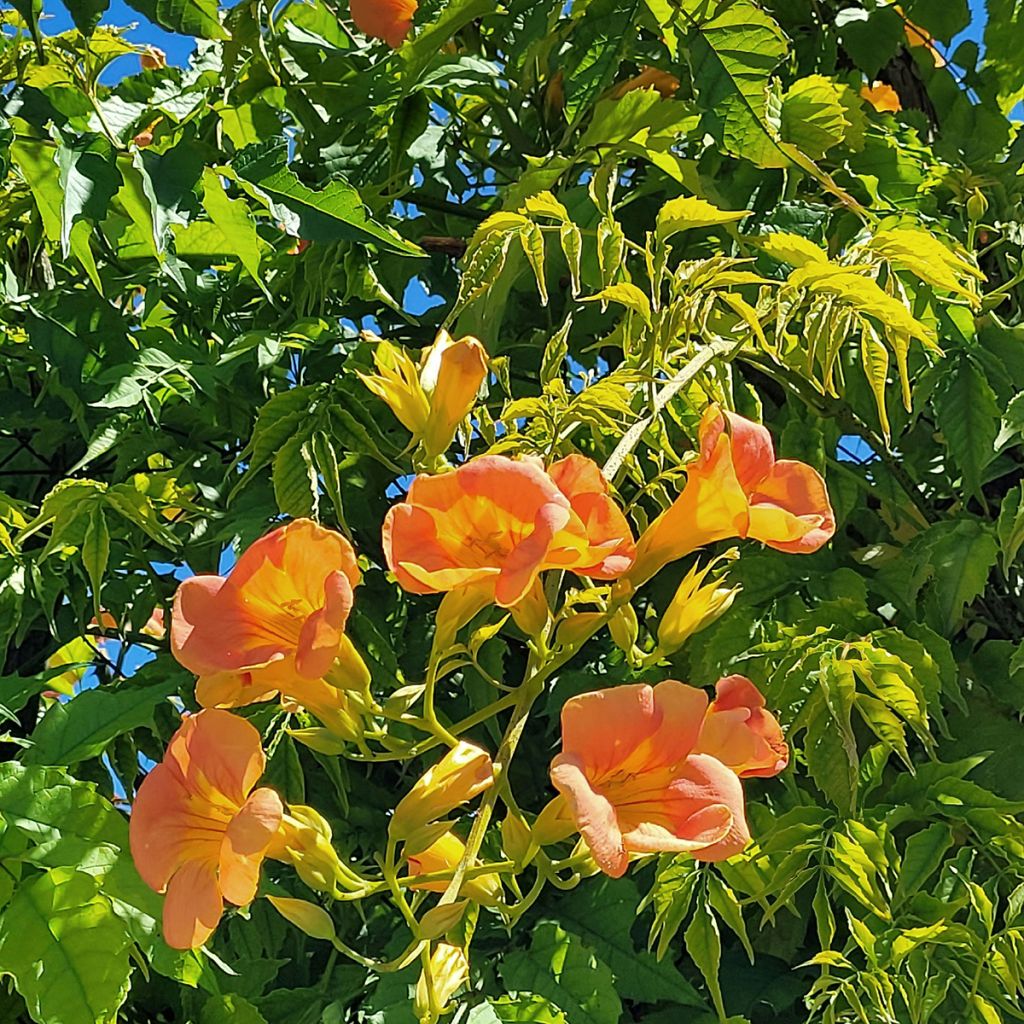
Campsis x tagliabuana Summer Jazz Gold
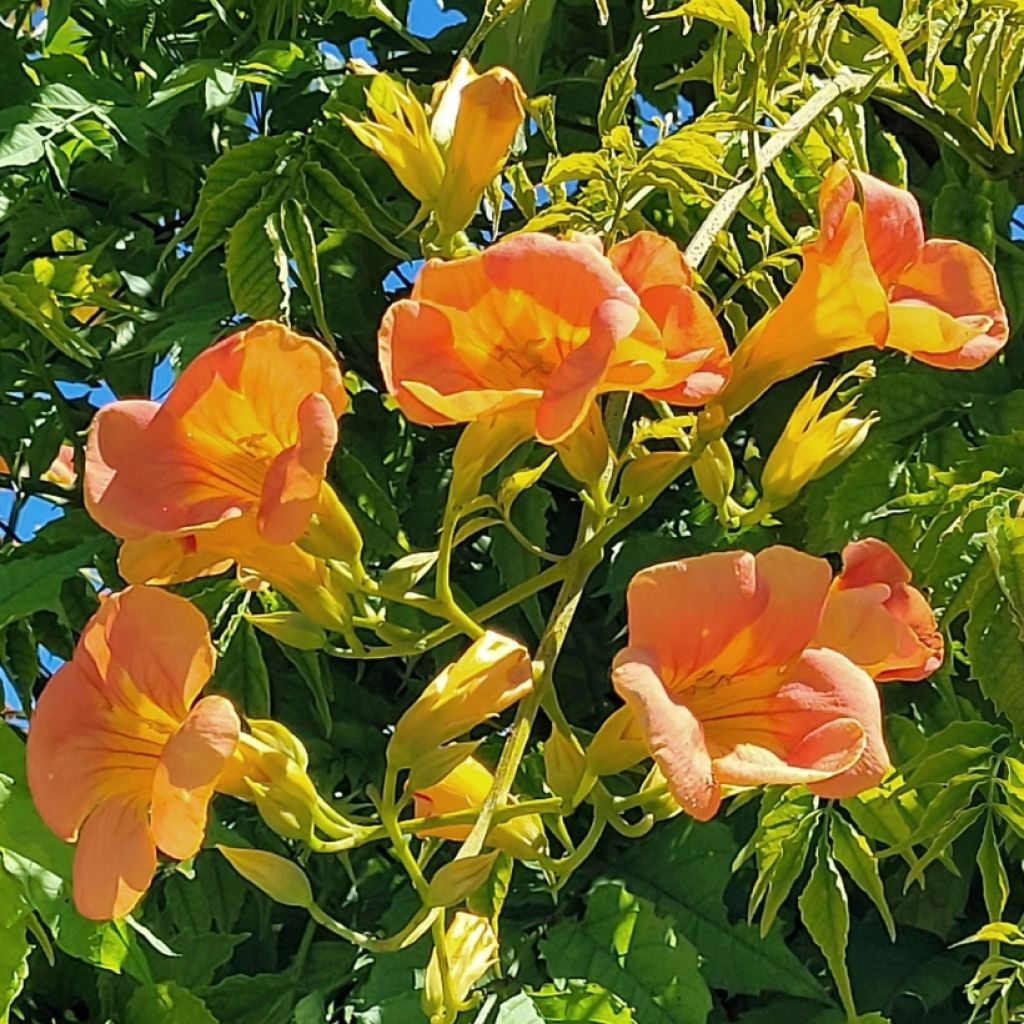
Campsis x tagliabuana Summer Jazz Gold
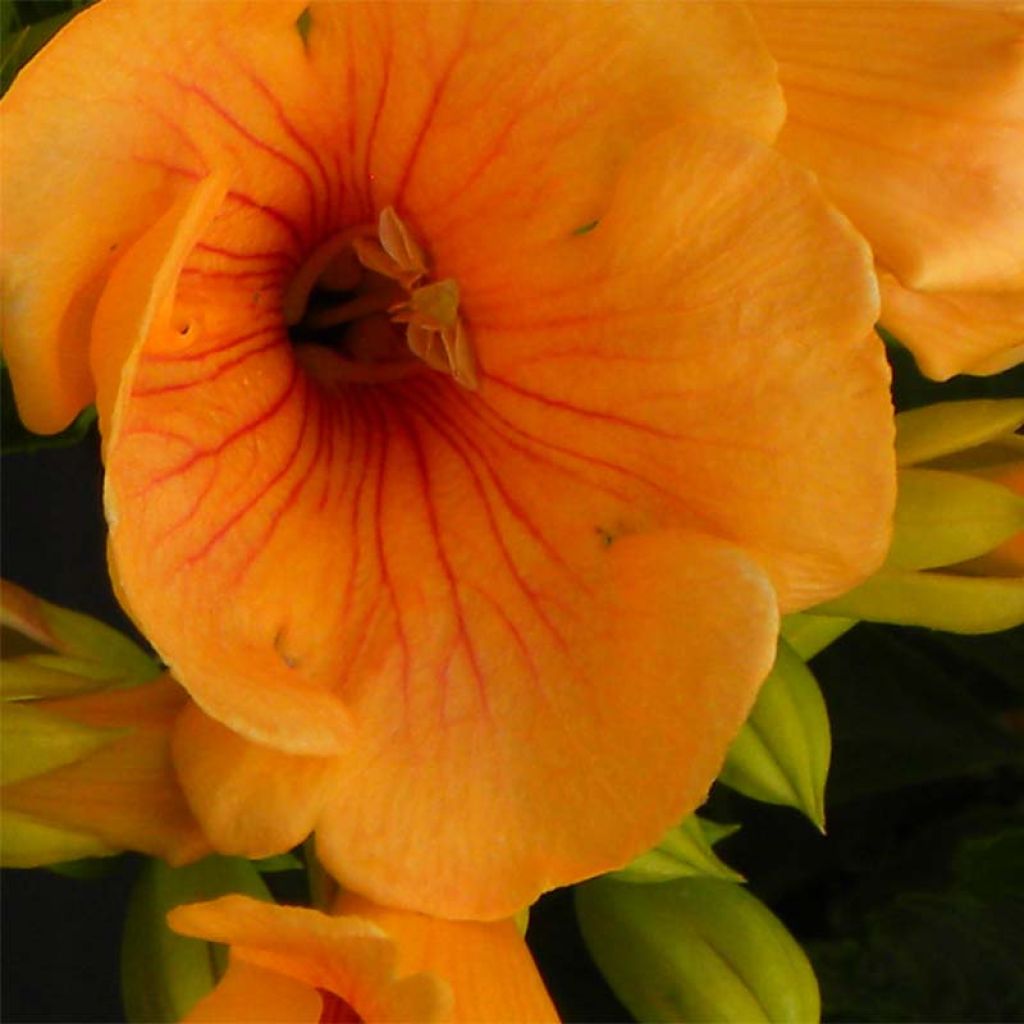
Campsis x tagliabuana Summer Jazz Gold
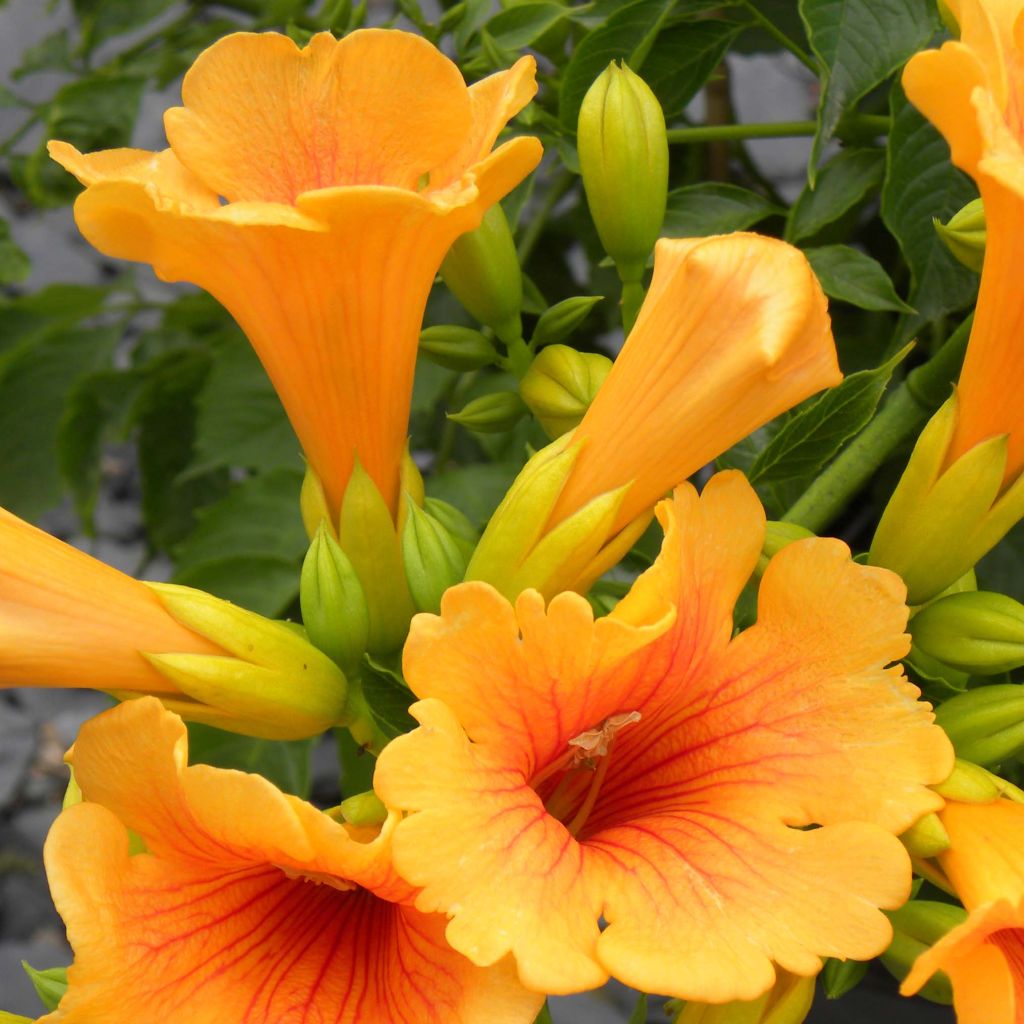
Campsis x tagliabuana Summer Jazz Gold
Campsis x tagliabuana Summer Jazz Gold
Campsis x tagliabuana Summer Jazz Gold
Campsis x tagliabuana Summer Jazz Gold
Campsis x tagliabuana Summer Jazz® Gold®
Trumpet Vine
A disaster. I received two completely dry stems, one of which was broken in half. Unsurprisingly, there's been no sign of them taking root for nearly three weeks now. But the customer service team isn't responding to my messages. Very disappointed with Promesse de fleurs on this one.
Barbara, 02/04/2026
Back-to-school special offer!
Get €10 off for every €50 you spend! And get up to €40 off on a single order.
How does it work?
1. Shop your favourites
Add your favourite plants to your basket. For every €50 you spend (excluding delivery charges, store credit and the plastic-free option), you’ll receive a €10 voucher.
€50 spent = €10 voucher
€100 spent = €20 voucher
€150 spent = €30 voucher
€200 spent = €40 voucher
2. Place your order
Once your basket reaches one of the spending thresholds, place your order. You can even choose your delivery date!
3. Receive your voucher
As soon as your order has been shipped, you’ll receive an email containing your personal voucher code and its value.
4. Use it on your next order
Your voucher is valid for 90 days from the date you receive it. It can be used once only, on a new order worth at least the value of the voucher, excluding delivery charges.
Please note: Vouchers can be combined with other offers, but cannot be split or refunded.
Home or relay delivery (depending on size and destination)
Important: You may be charged customs duties by your country’s customs authorities upon delivery.
Schedule delivery date
and select date in basket
This plant carries a 12 months recovery warranty
More information
We guarantee the quality of our plants for a full growing cycle, and will replace at our expense any plant that fails to recover under normal climatic and planting conditions.
Does this plant fit my garden?
Set up your Plantfit profile →
Description
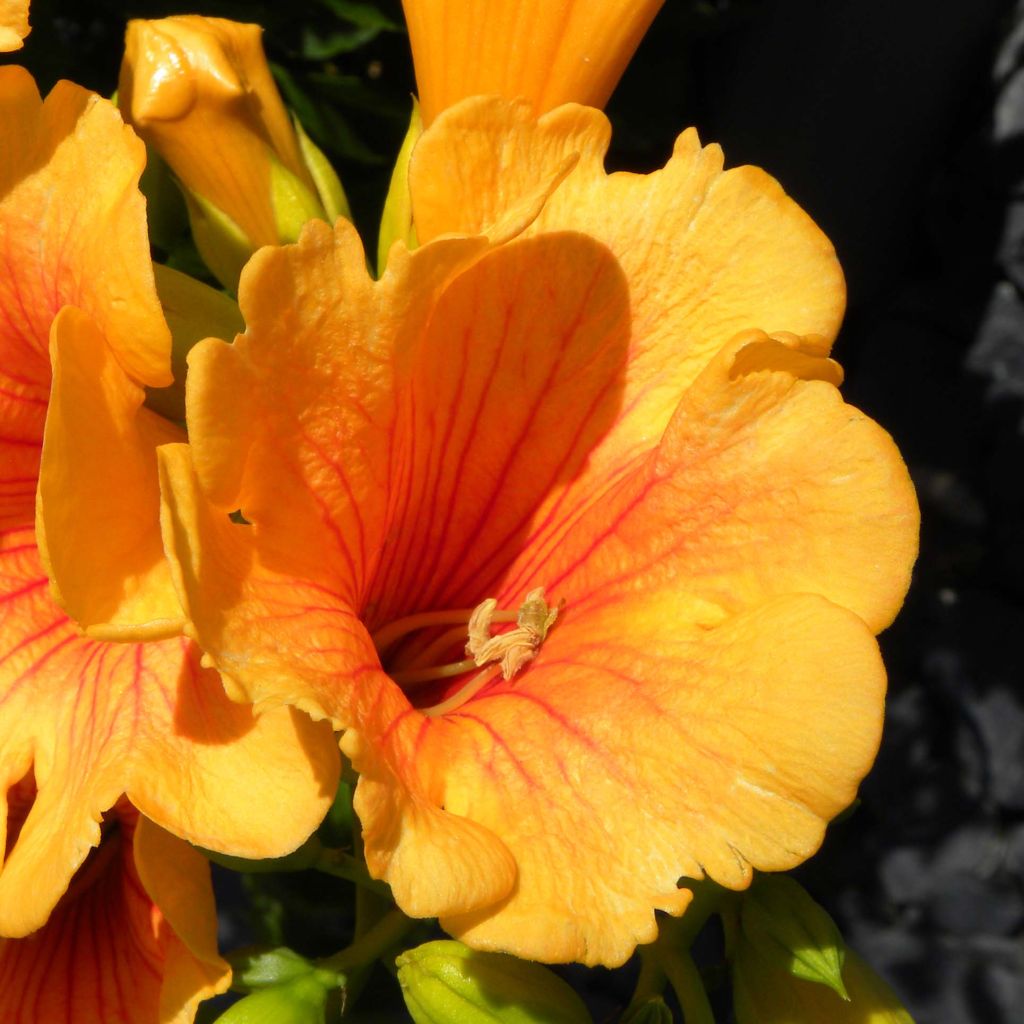
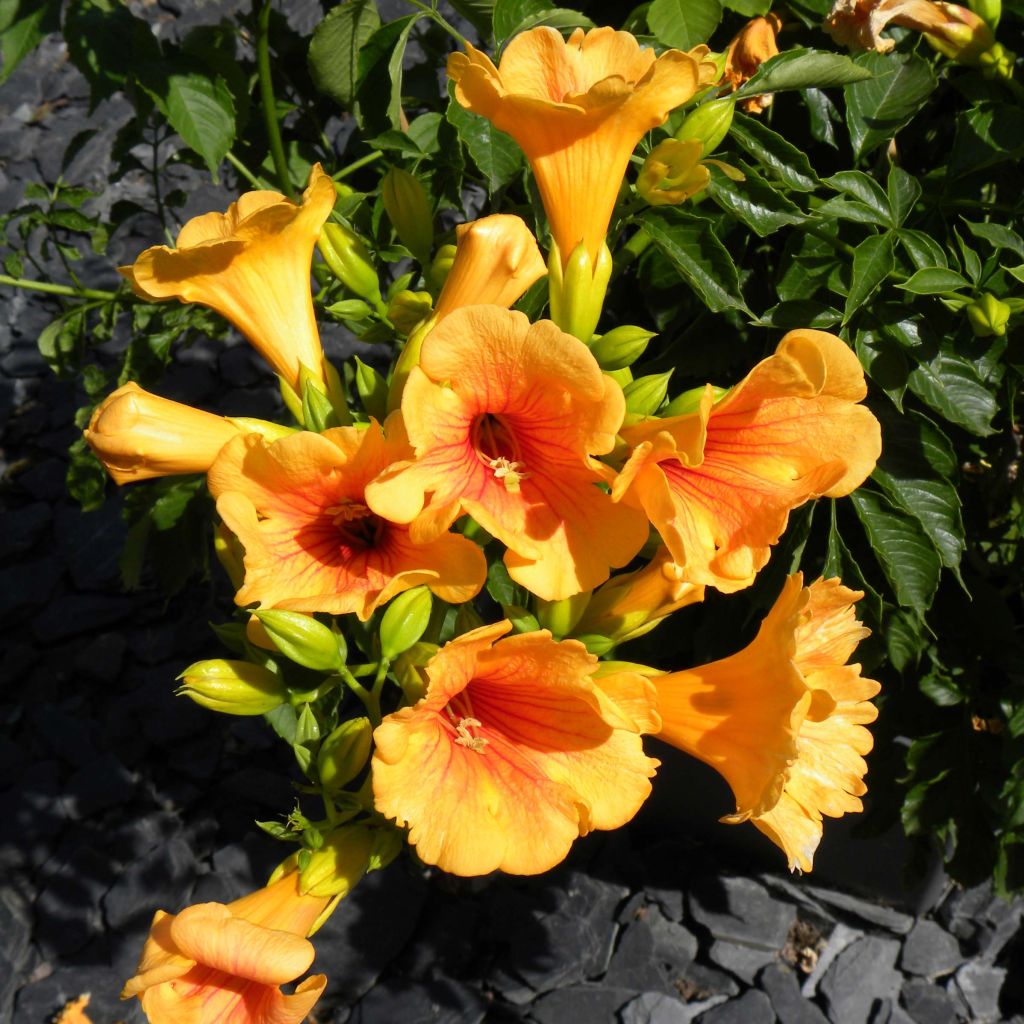
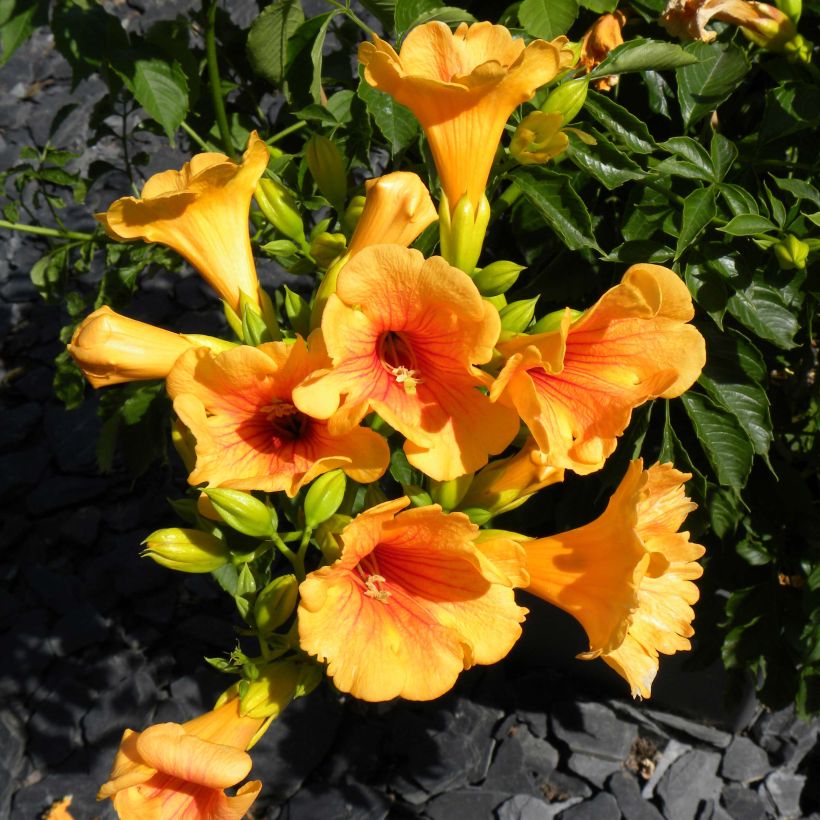
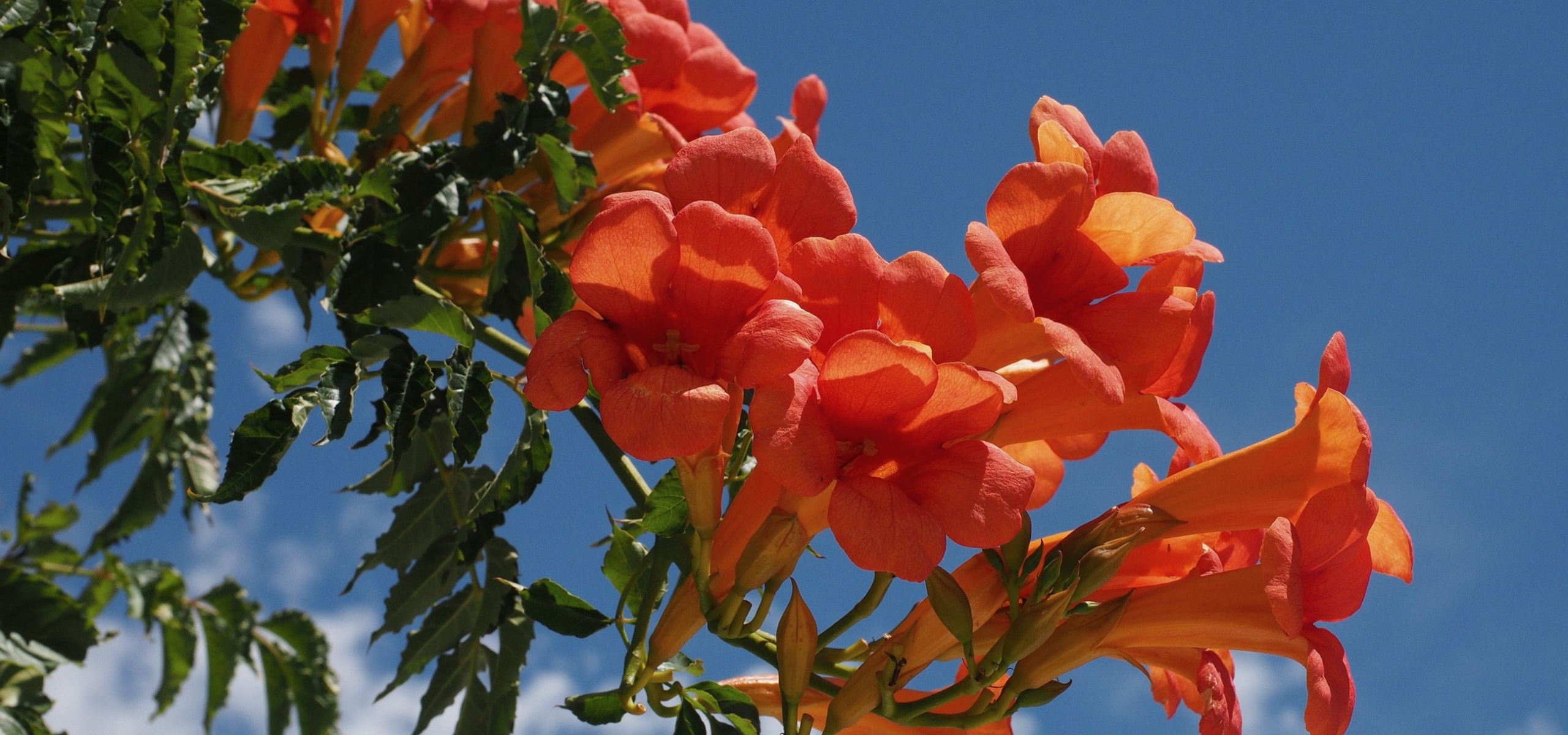
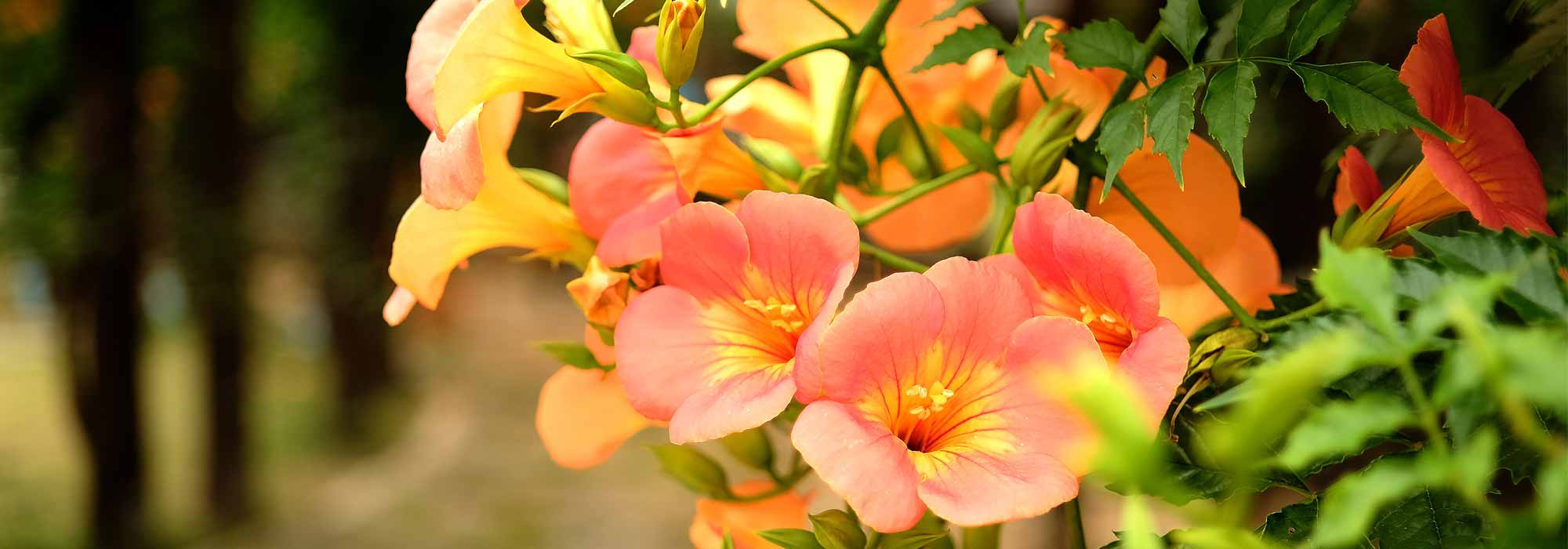
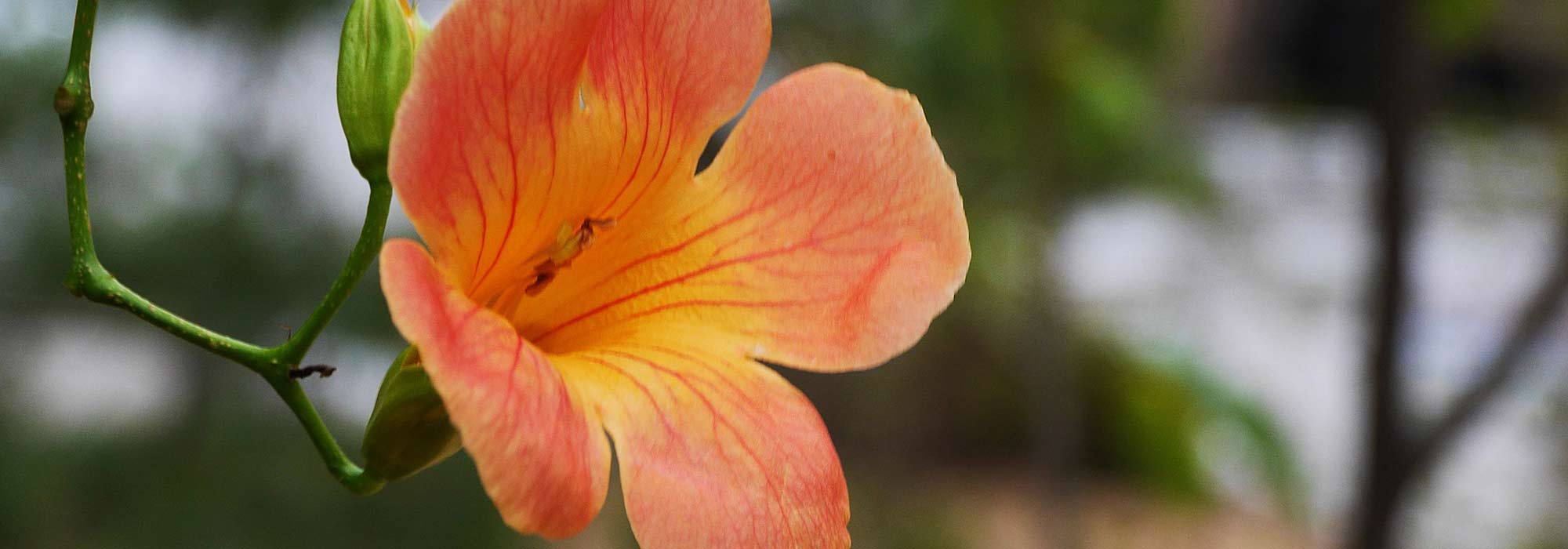
Campsis x tagliabuana Summer Jazz® Gold® is part of a series of hybrid Trumpet Vines selected for their very compact growth, perfectly suited for small spaces but also for container cultivation on sunny terraces and balconies. 'Gold', as its name suggests, offers large clusters of beautiful golden yellow trumpets, finely veined with blood orange at the throat, throughout the summer and almost along its entire height. Resolutely different, this yellow Trumpet Vine is also distinguished by its long, deeply cut leaves, a bright and light green that turns a beautiful golden hue in autumn before falling.
Campsis x tagliabuana is a plant from the Bignoniaceae family, resulting from the cross-breeding between Campsis radicans, native to the hot and dry regions of the southeastern United States, and Campsis grandiflora, native to China. Obtained around 1850 in the Tagliabue nursery near Milan, it possesses the excellent hardiness of its American parent and the strong tendrils and large spectacular flowers of its Asian ancestor.
The cultivar Summer Jazz Gold ('Takarazuka Yellow') belongs to the Summer Jazz Trumpet Vine series, developed in Japan in the city of Takarazuka during the years 2007-2008. The plants in this series, perfectly cold-resistant, are characterised by a very compact habit and a fairly exceptional flowering, which appears near the base of the plant and along almost its entire height.
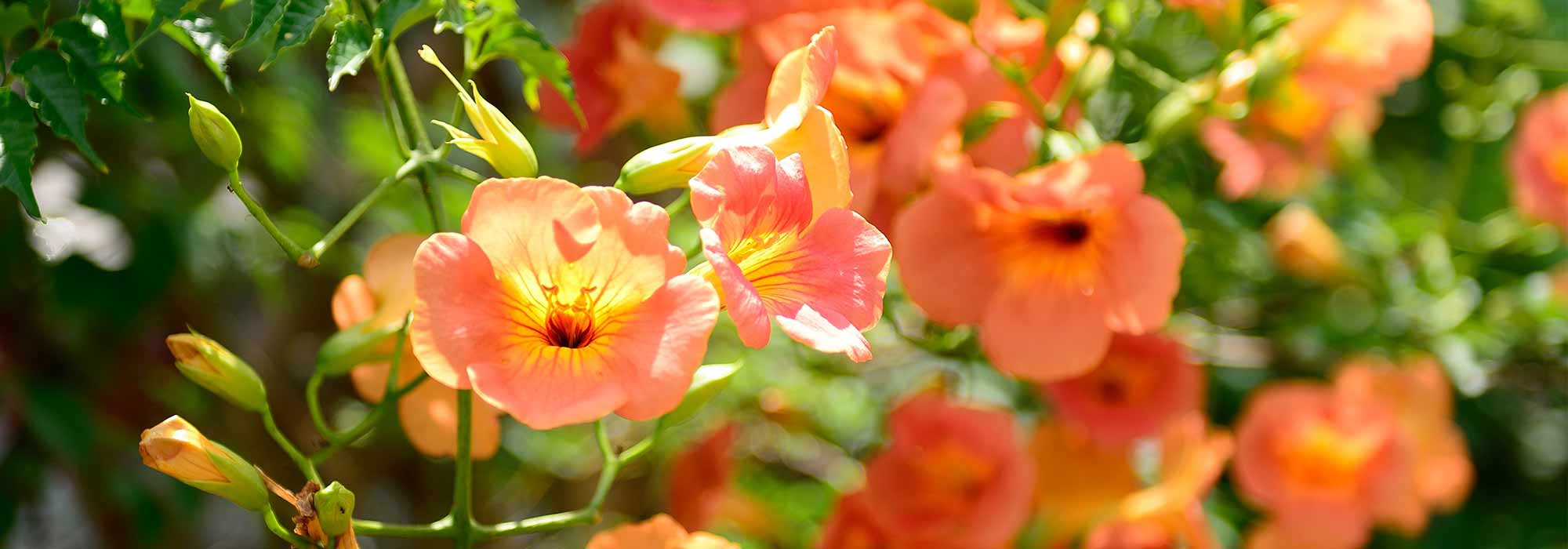
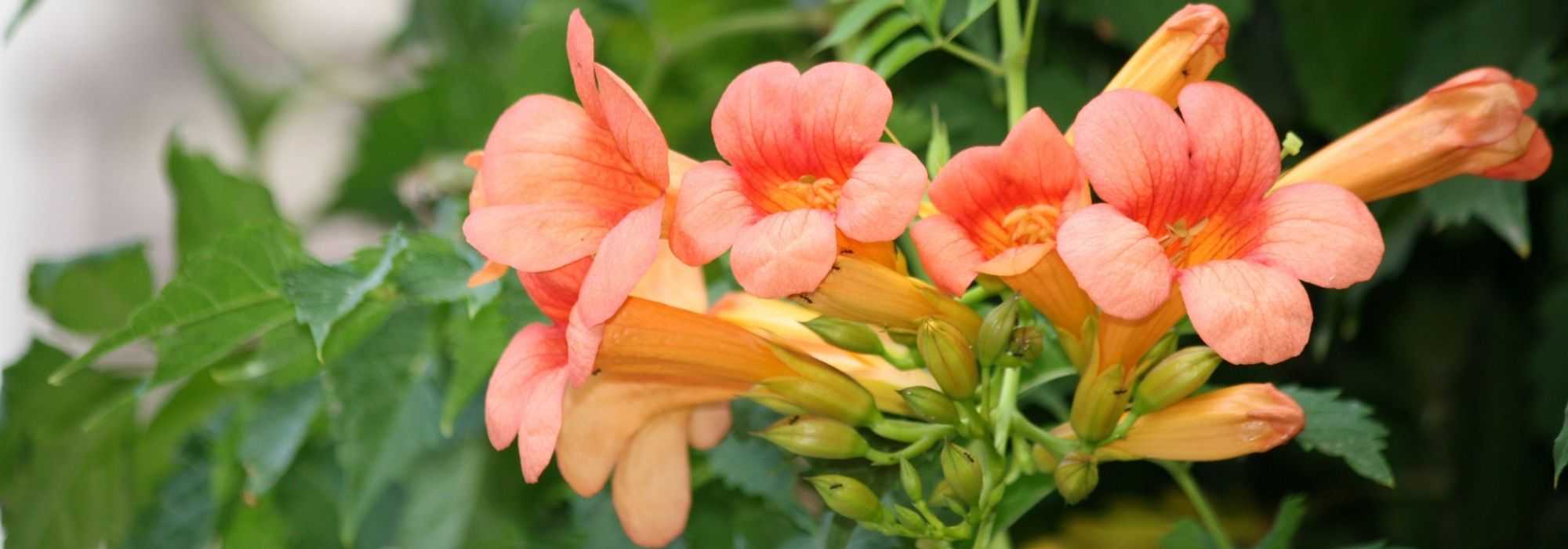
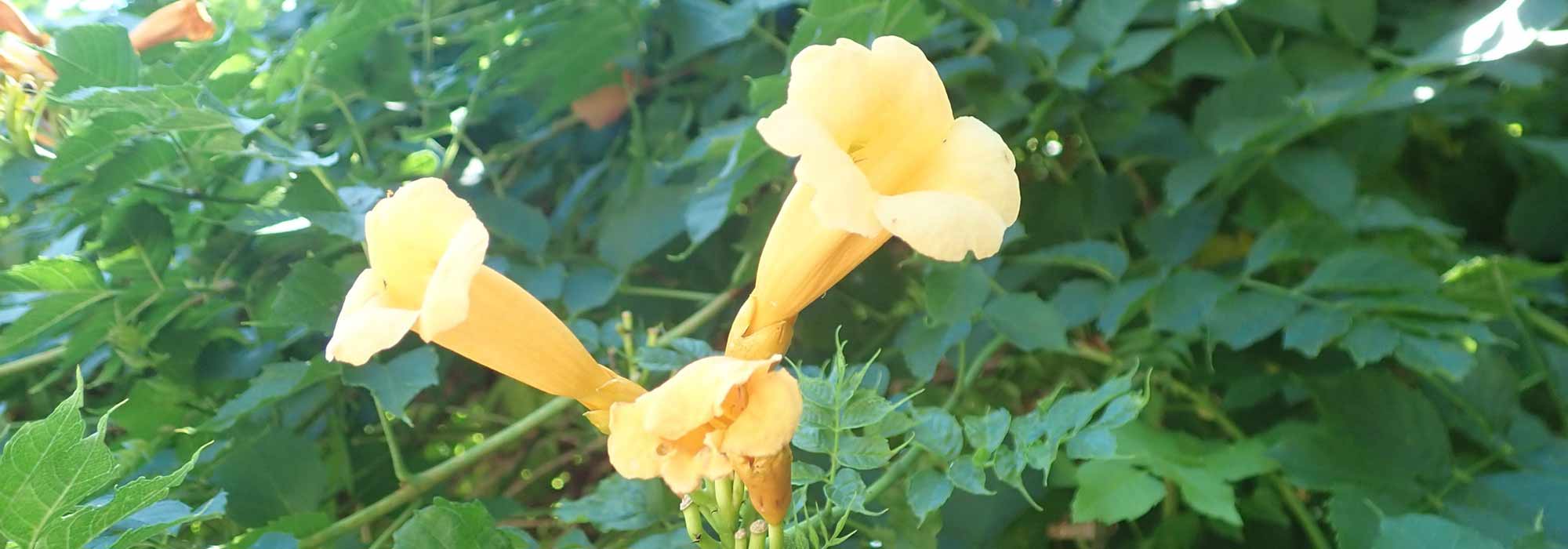
This small deciduous climber with fairly slow growth has a very bushy habit and will not exceed 3m (10ft) in all directions after many years. Its growth is also easily contained by regular pruning. The abundant and generous flowering of 'Summer Jazz Gold' occurs from the first years of cultivation. It starts in July in average climates, sometimes as early as June in mild climates, and continues until September. The flowers bloom in the axils of the leaves, in clusters measuring up to 30 cm (12in), sometimes with up to 60 trumpet-shaped flowers measuring 7 to 8 cm (3in) long. Each flower has a tube that opens into 5 lobes. Their colour evolves from bright yellow to a warmer golden yellow, shaded with apricot. The throat of the flower, more orange and traversed by fine veins of a reddish orange, is occupied by short arching stamens. The deciduous foliage, a fairly light green, is composed of large leaves reaching 30 to 40 cm (12 to 16in) in length, finely cut into 11 to 15 lanceolate leaflets with crenate edges. The autumn foliage, particularly bright in this Summer Jazz Gold variety, displays a beautiful golden yellow colour. It is its tendrils that allow the plant to cling to its support.
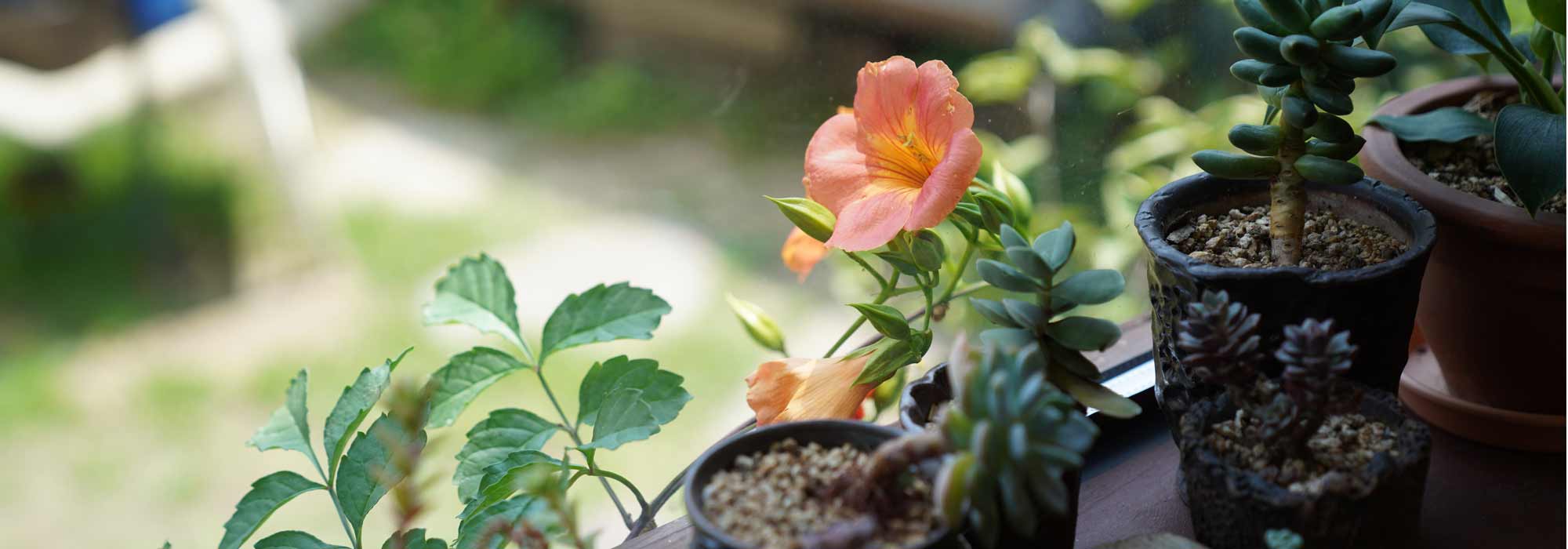
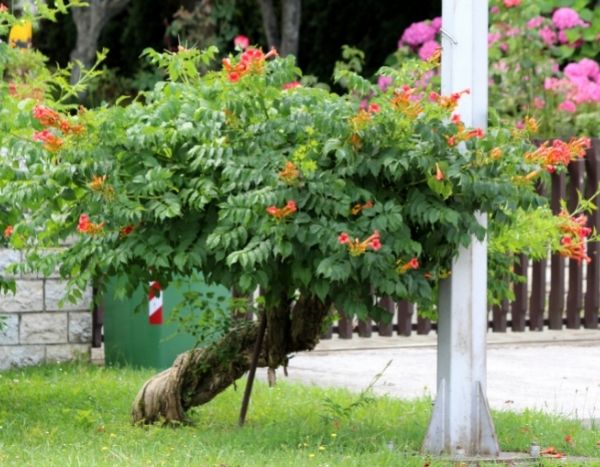
Campsis x tagliabuana 'Summer Jazz Gold' finds its place in all gardens, even the smallest ones, and confidently invites itself onto any sunny patio. Of modest stature, shaped by regular pruning, it will become an extraordinary bush in the middle of a flower bed, becoming the focal point of a small garden. It can be used everywhere, to dress up a wall sheltered from cold winds, an unsightly building, a fence, a pillar, or a gnarled small tree. Its tendrils take over this providential structure, covering its forms with a lush green mane brilliantly flowering for 3 months. Perennials or small bushes such as violet, blue, and fuchsia pink shrubby salvias, a Ceratostigma with small unreal blue flowers, daylilies, mauve and blue small-flowered asters, and variegated Euphorbia can be planted at its base. The spectacle is magical from July to September. For example, you can associate it with other climbing plants such as Sollya heterophylla, a sky blue annual morning glory (Heavenly Blue), or the Clematis H F Young, a very blue variety, to create a colourful scene.
Campsis x tagliabuana Summer Jazz Gold in pictures
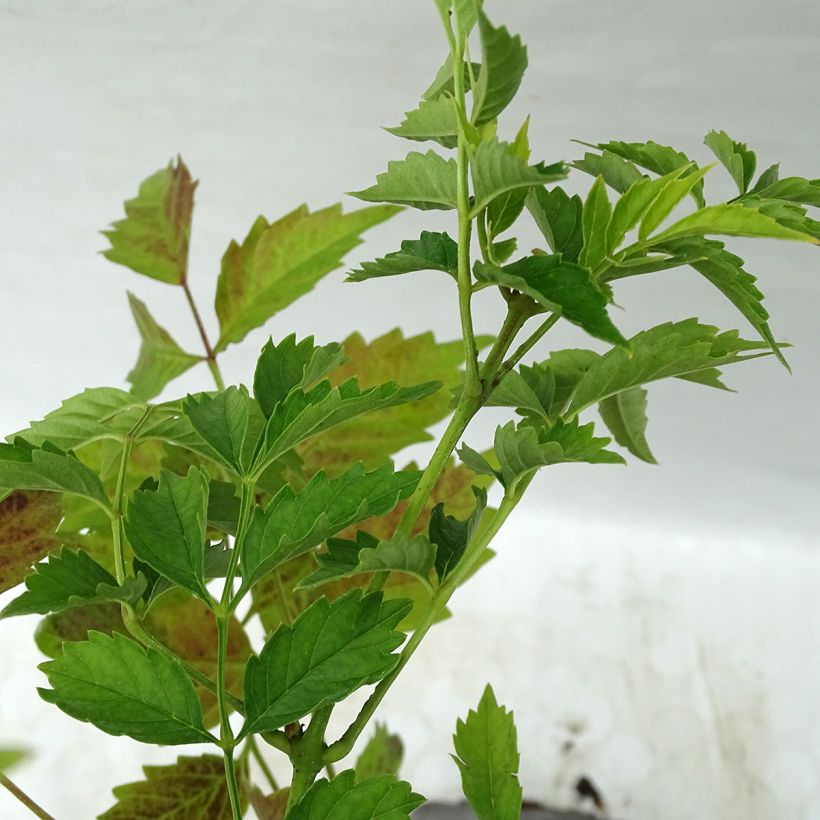
Plant habit
Flowering
Foliage
Botanical data
Campsis
x tagliabuana
Summer Jazz® Gold®
Bignoniaceae
Trumpet Vine
Cultivar or hybrid
Planting and care
The Summer Jazz Gold trumpet vine is a plant that is undemanding in terms of soil type, but it dislikes heavy, compact, poorly-drained soils where moisture can stagnate. If the soil in your garden is too heavy, incorporate coarse sand or gravel before planting. It can grow in any well-drained garden soil, even if it is quite poor and slightly chalky. It prefers a sunny position, except in the south of our country where it will thrive in partial shade. Plant it along a well-exposed wall or against a tree, guiding it with a stake. Water regularly in the first summers, or during prolonged periods of drought. Once established, the plant can tolerate moderate drought periods, especially if it is planted in deep soil. In the first few years, protect its base from heavy frost with a thick mulch. Pruning is not essential. If necessary, prune in late winter or early spring. In August-September, remove faded branches as well as the oldest shoots identifiable by their cracked bark.
This trumpet vine can be trained as a small tree, just like a wisteria. Select the most beautiful stem that you will train on a sturdy stake deeply planted in the ground. Then remove the secondary branches up to the desired height to form a trunk. Prune every year by removing branches that detract from the overall habit.
Trumpet vines are often visited by ants that come to collect sweet exudates produced by aphids that settle at the tips of the shoots, usually without causing any harm to the plant. Powdery mildew can affect the trumpet vine. Watch out for the appearance of mealybugs.
Planting period
Intended location
Care
Planting & care advice
-
-
-
-
-
-
-
-
-
, onOrder confirmed
Reply from on Promesse de fleurs
Recently viewed products
Haven't found what you were looking for?
Hardiness is the lowest winter temperature a plant can endure without suffering serious damage or even dying. However, hardiness is affected by location (a sheltered area, such as a patio), protection (winter cover) and soil type (hardiness is improved by well-drained soil).
In temperate climates, pruning of spring-flowering shrubs (forsythia, spireas, etc.) should be done just after flowering.
Pruning of summer-flowering shrubs (Indian Lilac, Perovskia, etc.) can be done in winter or spring.
In cold regions as well as with frost-sensitive plants, avoid pruning too early when severe frosts may still occur.
The harvesting period indicated on our website applies to countries and regions in USDA zone 8 (France, England, Ireland, the Netherlands).
In colder areas (Scandinavia, Poland, Austria...) fruit and vegetable harvests are likely to be delayed by 3-4 weeks.
In warmer areas (Italy, Spain, Greece, etc.), harvesting will probably take place earlier, depending on weather conditions.
The sowing periods indicated on our website apply to countries and regions within USDA Zone 8 (France, UK, Ireland, Netherlands).
In colder areas (Scandinavia, Poland, Austria...), delay any outdoor sowing by 3-4 weeks, or sow under glass.
In warmer climes (Italy, Spain, Greece, etc.), bring outdoor sowing forward by a few weeks.
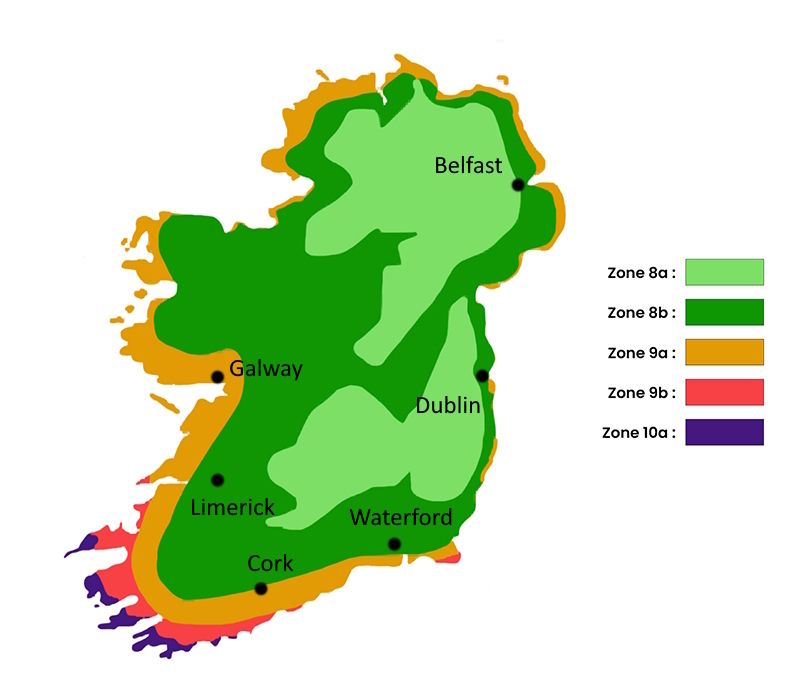
The planting period indicated on our website applies to regions in USDA Zone 9a (East Coast and Midlands: Dublin, Wexford, Waterford, Kilkenny, Portlaoise). It will vary depending on where you live:
- On the west coast and in the north-west (Galway, Limerick, Sligo, Donegal, Westport), delay planting by 1 to 2 weeks in spring and bring it forward by 1 to 2 weeks in autumn compared to the dates given, preferably choosing periods without strong winds.
- In the inland hills and plateaus (Wicklow Mountains, Macgillycuddy’s Reeks, Connemara, Killarney), it is best to plant in spring (April–May) or autumn (September–October), avoiding periods of waterlogged soil in winter and strong winds, which pose the main risk to newly planted trees in these areas.
The flowering period indicated on our website applies to regions in USDA Zone 9a, such as the East Coast and Midlands, including Dublin, Wexford, Waterford, Kilkenny and Portlaoise.
This will vary depending on where you live:
- On the west coast and in the northwest (Galway, Limerick, Sligo, Donegal and Westport), it will be delayed by one to two weeks compared to the given dates, due to stronger Atlantic winds and less spring sunshine.
- In the inland hills and plateaus (the Wicklow Mountains, the Macgillycuddy's Reeks, Connemara and Killarney), flowering will be delayed by two to three weeks. Flowering mainly occurs between May and July, with the limiting factors being less frost and more of the excessive humidity, strong winds and lack of sunshine that are characteristic of these areas.
Shipping country and language
Your country of residence may be:
Your country of residence is:
For a better user experience on our website, you can select:
Your shipping country:
-
 Austria
-
 Belgium
-
 Bosnia & Herzegovina
-
 Bulgaria
-
 Croatia
-
 Cyprus
-
 Czechia
-
 Denmark
-
 Estonia
-
 Finland
-
 France
-
 Germany
-
 Greece
-
 Hungary
-
 Iceland
-
 Ireland
-
 Italy
Italy
-
 Latvia
-
 Liechtenstein
-
 Lithuania
-
 Luxembourg
-
 Malta
Malta
-
 Netherlands
-
 Poland
-
 Portugal
-
 Romania
-
 Serbia
-
 Slovakia
-
 Slovenia
-
 Spain
Spain
-
 Sweden
-
 Switzerland
Language:
-
French
-
 English
-
Spanish
-
Italian
-
German
-
Portuguese
-
Dutch
-
Finnish
My Account
Hello
My wish lists
My cart
Log in / Register
Existing customer?
This form is protected by reCAPTCHA - the Google Privacy Policy and Terms of Service apply.
New customer?
Create an account to track your orders, access our customer service and, if you wish, make the most of our upcoming offers.