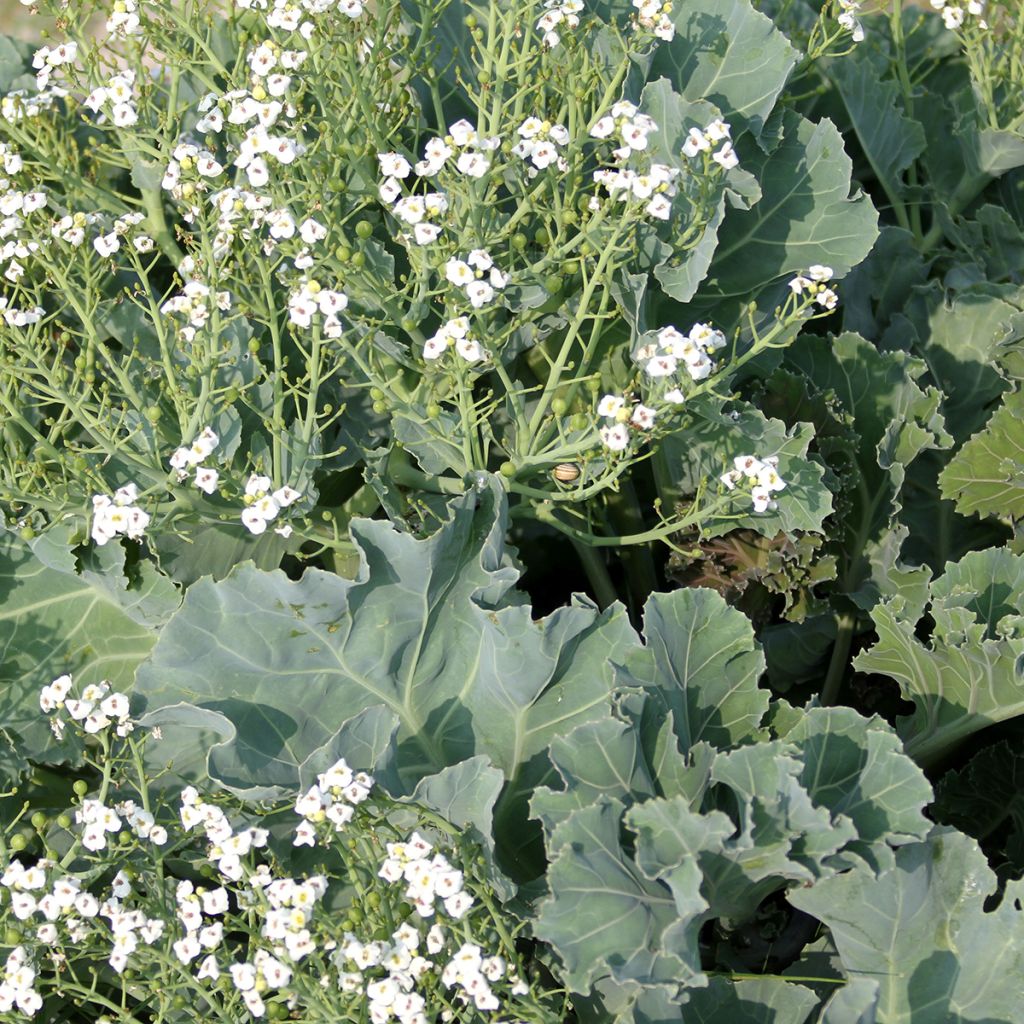
Crambe maritima - Seeds of Sea Kale
Crambe maritima - Seeds of Sea Kale
Crambe maritima
Sea kale
Back-to-school special offer!
Get €10 off for every €50 you spend! And get up to €40 off on a single order.
How does it work?
1. Shop your favourites
Add your favourite plants to your basket. For every €50 you spend (excluding delivery charges, store credit and the plastic-free option), you’ll receive a €10 voucher.
€50 spent = €10 voucher
€100 spent = €20 voucher
€150 spent = €30 voucher
€200 spent = €40 voucher
2. Place your order
Once your basket reaches one of the spending thresholds, place your order. You can even choose your delivery date!
3. Receive your voucher
As soon as your order has been shipped, you’ll receive an email containing your personal voucher code and its value.
4. Use it on your next order
Your voucher is valid for 90 days from the date you receive it. It can be used once only, on a new order worth at least the value of the voucher, excluding delivery charges.
Please note: Vouchers can be combined with other offers, but cannot be split or refunded.
Home or relay delivery (depending on size and destination)
Important: You may be charged customs duties by your country’s customs authorities upon delivery.
Schedule delivery date
and select date in basket
This plant carries a 6 months recovery warranty
More information
We guarantee the quality of our plants for a full growing cycle, and will replace at our expense any plant that fails to recover under normal climatic and planting conditions.
Does this plant fit my garden?
Set up your Plantfit profile →
Description
Sea Kale, in Latin Crambe maritima, is a wild and perennial close relative of the biennial cabbage from our vegetable gardens. It grows wild on oceanic coasts, where it is rare, and this decorative and delicious kale also has a place in our gardens. It prefers stony or sandy, very well-drained but not arid soil. This plant is charming with its beautiful bluish-grey, frilly foliage and abundant, ivory-white, nectar-rich spring flowering with a sweet honey scent.
This sea kale, sometimes called Chourbe, is native to Western Europe, found from Sweden and Russia to Portugal, passing through France. It grows wild on the pebbles of the beaches of Normandy, here and there in the sands and gravels of the coast of the English Channel and the Atlantic Ocean, from Pas-de-Calais to Morbihan, where it is now strictly protected. It is a very perennial plant, with a lifespan that can reach or exceed 20 years. Its perfect growing conditions are a very sunny exposure, a cool and humid maritime climate, a rather basic (chalky) and rocky soil, very poor in organic matter (soil, compost), but rich in mineral elements. Like all kales, it belongs to the Brassicaceae family, formerly known as Cruciferae. It is a hardy plant (-20°C), quite easy to grow in gardens with well-drained soil.
Sea Kale develops from a thick and woody crown from which crested, violet young shoots emerge, unfolding into large rounded and fleshy leaves, very wavy at the edges and covered with a bluish bloom. An aged clump can reach a height of 60-70 cm in flower (40 cm for the foliage), with a spread at least equivalent. It is the young leaves that are edible, especially when "blanched" by sheltering them from light with mulch or a terracotta bell. This pretty vegetation persists in winter. The plant flowers generously from May to July, depending on the climate. Numerous floral stems emerge from the clump of foliage. They bear a few small leaves at the base and branch out into panicles at their ends. Each rather dense panicle is adorned with white to pinkish flowers with 4 petals, rather large and pleasantly scented. This flowering, with its sweet honey scent, is rich in nectar and attracts many pollinating insects. It is followed by round, yellowish fruits called siliques, containing seeds that can be harvested and easily sown in March-April, after being exposed to cold for 2 to 3 months.
In the kitchen:
All parts of the Sea Kale are edible, their flavour is slightly different from that of garden kale. The leaves are consumed before flowering, and the flower buds can be eaten raw or cooked. The blanched young shoots (petioles) are used in English cuisine, their delicate flavour is reminiscent of cardoon and asparagus. The roots are rich in starch and sugar and can be consumed cooked.
In the garden:
Sea Kale is a star plant for a sunny rockery with moist soil. Plant it among some large stones in a gravel bed where it will be the only thing visible in winter. Its strong personality does not prevent it from mingling in mixed borders with ground-cover roses, perennial or shrubby salvias, daylilies, and heathers. The quite accommodating sea kale is spectacular in fertile and fresh garden soil like the vegetable garden, but it often ages less well there.
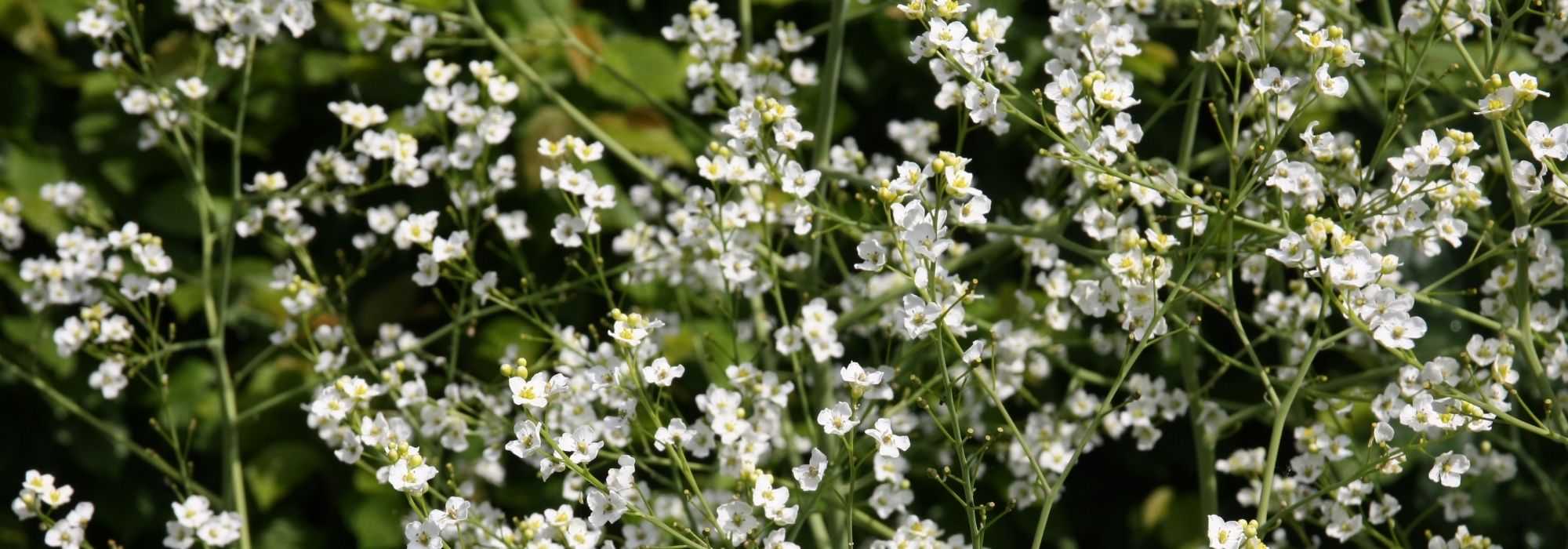
Flowering
Foliage
Plant habit
Botanical data
Crambe
maritima
Brassicaceae
Sea kale
Crambe pontica
Western Europe
Planting and care
Sowing tips:
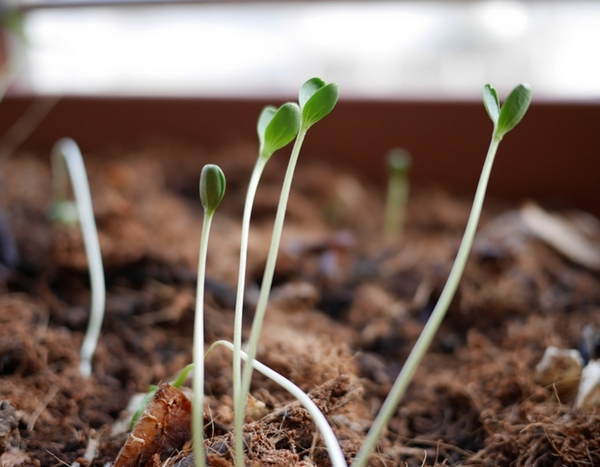
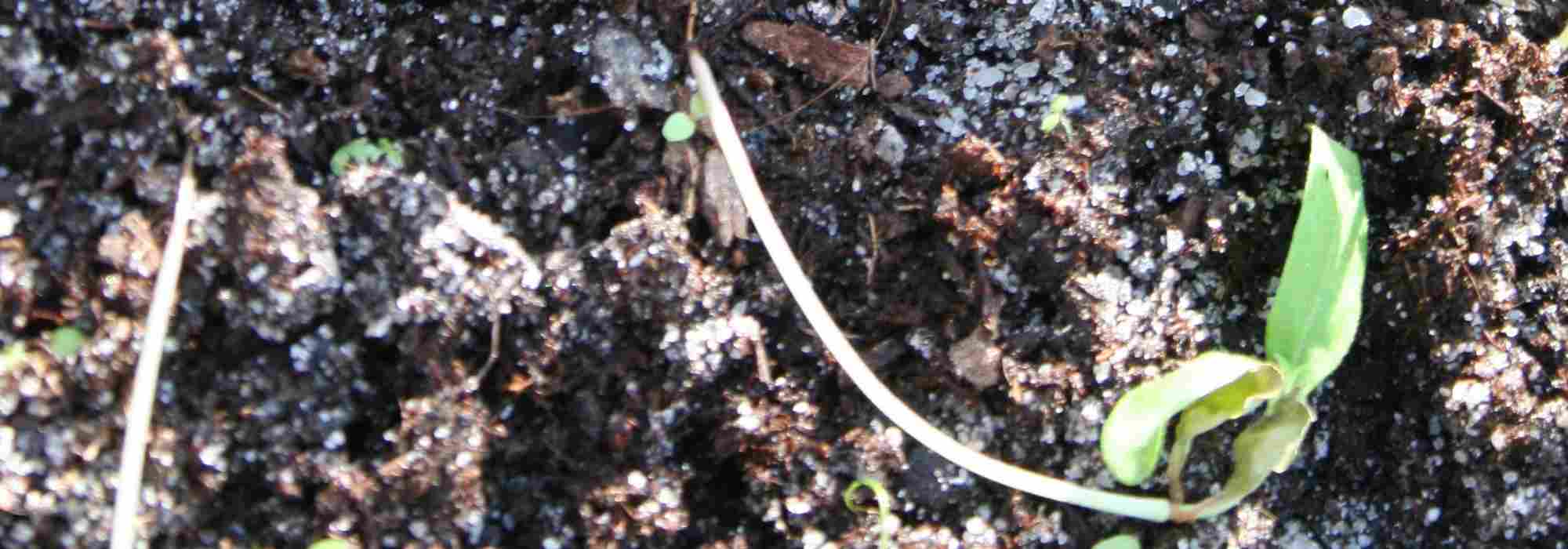
The seeds can take a long time to germinate, up to 5 weeks. To stimulate the germination process, place the seeds in slightly damp sand and keep them cool (5 °C), for example in the refrigerator, for two to four weeks.
Sow under cover or directly in place, from March to May, covering the seeds with 1 cm of fine soil.
Direct sowing in open ground can be done in small holes spaced 40 to 50 cm apart in all directions, with 3 to 4 seeds in each hole. When the seedlings have 3 or 4 leaves, keep only the most vigorous one.
For under cover sowing, transplant the seedlings into individual pots at the stage of 4 or 5 leaves. You can plant them in the garden once all danger of frost has passed.
Cultivation tips:
Sea Kale prefers sandy, loamy, and stony soils, with a tendency to be chalky, but retaining moisture in depth. It likes cool and humid oceanic climates and does not like heatwaves. It is a good plant for a seaside garden. However, it is accommodating enough to succeed inland, with vegetable garden plants. The essential thing is to provide it with soil which is well-draining and deep enough for it to extend its roots deeply and seek moisture. Plant it in the sun, in a raised bed, enriched with gravel or between the stones of a watered rockery. Its resistance to cold is good, down to -15°C. The base of the plant tends to loosen over time, so occasionally add some soil at the base of your Sea Kale. You can mulch the soil around the plant (not at the level of the crown, which could rot) to retain some moisture.
Protect young shoots from snails and slugs. Like all brassicas, Crambe can be prey to flea beetles that pierce the leaves: regularly spray water on the cabbage leaves in the morning and during the hot hours of the day to chase away these small beetles.
In the vegetable garden: wait three years before harvesting the first shoots. It can remain in one place for 8 to 10 years, so choose its location carefully at planting and avoid transplanting it.
Sea Kale can be propagated by taking suckers or by sowing in March-April. The seeds need winter cold to germinate.
Sowing period
Intended location
Planting & care advice
-
-
-
-
-
-
-

-
This item has not been reviewed yet - be the first to leave a review about it.
Recently viewed products
Haven't found what you were looking for?
Hardiness is the lowest winter temperature a plant can endure without suffering serious damage or even dying. However, hardiness is affected by location (a sheltered area, such as a patio), protection (winter cover) and soil type (hardiness is improved by well-drained soil).
In temperate climates, pruning of spring-flowering shrubs (forsythia, spireas, etc.) should be done just after flowering.
Pruning of summer-flowering shrubs (Indian Lilac, Perovskia, etc.) can be done in winter or spring.
In cold regions as well as with frost-sensitive plants, avoid pruning too early when severe frosts may still occur.
The harvesting period indicated on our website applies to countries and regions in USDA zone 8 (France, England, Ireland, the Netherlands).
In colder areas (Scandinavia, Poland, Austria...) fruit and vegetable harvests are likely to be delayed by 3-4 weeks.
In warmer areas (Italy, Spain, Greece, etc.), harvesting will probably take place earlier, depending on weather conditions.
The sowing periods indicated on our website apply to countries and regions within USDA Zone 8 (France, UK, Ireland, Netherlands).
In colder areas (Scandinavia, Poland, Austria...), delay any outdoor sowing by 3-4 weeks, or sow under glass.
In warmer climes (Italy, Spain, Greece, etc.), bring outdoor sowing forward by a few weeks.
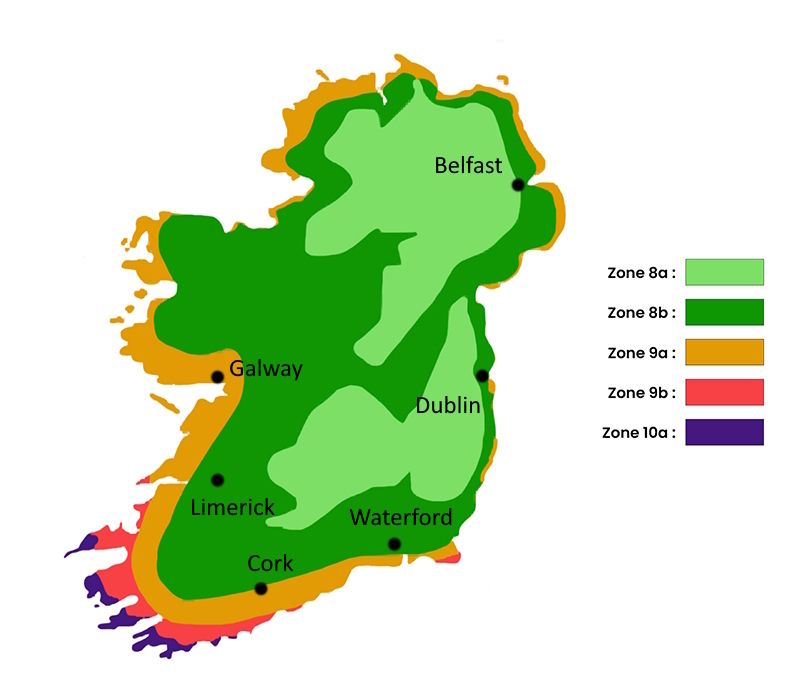
The planting period indicated on our website applies to regions in USDA Zone 9a (East Coast and Midlands: Dublin, Wexford, Waterford, Kilkenny, Portlaoise). It will vary depending on where you live:
- On the west coast and in the north-west (Galway, Limerick, Sligo, Donegal, Westport), delay planting by 1 to 2 weeks in spring and bring it forward by 1 to 2 weeks in autumn compared to the dates given, preferably choosing periods without strong winds.
- In the inland hills and plateaus (Wicklow Mountains, Macgillycuddy’s Reeks, Connemara, Killarney), it is best to plant in spring (April–May) or autumn (September–October), avoiding periods of waterlogged soil in winter and strong winds, which pose the main risk to newly planted trees in these areas.
The flowering period indicated on our website applies to regions in USDA Zone 9a, such as the East Coast and Midlands, including Dublin, Wexford, Waterford, Kilkenny and Portlaoise.
This will vary depending on where you live:
- On the west coast and in the northwest (Galway, Limerick, Sligo, Donegal and Westport), it will be delayed by one to two weeks compared to the given dates, due to stronger Atlantic winds and less spring sunshine.
- In the inland hills and plateaus (the Wicklow Mountains, the Macgillycuddy's Reeks, Connemara and Killarney), flowering will be delayed by two to three weeks. Flowering mainly occurs between May and July, with the limiting factors being less frost and more of the excessive humidity, strong winds and lack of sunshine that are characteristic of these areas.
Shipping country and language
Your country of residence may be:
Your country of residence is:
For a better user experience on our website, you can select:
Your shipping country:
-
 Austria
-
 Belgium
-
 Bosnia & Herzegovina
-
 Bulgaria
-
 Croatia
-
 Cyprus
-
 Czechia
-
 Denmark
-
 Estonia
-
 Finland
-
 France
-
 Germany
-
 Greece
-
 Hungary
-
 Iceland
-
 Ireland
-
 Italy
Italy
-
 Latvia
-
 Liechtenstein
-
 Lithuania
-
 Luxembourg
-
 Malta
Malta
-
 Netherlands
-
 Poland
-
 Portugal
-
 Romania
-
 Serbia
-
 Slovakia
-
 Slovenia
-
 Spain
Spain
-
 Sweden
-
 Switzerland
Language:
-
French
-
 English
-
Spanish
-
Italian
-
German
-
Portuguese
-
Dutch
-
Finnish
My Account
Hello
My wish lists
My cart
Log in / Register
Existing customer?
This form is protected by reCAPTCHA - the Google Privacy Policy and Terms of Service apply.
New customer?
Create an account to track your orders, access our customer service and, if you wish, make the most of our upcoming offers.