Phormium tenax Atropurpureum seeds - New Zealand flax
Phormium tenax Atropurpureum seeds - New Zealand flax
Phormium tenax Atropurpureum
New Zealand Flax, Flax Lily
Back-to-school special offer!
Get €10 off for every €50 you spend! And get up to €40 off on a single order.
How does it work?
1. Shop your favourites
Add your favourite plants to your basket. For every €50 you spend (excluding delivery charges, store credit and the plastic-free option), you’ll receive a €10 voucher.
€50 spent = €10 voucher
€100 spent = €20 voucher
€150 spent = €30 voucher
€200 spent = €40 voucher
2. Place your order
Once your basket reaches one of the spending thresholds, place your order. You can even choose your delivery date!
3. Receive your voucher
As soon as your order has been shipped, you’ll receive an email containing your personal voucher code and its value.
4. Use it on your next order
Your voucher is valid for 90 days from the date you receive it. It can be used once only, on a new order worth at least the value of the voucher, excluding delivery charges.
Please note: Vouchers can be combined with other offers, but cannot be split or refunded.
Home or relay delivery (depending on size and destination)
Important: You may be charged customs duties by your country’s customs authorities upon delivery.
Schedule delivery date,
and select date in basket
This plant carries a 6 months recovery warranty
More information
We guarantee the quality of our plants for a full growing cycle, and will replace at our expense any plant that fails to recover under normal climatic and planting conditions.
Does this plant fit my garden?
Set up your Plantfit profile →
Description
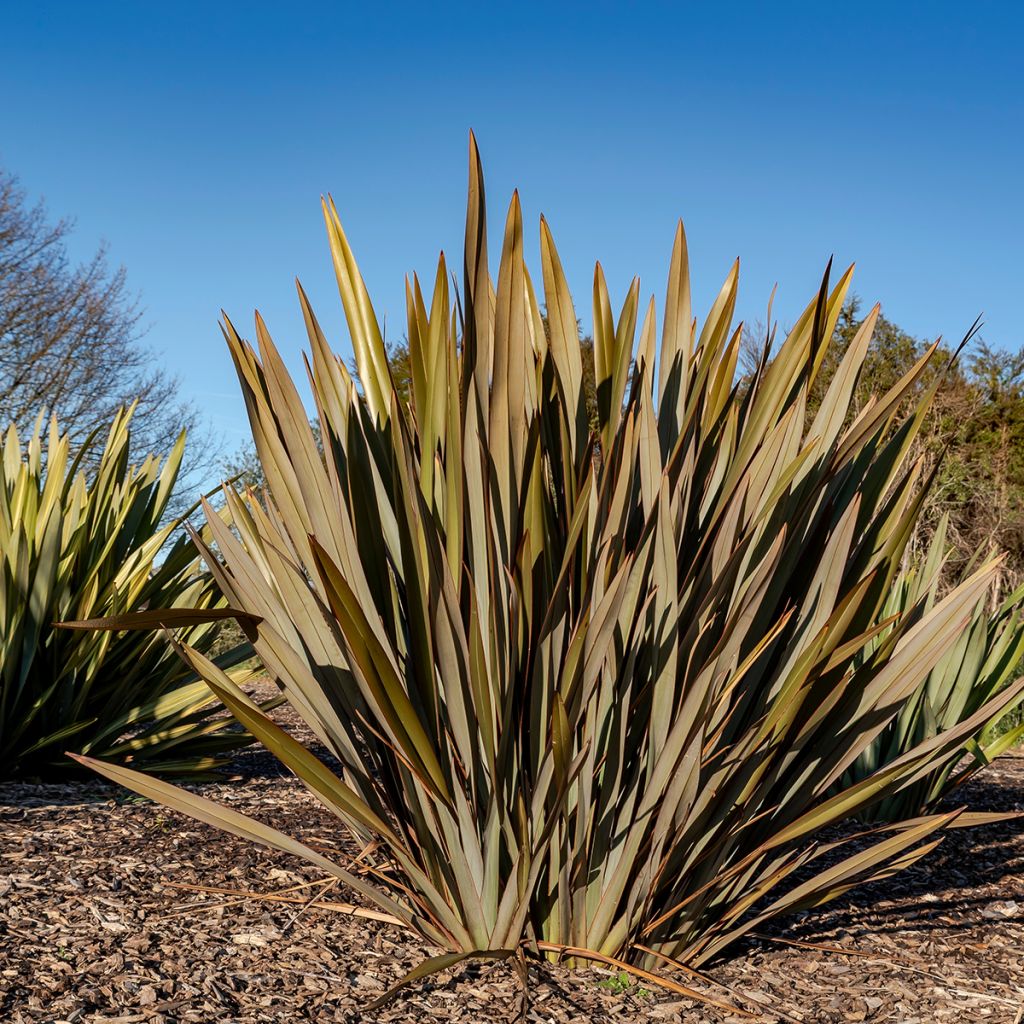
Phormium tenax ‘Atropurpureum’, or purple New Zealand flax, is distinguished by its bronze-purple, thick and strap-shaped leaves, which hold their shape all winter. More colourful and often slightly more compact than the species, it brings an exotic accent to borders, the edges of a terrace, or a large container. In good conditions, it can also produce tall spikes of bronze-red, nectar-rich flowers, highly decorative in a mild-climate garden.
Phormium tenax ‘Atropurpureum’ belongs to the Asphodelaceae family. It is an old horticultural selection with purple foliage, originating from a sport of Phormium tenax ‘Purpureum’. New Zealand nurseries have been growing it for many decades.
This evergreen perennial forms a dense clump from fleshy rhizomes. The sword-shaped leaves are thick, fibrous, slightly sharp on the edges, 1.20m to 2m long and 5 to 8cm wide. They begin olive green tinged with red, then become distinctly bronze-purple to violet. Planted in open ground in good soil, the clump commonly reaches 1.80m tall and 1.60m wide; in a pot, it will be somewhat more modest. The plant will flower in summer in regions with mild climates. The rigid flower stalks can rise to 3m above the foliage. They bear panicles of tubular, brown-red to coppery, nectar-rich flowers, much loved by pollinators. The flowers are followed by upright, elongated, three-angled capsules containing numerous flat black seeds, easy to harvest.
Phormium tenax ‘Atropurpureum’ creates a seaside atmosphere or an exotic setting in the garden or on the terrace. In mild climates, plant it as a specimen near an entrance, in the centre of a grass border, or in a row along a path. Further north, it will do wonderfully in a large container, to be brought in frost-free over winter. Its purple foliage pairs well with more compact phormiums such as ‘Bronze Baby’, with the changing plumes of Panicum virgatum ‘Prairie Sky’, the royal blue umbels of Agapanthus ‘Northern Star’, or the slender silhouette of Cordyline australis ‘Red Star’. Together, these plants create architectural scenes, decorative for a large part of the year.
Phormium tenax is a major textile plant in New Zealand: known as harakeke, its leaves have provided a strong fibre for cordage, mats and clothing for centuries, still used and valued in contemporary Māori craftsmanship.

Flowering
Foliage
Plant habit
Botanical data
Phormium
tenax
Atropurpureum
Asphodelaceae
New Zealand Flax, Flax Lily
Lachenalia ramosa, Chlamydia tenacissima, Phormium ramosum, Phormium flavovirens
Oceania
Planting and care
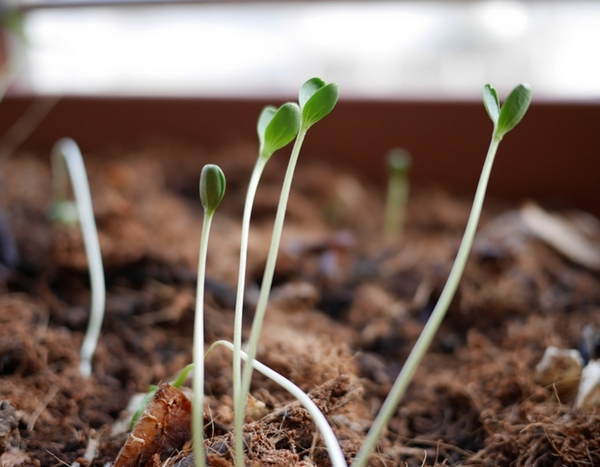
Sow Phormium tenax 'Atropurpureum' in spring, under cover, in a seed tray filled with a light substrate (fine sieved potting compost mixed with sand or vermiculite), kept at around 18–21°C.
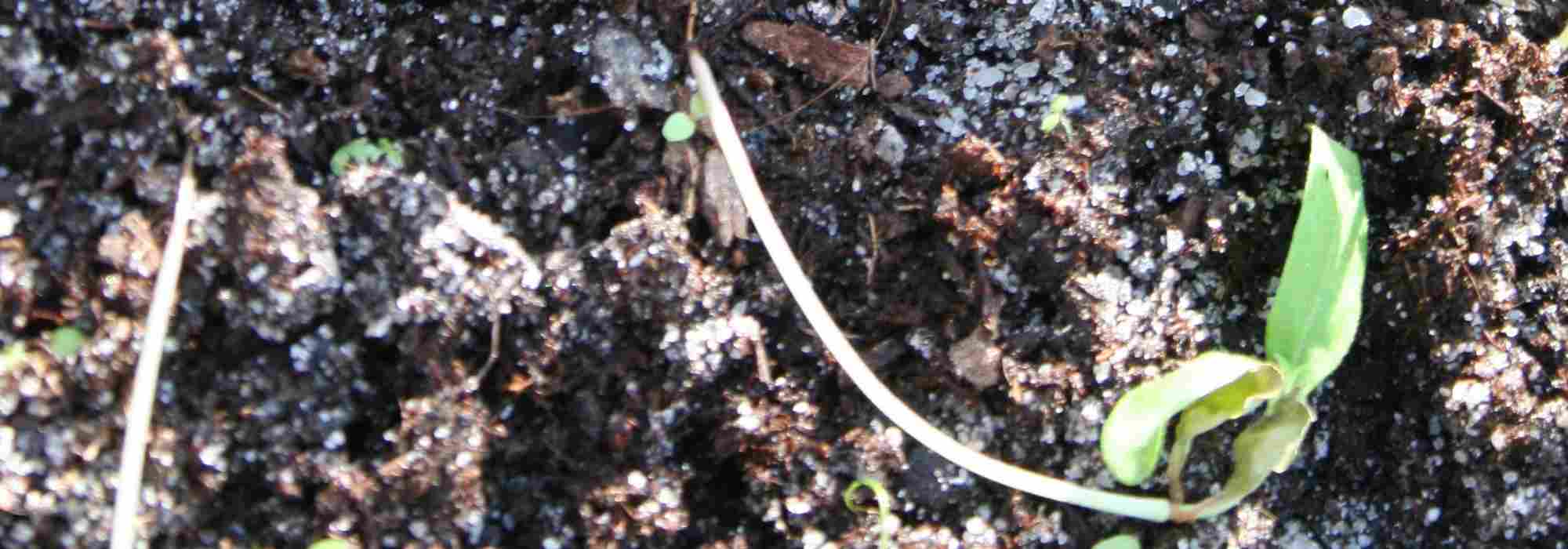
Sow the seeds, previously cleaned and possibly soaked for a few hours in lukewarm water, on the surface and then barely cover them with a very fine layer of substrate or sand. Moisten the tray with a spray and place it in the light without direct sun, under a lid or plastic film to maintain a slightly humid but well-ventilated atmosphere. The seeds germinate somewhat irregularly: some sprout within three to four weeks, others several months later, so don't abandon the tray too soon.
As soon as the young seedlings have a few leaves, carefully prick them out into individual small pots, still in a light, well-draining mix, taking care not to damage the fleshy roots.
Plant out in the garden or in a large pot after the last frosts, gradually hardening off the young plants to outdoor conditions.
Growing:
Plant Phormium tenax in light to medium-rich, well-drained soil, without excess lime, in full sun or light partial shade, sheltered from the harshest cold. Water regularly for the first two years to encourage rooting, then only in severe drought: once well established, it tolerates a lack of water fairly well.
An application of mature compost or organic fertiliser in spring is enough to support its growth.
In cold regions, grow it in a large pot or provide good winter protection (thick mulch around the base, fleece in case of hard frosts).
Sowing period
Intended location
Planting & care advice
-

-
-
-

-

-

-

-

This item has not been reviewed yet - be the first to leave a review about it.
Recently viewed products
Haven't found what you were looking for?
Hardiness is the lowest winter temperature a plant can endure without suffering serious damage or even dying. However, hardiness is affected by location (a sheltered area, such as a patio), protection (winter cover) and soil type (hardiness is improved by well-drained soil).
In temperate climates, pruning of spring-flowering shrubs (forsythia, spireas, etc.) should be done just after flowering.
Pruning of summer-flowering shrubs (Indian Lilac, Perovskia, etc.) can be done in winter or spring.
In cold regions as well as with frost-sensitive plants, avoid pruning too early when severe frosts may still occur.
The harvesting period indicated on our website applies to countries and regions in USDA zone 8 (France, England, Ireland, the Netherlands).
In colder areas (Scandinavia, Poland, Austria...) fruit and vegetable harvests are likely to be delayed by 3-4 weeks.
In warmer areas (Italy, Spain, Greece, etc.), harvesting will probably take place earlier, depending on weather conditions.
The sowing periods indicated on our website apply to countries and regions within USDA Zone 8 (France, UK, Ireland, Netherlands).
In colder areas (Scandinavia, Poland, Austria...), delay any outdoor sowing by 3-4 weeks, or sow under glass.
In warmer climes (Italy, Spain, Greece, etc.), bring outdoor sowing forward by a few weeks.
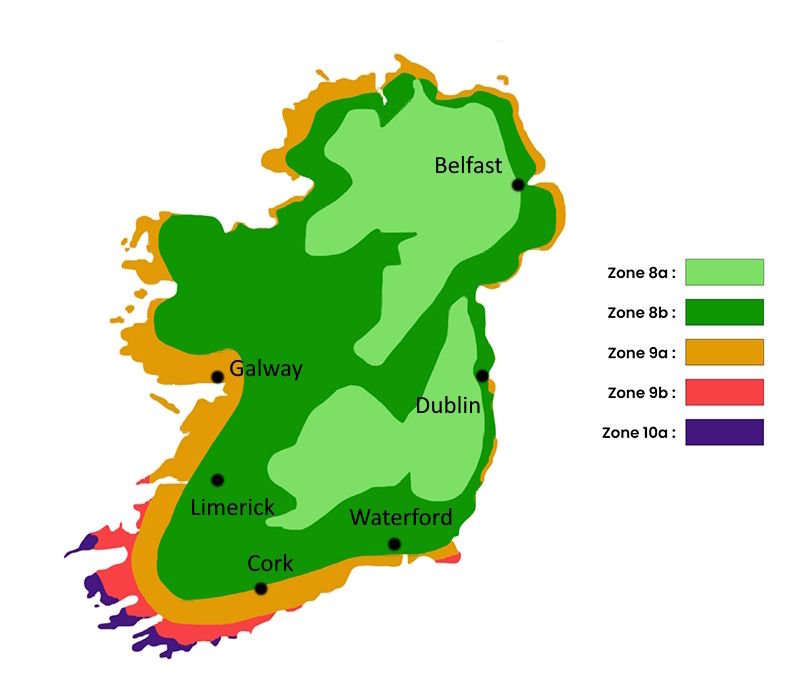
The planting period indicated on our website applies to regions in USDA Zone 9a (East Coast and Midlands: Dublin, Wexford, Waterford, Kilkenny, Portlaoise). It will vary depending on where you live:
- On the west coast and in the north-west (Galway, Limerick, Sligo, Donegal, Westport), delay planting by 1 to 2 weeks in spring and bring it forward by 1 to 2 weeks in autumn compared to the dates given, preferably choosing periods without strong winds.
- In the inland hills and plateaus (Wicklow Mountains, Macgillycuddy’s Reeks, Connemara, Killarney), it is best to plant in spring (April–May) or autumn (September–October), avoiding periods of waterlogged soil in winter and strong winds, which pose the main risk to newly planted trees in these areas.
The flowering period indicated on our website applies to regions in USDA Zone 9a, such as the East Coast and Midlands, including Dublin, Wexford, Waterford, Kilkenny and Portlaoise.
This will vary depending on where you live:
- On the west coast and in the northwest (Galway, Limerick, Sligo, Donegal and Westport), it will be delayed by one to two weeks compared to the given dates, due to stronger Atlantic winds and less spring sunshine.
- In the inland hills and plateaus (the Wicklow Mountains, the Macgillycuddy's Reeks, Connemara and Killarney), flowering will be delayed by two to three weeks. Flowering mainly occurs between May and July, with the limiting factors being less frost and more of the excessive humidity, strong winds and lack of sunshine that are characteristic of these areas.
Shipping country and language
Your country of residence may be:
Your country of residence is:
For a better user experience on our website, you can select:
Your shipping country:
-
 Austria
-
 Belgium
-
 Bosnia & Herzegovina
-
 Bulgaria
-
 Croatia
-
 Cyprus
-
 Czechia
-
 Denmark
-
 Estonia
-
 Finland
-
 France
-
 Germany
-
 Greece
-
 Hungary
-
 Iceland
-
 Ireland
-
 Italy
Italy
-
 Latvia
-
 Liechtenstein
-
 Lithuania
-
 Luxembourg
-
 Malta
Malta
-
 Netherlands
-
 Poland
-
 Portugal
-
 Romania
-
 Serbia
-
 Slovakia
-
 Slovenia
-
 Spain
Spain
-
 Sweden
-
 Switzerland
Language:
-
French
-
 English
-
Spanish
-
Italian
-
German
-
Portuguese
-
Dutch
-
Finnish
My Account
Hello
My wish lists
My cart
Log in / Register
Existing customer?
This form is protected by reCAPTCHA - the Google Privacy Policy and Terms of Service apply.
New customer?
Create an account to track your orders, access our customer service and, if you wish, make the most of our upcoming offers.