






























La Cordeline Food Safe Ecru Linen Cord - 100g Ball Ø1mm (0in) ±110m (361ft)
La Cordeline Food Safe Ecru Linen Cord - 100g Ball Ø1mm (0in) ±110m (361ft)
Special offer!
Receive a €20 voucher for any order over €90 (excluding delivery costs, credit notes, and plastic-free options)!
1- Add your favorite plants to your cart.
2- Once you have reached €90, confirm your order (you can even choose the delivery date!).
3- As soon as your order is shipped, you will receive an email containing your voucher code, valid for 3 months (90 days).
Your voucher is unique and can only be used once, for any order with a minimum value of €20, excluding delivery costs.
Can be combined with other current offers, non-divisible and non-refundable.
Home or relay delivery (depending on size and destination)
Important: You may be charged customs duties by your country’s customs authorities upon delivery.
Schedule delivery date,
and select date in basket
We guarantee the quality of our plants for a full growing cycle, and will replace at our expense any plant that fails to recover under normal climatic and planting conditions.

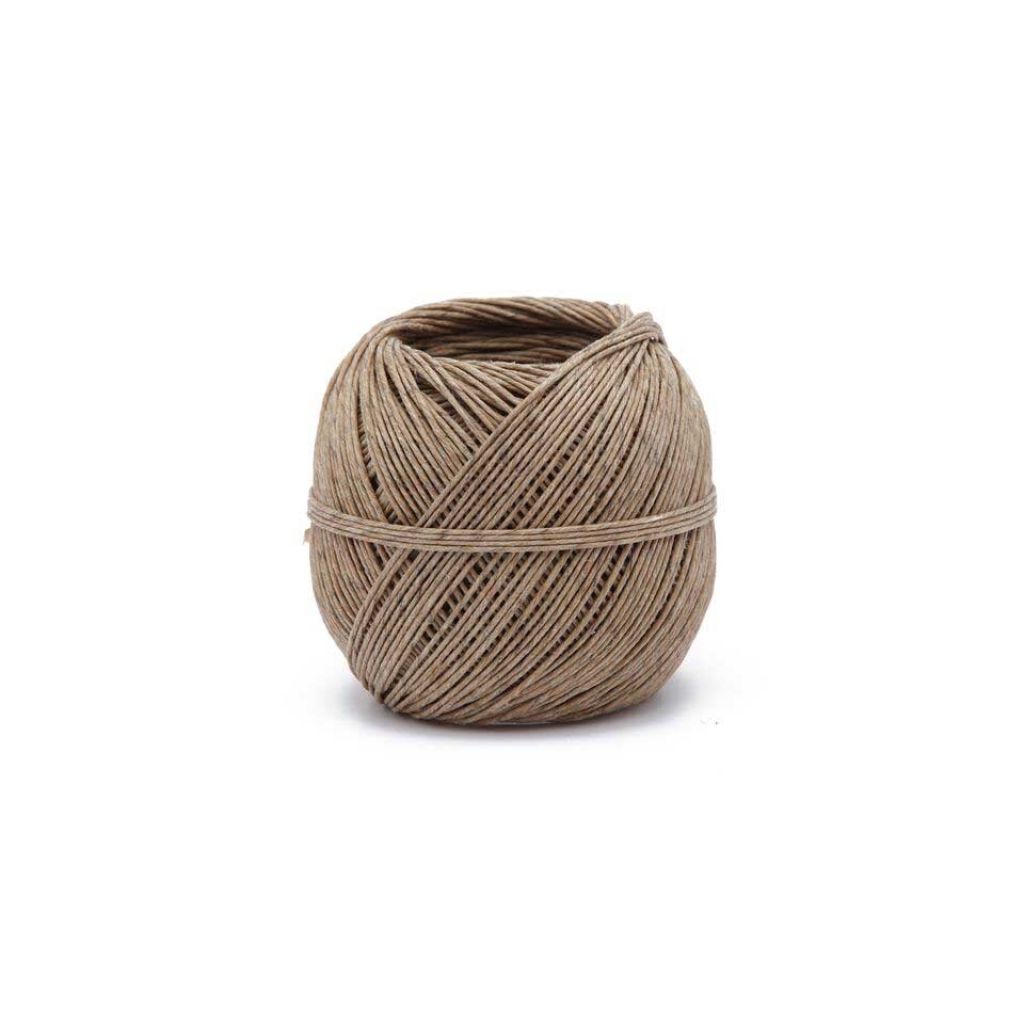
This Food Safe Natural Linen Cord from La Cordeline, made from100% natural and untreated linen fibre, has a traceability number and a certificate of suitability for use with food. It is suitable for cooking meats, curing and trussing roasts, and many more. Approximately 110m (361ft) of this fine 1mm (0in) diameter thread is contained in this 100g ball.
Linen is a material that comes directly from a beautiful plant called flax, cultivated since antiquity for its many qualities that are being rediscovered today. In addition to the legendary strength of linen fibres are appreciated for their length and fineness. Items made with them have an attractive, natural look and rustic character. Additionally, linen cord is biodegradable, has high mechanical resistance, is difficult to burn, and withstands abrasion and moisture well. To make this cord suitable for food contact, several natural linen threads are assembled and then twisted in the opposite direction to the original twist of each thread. This La Cordeline cord has a natural ecru colour and a slightly rough texture.
It has great versatility: use in the kitchen, of course, for sewing up stuffed poultry, trussing roasts and paupiettes, or for preparing cured meats (ham, dried sausages...), or drying herbs. It is also used in gardening to tie all types of plants, in floral art, in crafts, for DIY projects, in decoration, for gift wrapping, for creative hobbies (crochet, knitting, macramé), for sewing strong seams, and even in upholstery. It can be cut with scissors, a sharp knife or a cutter.
Approximate length 110m (361ft), diameter 1mm (0in).
Technical features
Detailed features
This item has not been reviewed yet - be the first to leave a review about it.
Recently viewed products
Haven't found what you were looking for?
Hardiness is the lowest winter temperature a plant can endure without suffering serious damage or even dying. However, hardiness is affected by location (a sheltered area, such as a patio), protection (winter cover) and soil type (hardiness is improved by well-drained soil).
In temperate climates, pruning of spring-flowering shrubs (forsythia, spireas, etc.) should be done just after flowering.
Pruning of summer-flowering shrubs (Indian Lilac, Perovskia, etc.) can be done in winter or spring.
In cold regions as well as with frost-sensitive plants, avoid pruning too early when severe frosts may still occur.
The harvesting period indicated on our website applies to countries and regions in USDA zone 8 (France, England, Ireland, the Netherlands).
In colder areas (Scandinavia, Poland, Austria...) fruit and vegetable harvests are likely to be delayed by 3-4 weeks.
In warmer areas (Italy, Spain, Greece, etc.), harvesting will probably take place earlier, depending on weather conditions.
The sowing periods indicated on our website apply to countries and regions within USDA Zone 8 (France, UK, Ireland, Netherlands).
In colder areas (Scandinavia, Poland, Austria...), delay any outdoor sowing by 3-4 weeks, or sow under glass.
In warmer climes (Italy, Spain, Greece, etc.), bring outdoor sowing forward by a few weeks.
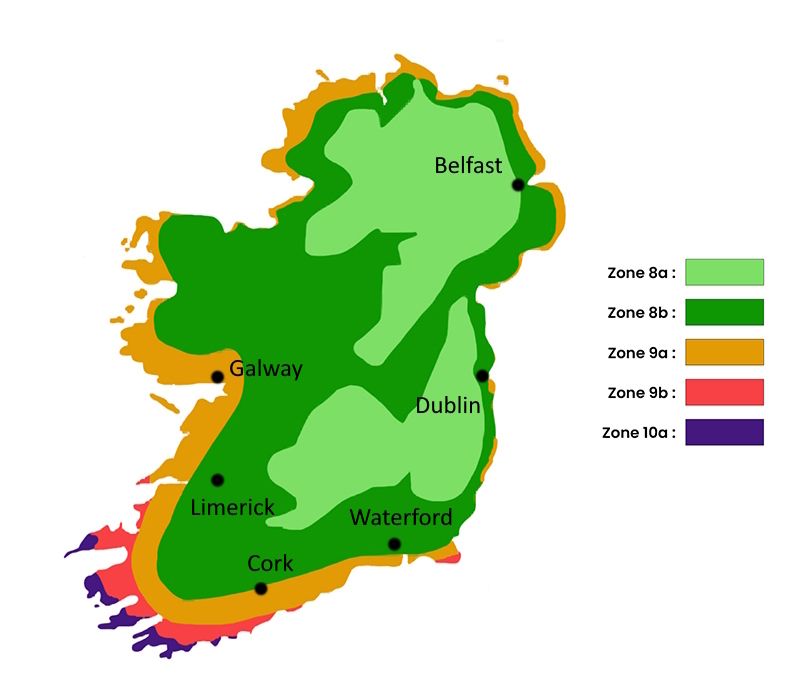
The planting period indicated on our website applies to regions in USDA Zone 9a (East Coast and Midlands: Dublin, Wexford, Waterford, Kilkenny, Portlaoise). It will vary depending on where you live:
- On the west coast and in the north-west (Galway, Limerick, Sligo, Donegal, Westport), delay planting by 1 to 2 weeks in spring and bring it forward by 1 to 2 weeks in autumn compared to the dates given, preferably choosing periods without strong winds.
- In the inland hills and plateaus (Wicklow Mountains, Macgillycuddy’s Reeks, Connemara, Killarney), it is best to plant in spring (April–May) or autumn (September–October), avoiding periods of waterlogged soil in winter and strong winds, which pose the main risk to newly planted trees in these areas.
The flowering period indicated on our website applies to regions in USDA Zone 9a, such as the East Coast and Midlands, including Dublin, Wexford, Waterford, Kilkenny and Portlaoise.
This will vary depending on where you live:
- On the west coast and in the northwest (Galway, Limerick, Sligo, Donegal and Westport), it will be delayed by one to two weeks compared to the given dates, due to stronger Atlantic winds and less spring sunshine.
- In the inland hills and plateaus (the Wicklow Mountains, the Macgillycuddy's Reeks, Connemara and Killarney), flowering will be delayed by two to three weeks. Flowering mainly occurs between May and July, with the limiting factors being less frost and more of the excessive humidity, strong winds and lack of sunshine that are characteristic of these areas.