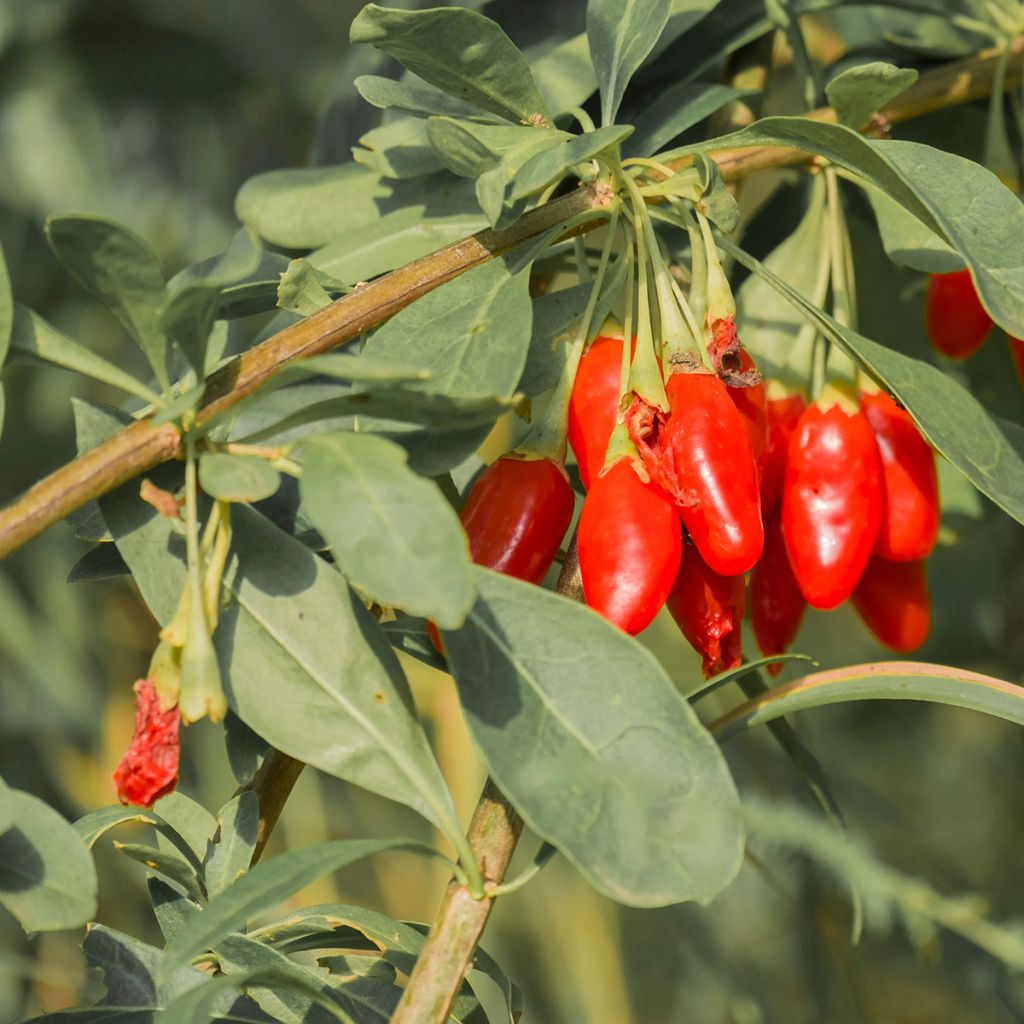
Lycium barbarum Q1 - Goji berry
Lycium barbarum Q1 - Goji berry
Lycium barbarum Q1
Back-to-school special offer!
Get €10 off for every €50 you spend! And get up to €40 off on a single order.
How does it work?
1. Shop your favourites
Add your favourite plants to your basket. For every €50 you spend (excluding delivery charges, store credit and the plastic-free option), you’ll receive a €10 voucher.
€50 spent = €10 voucher
€100 spent = €20 voucher
€150 spent = €30 voucher
€200 spent = €40 voucher
2. Place your order
Once your basket reaches one of the spending thresholds, place your order. You can even choose your delivery date!
3. Receive your voucher
As soon as your order has been shipped, you’ll receive an email containing your personal voucher code and its value.
4. Use it on your next order
Your voucher is valid for 90 days from the date you receive it. It can be used once only, on a new order worth at least the value of the voucher, excluding delivery charges.
Please note: Vouchers can be combined with other offers, but cannot be split or refunded.
Home or relay delivery (depending on size and destination)
Important: You may be charged customs duties by your country’s customs authorities upon delivery.
Schedule delivery date,
and select date in basket
This plant carries a 12 months recovery warranty
More information
We guarantee the quality of our plants for a full growing cycle, and will replace at our expense any plant that fails to recover under normal climatic and planting conditions.
Description
The Common Goji 'Q1' (Lycium barbarum) is a very hardy and naturally productive fruit bush, ideal for harvesting your own tasty, antioxidant-rich goji berries in the garden. This 'Q1' selection is distinguished by its rapid fruiting, summer flowering, and generous harvests from late summer to autumn. It is easy to grow, thriving in full sun in ordinary but well-drained soil. It is self-fertile, so it can produce fruit on its own, but yields are better if you plant two specimens.
Goji (Lycium barbarum), also called Barbary wolfberry or common goji, is a deciduous bush from the Solanaceae family. The species is now generally considered native to Asia, especially China, where it has been cultivated for centuries, and later naturalised in South-Eastern Europe; the debate about a Mediterranean origin still exists in the literature.
The cultivar 'Q1' is a recent horticultural selection, distributed on the European market—notably by French nurseries—for its vigour and regular fruiting.
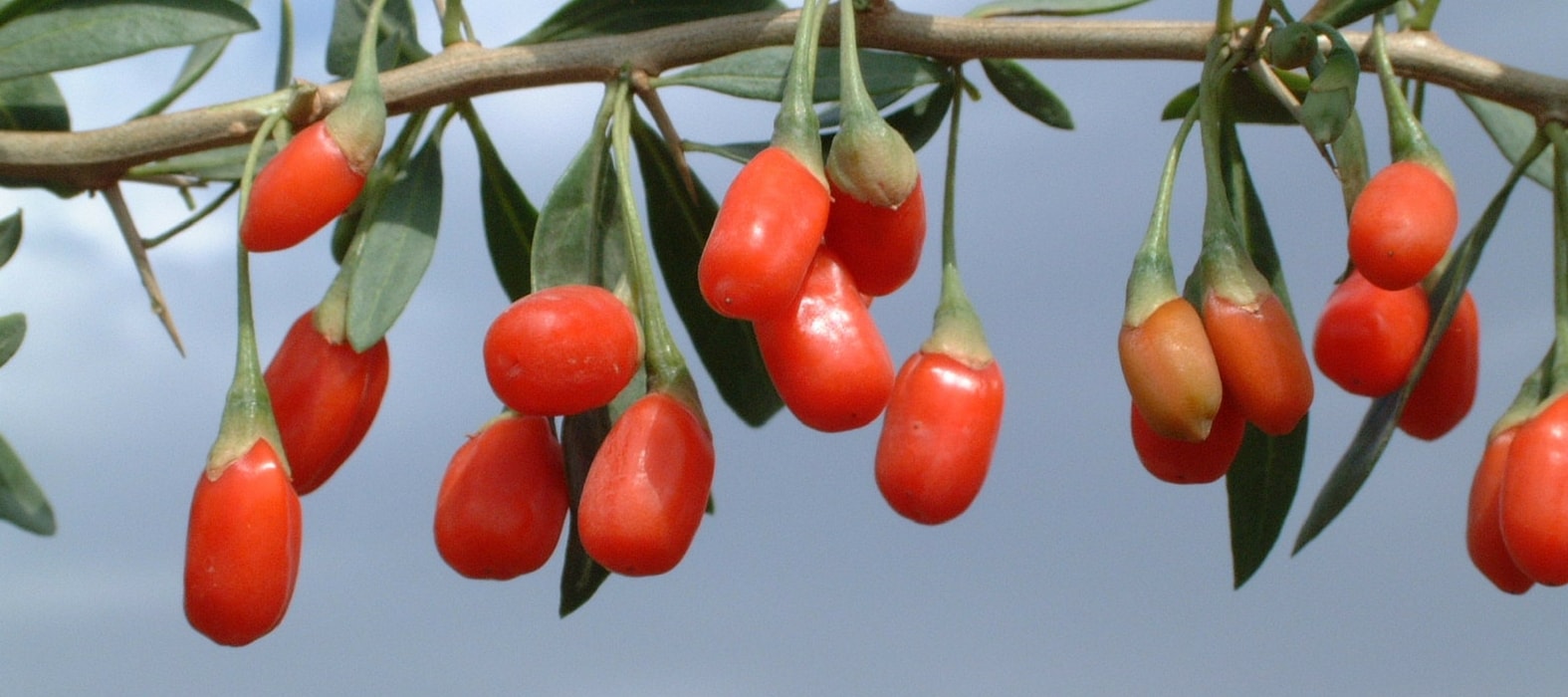
Goji 'Q1' is a bush with an initially upright habit that becomes gracefully trailing, reaching 1.50 m to 3 m in height depending on conditions. The flexible shoots bear a few spaced thorns. The deciduous foliage changes from a bright juvenile green to a greyish-green on mature leaves. The nectar-rich flowering occurs between late May and July, depending on the climate, in the form of small purple to violet corollas. The berries are red when ripe, and should be eaten when fully ripe, fresh or dried.
Goji berries are primarily valued for their richness in antioxidant compounds: polysaccharides, carotenoids (including zeaxanthin), flavonoids, as well as vitamins (notably C) and minerals. Numerous literature reviews confirm this nutritional profile and the antioxidant activity measured in the laboratory.
In the garden, Goji 'Q1' fits into a country hedge, but it can also be trained against a support. Cultivation in a large container is possible, provided it is regularly pruned. It appreciates full sun and well-drained soil, tolerates drought once established, and proves to be very hardy. Production is better in fertile soil that remains moist in summer; the harvest is staggered from late August to October, even into November in mild climates.
For a tasty and nectar-rich hedge, pair goji 'Q1' with easy small fruits: raspberry 'Autumn Bliss', redcurrant 'Rovada', blackcurrant 'Noir de Bourgogne' and thornless blackberry 'Triple Crown'. These bushes spread flowering and harvests from June to autumn, while offering varied textures and colours. Plant thyme or lavender at its base to attract pollinators and keep the soil well-drained.
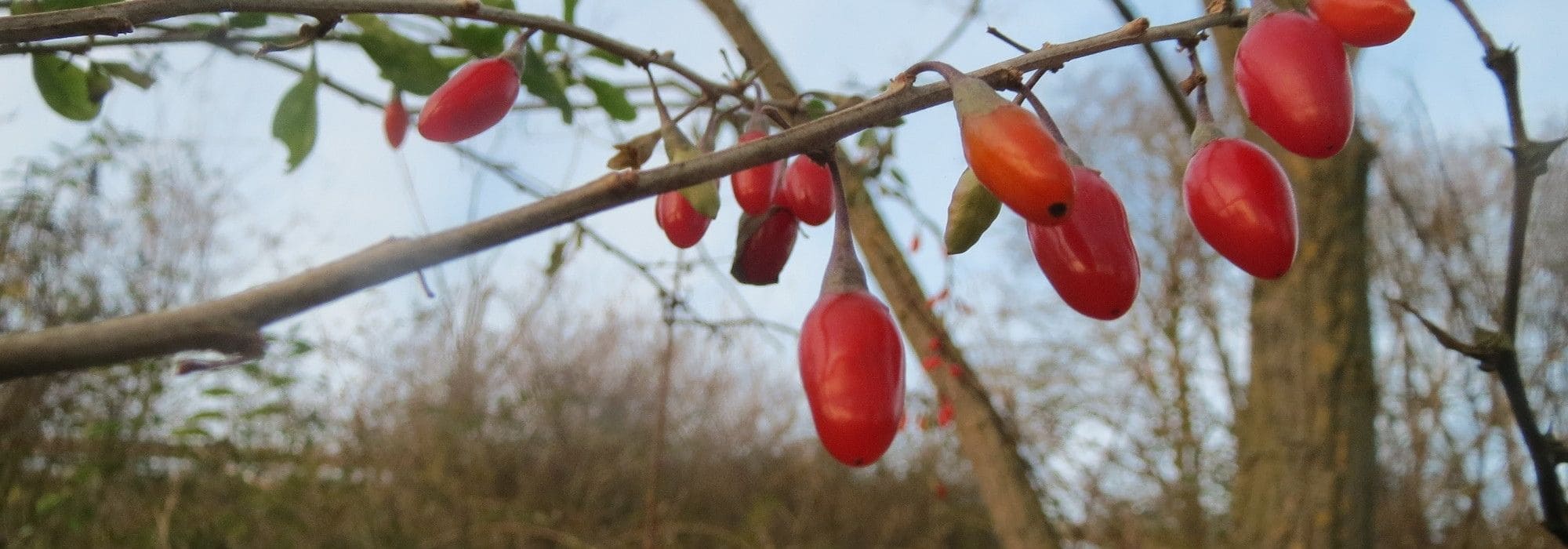
Lycium barbarum Q1 - Goji berry in pictures
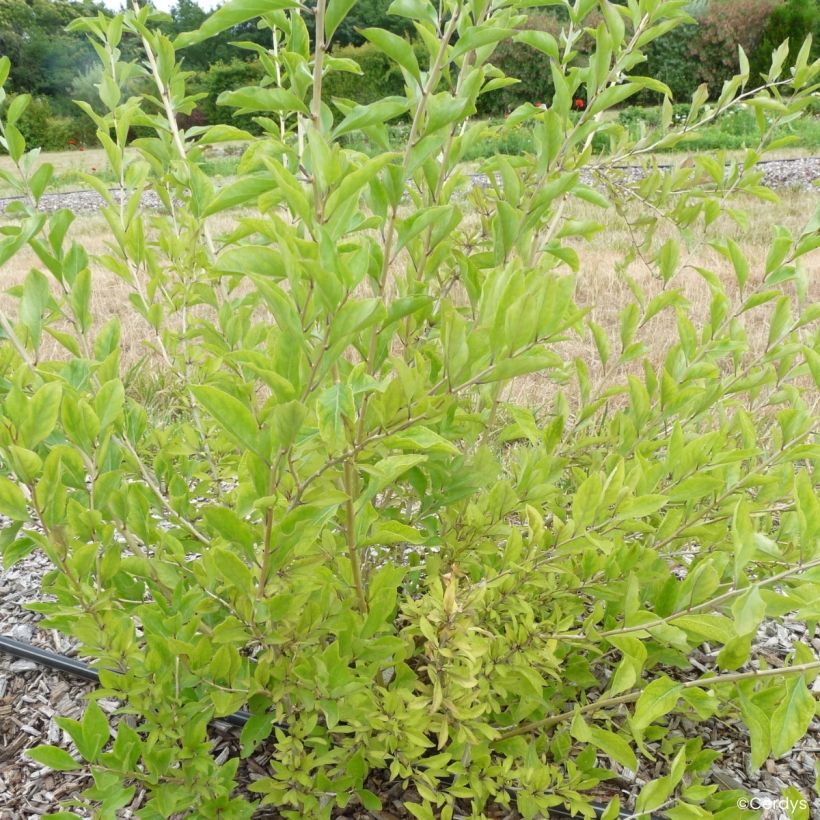
Plant habit
Fruit
Flowering
Foliage
Botanical data
Lycium
barbarum
Q1
Solanaceae
Lycium barbarum Q1
Cultivar or hybrid
Planting and care
The 'Q1' goji (Lycium barbarum) is not a demanding plant in terms of soil. Plant in spring or autumn. The shrub prefers well-drained soils, remaining somewhat moist, quite calcareous, and requires a very sunny exposure to fruit well. It is a very hardy plant, tolerating down to -22°C, but it doesn't like frost when it is still green and has not formed wood. When planting, dig a hole 50 cm in all directions. In heavy soil, place a layer of gravel or coarse sand at the bottom of the hole, then add a mixture of compost, ground horn and garden soil. This plant can be grown as a bush, in open ground or in a large pot, or be trained on a trellis. Water regularly after planting to ensure good establishment.
The plant is self-fertile, meaning it does not need the presence of a plant of the opposite sex to fruit. Goji can be attacked by powdery mildew, a microscopic fungus that forms light, whitish spots on the leaves. Young plants show rapid growth in full sun, often several centimetres per week. Seeming to become leggy at first and producing sometimes deformed leaves, they then strengthen and take their definitive, long and slender form. To encourage branching, it can be useful to pinch the top of the young plant a few centimetres below the tip of the stem. This will strengthen the trunk and promote several secondary branches, either at the base of the young plant or at the pinching point.
Routine maintenance: water in case of prolonged drought, once a week and abundantly. If the young plant is grown in a pot, you will need to water it in summer, every two or three days, depending on the heat and dryness. Apply an organic fertiliser or well-rotted compost once a year, in March.
Planting period
Intended location
Care
Planting & care advice
-
-
-
-
-
-

-

-
This item has not been reviewed yet - be the first to leave a review about it.
Recently viewed products
Haven't found what you were looking for?
Hardiness is the lowest winter temperature a plant can endure without suffering serious damage or even dying. However, hardiness is affected by location (a sheltered area, such as a patio), protection (winter cover) and soil type (hardiness is improved by well-drained soil).
In temperate climates, pruning of spring-flowering shrubs (forsythia, spireas, etc.) should be done just after flowering.
Pruning of summer-flowering shrubs (Indian Lilac, Perovskia, etc.) can be done in winter or spring.
In cold regions as well as with frost-sensitive plants, avoid pruning too early when severe frosts may still occur.
The harvesting period indicated on our website applies to countries and regions in USDA zone 8 (France, England, Ireland, the Netherlands).
In colder areas (Scandinavia, Poland, Austria...) fruit and vegetable harvests are likely to be delayed by 3-4 weeks.
In warmer areas (Italy, Spain, Greece, etc.), harvesting will probably take place earlier, depending on weather conditions.
The sowing periods indicated on our website apply to countries and regions within USDA Zone 8 (France, UK, Ireland, Netherlands).
In colder areas (Scandinavia, Poland, Austria...), delay any outdoor sowing by 3-4 weeks, or sow under glass.
In warmer climes (Italy, Spain, Greece, etc.), bring outdoor sowing forward by a few weeks.
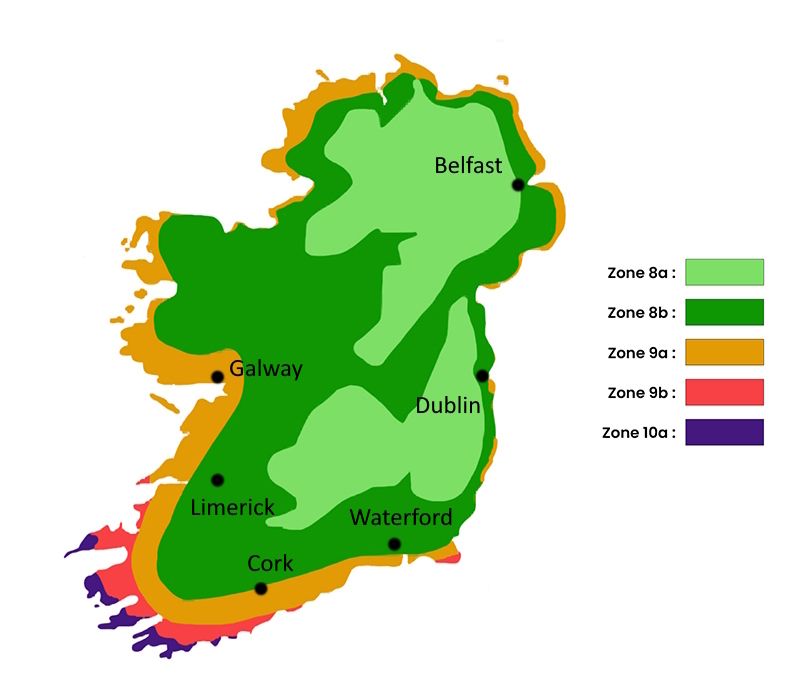
The planting period indicated on our website applies to regions in USDA Zone 9a (East Coast and Midlands: Dublin, Wexford, Waterford, Kilkenny, Portlaoise). It will vary depending on where you live:
- On the west coast and in the north-west (Galway, Limerick, Sligo, Donegal, Westport), delay planting by 1 to 2 weeks in spring and bring it forward by 1 to 2 weeks in autumn compared to the dates given, preferably choosing periods without strong winds.
- In the inland hills and plateaus (Wicklow Mountains, Macgillycuddy’s Reeks, Connemara, Killarney), it is best to plant in spring (April–May) or autumn (September–October), avoiding periods of waterlogged soil in winter and strong winds, which pose the main risk to newly planted trees in these areas.
The flowering period indicated on our website applies to regions in USDA Zone 9a, such as the East Coast and Midlands, including Dublin, Wexford, Waterford, Kilkenny and Portlaoise.
This will vary depending on where you live:
- On the west coast and in the northwest (Galway, Limerick, Sligo, Donegal and Westport), it will be delayed by one to two weeks compared to the given dates, due to stronger Atlantic winds and less spring sunshine.
- In the inland hills and plateaus (the Wicklow Mountains, the Macgillycuddy's Reeks, Connemara and Killarney), flowering will be delayed by two to three weeks. Flowering mainly occurs between May and July, with the limiting factors being less frost and more of the excessive humidity, strong winds and lack of sunshine that are characteristic of these areas.
Shipping country and language
Your country of residence may be:
Your country of residence is:
For a better user experience on our website, you can select:
Your shipping country:
-
 Austria
-
 Belgium
-
 Bosnia & Herzegovina
-
 Bulgaria
-
 Croatia
-
 Cyprus
-
 Czechia
-
 Denmark
-
 Estonia
-
 Finland
-
 France
-
 Germany
-
 Greece
-
 Hungary
-
 Iceland
-
 Ireland
-
 Italy
Italy
-
 Latvia
-
 Liechtenstein
-
 Lithuania
-
 Luxembourg
-
 Malta
Malta
-
 Netherlands
-
 Poland
-
 Portugal
-
 Romania
-
 Serbia
-
 Slovakia
-
 Slovenia
-
 Spain
Spain
-
 Sweden
-
 Switzerland
Language:
-
French
-
 English
-
Spanish
-
Italian
-
German
-
Portuguese
-
Dutch
-
Finnish
My Account
Hello
My wish lists
My cart
Log in / Register
Existing customer?
This form is protected by reCAPTCHA - the Google Privacy Policy and Terms of Service apply.
New customer?
Create an account to track your orders, access our customer service and, if you wish, make the most of our upcoming offers.