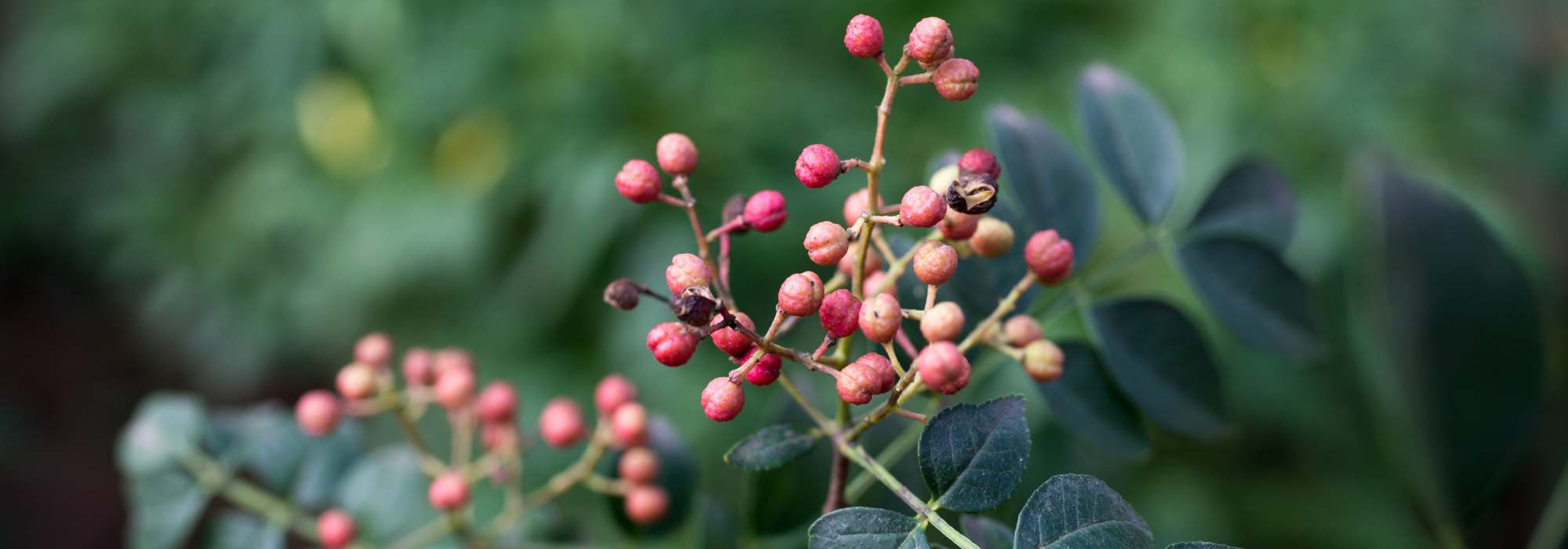
Choosing the ideal pepper tree for your garden: our complete buying guide
Selection of the best pepper plants to grow in your garden
Contents
Sichuan pepper (Zanthoxylum) is a small tree, sometimes called clavalier, usually of Asian origin, which produces very aromatic berries. These berries, commonly but mistakenly called peppers, give off fragrant notes. But it is the berry’s husk, dried and ground, that provides all the aroma to cooked dishes, while the seed, black in colour, is very hard. Traditionally, Sichuan pepper berries feature in the so-called “five-spice” blend. As for the shrub, it is generally very decorative, mainly because of its foliage, deeply divided into leaflets that are oval, slender and elongated, taking on magnificent golden-yellow hues in autumn. Flowering, more discreet, occurs in late spring. And harvest of the berries takes place between late summer and early autumn.
This Sichuan pepper belongs to the Rutaceae family, like citrus trees! That is why a lemony scent can be detected in its berries. True pepper, meanwhile, comes from Piper nigrum, a climber in the Piperaceae family.
Several species of Zanthoxylum exist. To choose between species and varieties with edible berries and those more ornamental, I invite you to read our comprehensive buying guide to help you choose the Sichuan pepper best suited to your criteria.
For more information: Sichuan pepper, Zanthoxylum: planting, growing and harvesting

For the flavour of its berries
Logically, the primary reason for buying and planting a Sichuan pepper (Zanthoxylum) is the harvest of the berries, whose pericarp or aromatic husk, at a bronze-pink to pink-red maturity, is dried for consumption. As for the seeds, black, hard and shiny, they have a very bitter taste. This husk contains a flavour of citrus trees, more or less pronounced, ranging from mandarin to lemon, via grapefruit and orange depending on species and varieties. On the tongue, these berries often produce a sensation of numbness and tingling.
If you really want to cultivate a pepper tree for the flavour of the berries, Zanthoxylum piperitum is certainly the most suitable. This Chinese prickly ash yields red berries with a flavour at once peppery, aniseed and lemony. Harvest occurs when the red husk splits to release the black seed. Once dried overnight, these husks are used to season soups or dishes based on pork, duck or chicken. The berries of this species are harvested in October. It also forms a large shrub up to 4 m high and 3 m wide with very aromatic foliage.
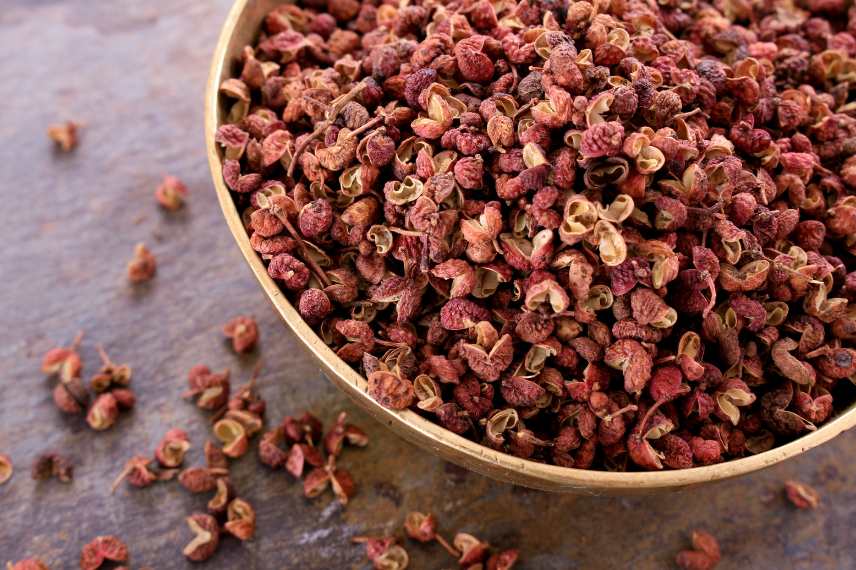
Zanthoxylum piperitum is the Sichuan pepper species with the most aromatic berries
Zanthoxylum schinifolium, also called Japanese pepper or mastic-leaved prickly ash, produces the sansho berries. This “mountain pepper”, very fresh on the palate, has a flavour rather close to lemongrass, enhanced by notes of mint and woodland understorey. In addition to this piquant, peppery and spicy flavour, these berries also have the ability to numb the tongue. They are widely used in Japan, notably to enhance fish dishes, raw or cooked, shellfish, and meats. This “pepper” also fits well in a fruit salad or a chocolate dessert thanks to its very delicate citrus trees aromas.
For both these species, wait at least 3 to 4 years before fruiting.
A final species of pepper tree produces exceptional berries. It is Zanthoxylum armatum, whose berry integuments are the source of Timut pepper, with very powerful citrus trees aromas, particularly grapefruit.
Read also
7 spices to grow in the gardenFor shrub aesthetics and foliage beauty
While harvesting spicy, aromatic berries is one of Sichuan pepper’s main assets, the shrub is also notable for its ornamental appeal. 3–6 m tall and 2–3 m wide, Zanthoxylum is a shrub with deciduous foliage, easy to grow in our latitudes thanks to its hardiness. It is above all the foliage that makes Sichuan pepper attractive. Alternate, the leaves are divided into numerous leaflets, rather slender and elongated, dentate along the edges. Odd-pinnate, Zanthoxylum leaves always bear an odd number of leaflets. They are highly aromatic, like the berries.
In terms of ornamentation, some Zanthoxylum species stand out. Starting with Zanthoxylum piperitum ‘Black Magic’. As its name suggests, this recently developed hybrid is notable for foliage tinted purplish-violet—almost chocolate to very glossy black—and particularly aromatic. Highly ornamental, this variety bears young shoots of deep black, haloed with metallic reflections. In summer the foliage turns green, then changes to red‑orange in autumn. This shrub also has a spreading, irregular, growing-like-a-bush habit and very fine foliage. At 3 m tall and wide, it can be grown in a pot on a large balcony or terrace. Gourmets may regret absence of berries, which this hybrid does not produce, but its leaves and buds are edible and used to accompany salads or fish.
The American prickly ash ( Zanthoxylum americanum), native to eastern North America, is a pepper species with deciduous foliage. Its leaves are compound, oval to elliptical, with 5 to 11 leaflets, very dark green above and lighter beneath. They are also pubescent on the underside, as are the young branches. In autumn, the leaves take on a lovely golden-yellow hue. With multiple stems and a very ramified structure, it is recognised by its broad silhouette.
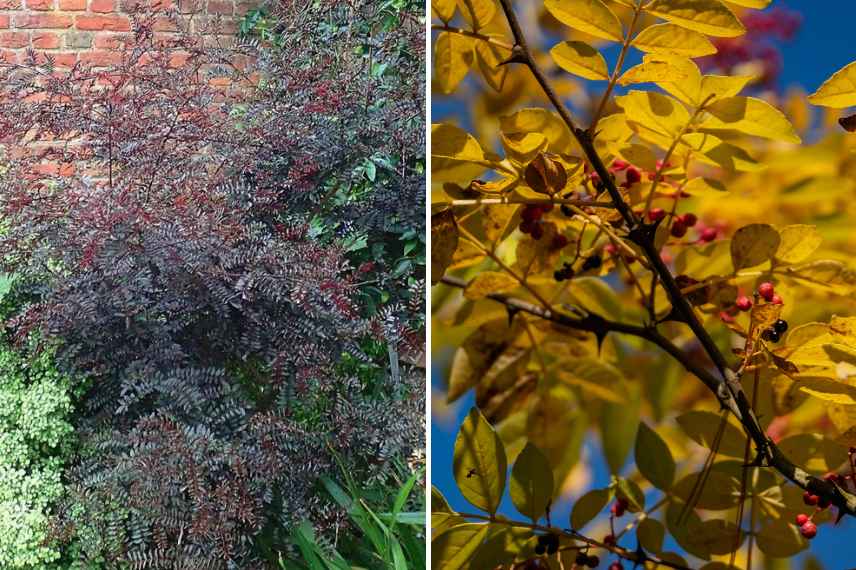
Zanthoxylum pipéritum ‘Black Magic’ and Zanthoxylum americanum are very ornamental species
Zanthoxylum simulans is also fairly ornamental because of its striking verrucate bark. Indeed, fine thorns cover trunk and branches. Over time they thicken and their points blunt. These thorns form outgrowths that are quite attractive because of their distinctive character.
For its frost resistance
Undoubtedly, it is the American prickly ash (Zanthoxylum americanum) that displays the greatest hardiness. While most varieties withstand frost down to -15 to -18 °C, this one stands out for its hardiness down to -25 °C. In other words, it can be grown throughout France in perfectly drained soil, even on rocky, lime-bearing ground. Indeed, this species, native to the eastern United States and Canada, naturally grows on cliffs or high-altitude rocky plateaus. It is also very resistant to pollution and to poor urban soils. It will only need a few waterings during periods of intense summer heat or drought.
Korean prickly ash (Zanthoxylum coreanum) also shows slightly above-average hardiness. Occasionally, it can tolerate temperatures down to -20 °C and altitudes between 700 and 1,000 m, provided it is planted in perfectly drained soil. It will also withstand wide temperature variations. This species also has the particularity of producing very strong thorns on the trunk and branches, coloured reddish-orange. Very striking, these thorns are extremely decorative, especially in winter when foliage has fallen.
For its ability to integrate into defensive hedging
The Sichuan pepper tree easily finds a place as a solitary specimen in a lawn. Its elegant silhouette, fruiting with small red berries and golden-yellow autumn foliage make it a delight. However, because of the presence of fairly sharp thorns in its early years, Zanthoxylum should not be planted where young children or pets pass frequently. That is why planting as an informal, defensive hedge is an interesting solution.
For this use as a defensive hedge, the American prickly ash (Zanthoxylum americanum) seems best suited, as it is very thorny. This species typically bears two thorns below each bud, thorns that blunt and form a sort of wart over time. Needless to say, these impressive thorns provide excellent protection against intrusion by wild animals or ill-intentioned people.
The other species suitable for forming a hedge is certainly Zanthoxylum simulans. This pepper tree is indeed armed with large, particularly fearsome thorns. Powerful thorns give it a certain charm in winter, after leaf fall, but can sometimes make berry harvesting difficult! As for the Korean pepper tree, it bears red thorns.
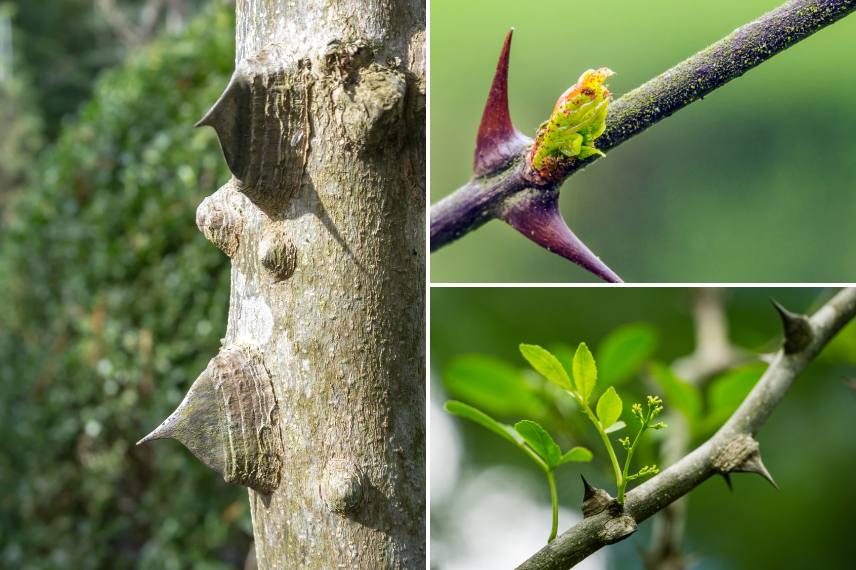
Presence of thorns that blunt over time makes Sichuan pepper tree ideal for defensive hedges
Both these pepper trees can be planted alongside other spiny shrubs such as barberry (Berberis), the trifoliate orange (Poncirus trifoliata), blackthorn (Prunus spinosa), firethorn (Pyracantha) or the Japanese quince (Chaenomeles).
- Subscribe!
- Contents
This form is protected by reCAPTCHA - the Google Privacy Policy and Terms of Service apply.


































Comments